 By
By
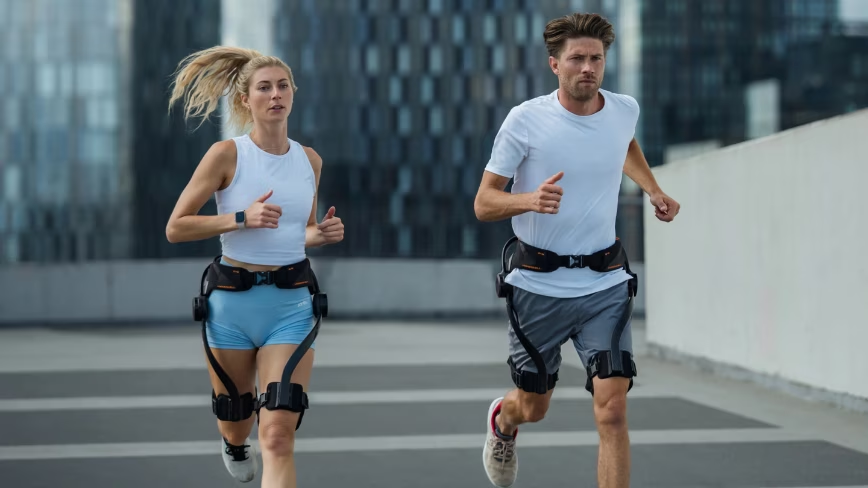
Shanghai-based consumer exoskeleton company Hypershell has raised $50 million in Series B+ funding, bringing its wider Series B financing to $120 million and signalling growing investor confidence in wearable robotics that augment human movement.
The funding round was co-led by Ant Group and Meituan Dragonball, with participation from Sofina and Granite Asia. According to The Next Web, the financing values Hypershell at close to $400 million post-money and comes ahead of the company’s global launch of its new Hypershell X Series.
For the orthotics, prosthetics and rehabilitation technology sector, the announcement matters because it shows how exoskeletons are beginning to move beyond hospital rehabilitation, military systems and industrial ergonomics into a broader consumer mobility category. Hypershell is not positioning its product primarily as a medical device, but as wearable technology for hiking, outdoor activity, search and rescue, work support and everyday mobility enhancement.
The company says its Hypershell X Series uses AI-powered motion control, lightweight robotics and a compact wearable design to assist users while walking, climbing and moving across different terrain. A global launch announcement described the system as using HyperIntuition, an AI motion-control algorithm intended to detect user intention and provide responsive assistance during movement. PR Newswire also reported the company’s claim that the device is the first consumer exoskeleton verified by TÜV Rheinland.
Hypershell’s rapid financing history suggests that investors now see consumer exoskeletons as a category with commercial scale. The Next Web reported that the wider Series B round followed $70 million raised in pre-B and B rounds in November 2024, led by Luminous Ventures and 5Y Capital, before the latest $50 million Series B+ tranche.
The company has also been presented as a fast-growing global exoskeleton brand. Coverage of the round states that Hypershell operates in more than 70 countries and has around 100 staff, while its X Series has been described as ranking first on Amazon in the United States and Europe by sales volume and market share in the consumer exoskeleton category.
For IMEA CPO readers, the most important question is what this means for the future of mobility technology. Consumer exoskeletons are not the same as clinical rehabilitation exoskeletons, and they should not be treated as a substitute for professional assessment, therapy or orthotic prescription. However, their growth may influence patient expectations, product affordability, wearable robotics design and the wider acceptance of powered mobility assistance.
The boundary between consumer mobility, rehabilitation robotics and assistive technology is becoming less fixed. A device created for hiking or outdoor endurance may not be clinically prescribed, but the underlying technologies — lightweight actuators, motion-intention sensing, battery management, wearable frames, AI control and user-adaptive assistance — are directly relevant to rehabilitation and O&P innovation.
This trend could have several implications for the IMEA region:
- Consumer exoskeleton investment may lower hardware costs over time.
- Wider adoption could improve public familiarity with wearable mobility assistance.
- AI motion-control systems may influence future rehabilitation and orthotic devices.
- Search and rescue, disaster response and worker-assist applications may become early non-clinical use cases.
- Clinicians will need to distinguish between wellness, performance, occupational and medical exoskeleton products.
Hypershell has also promoted HyperLIFT, an initiative aimed at search and rescue teams, suggesting that exoskeletons may find practical roles in physically demanding emergency-response environments. This is relevant for regions exposed to disaster response, mountainous terrain, conflict logistics or difficult rescue conditions, where reducing fatigue and increasing load-bearing capacity could have operational value.
For rehabilitation professionals, the opportunity is more cautious but still important. As exoskeletons become lighter, cheaper and more intuitive, some technologies developed for consumers may eventually inform therapeutic gait support, community mobility training, fall-risk reduction or powered orthotic assistance. But clinical translation will require evidence, safety testing, regulatory clarity and careful integration with trained rehabilitation teams.
There are also unanswered questions. Long-term use of consumer exoskeletons may raise issues around joint loading, user dependency, balance, fatigue, skin contact, musculoskeletal adaptation and safe use across different populations. These questions are especially important if products are used by older adults, people with weakness, people with neurological impairment or users recovering from injury.
For O&P and rehabilitation providers, the rise of consumer exoskeletons creates both opportunity and responsibility. Clinicians may increasingly be asked whether such devices are suitable for patients, whether they can be used alongside orthoses or prostheses, and whether they can support return to activity. The answer will depend on the user’s condition, goals, strength, balance, cognition, device interface and clinical risk.
The investment also signals a broader shift in robotics. Investors are increasingly looking beyond humanoid robots and industrial automation toward wearable systems that extend human capability. Hypershell’s positioning is built around augmentation rather than replacement: helping people walk further, climb more easily and reduce effort during movement.
For the IMEA region, where access to advanced rehabilitation technology remains uneven, consumer-scale exoskeleton development may eventually help reduce costs and expand availability. However, affordability alone will not be enough. Successful adoption will require local distribution, maintenance support, user training, clinical guidance and clear categorisation between recreational, occupational and medical use.
Hypershell’s $50 million Series B+ round is therefore more than a consumer-tech funding story. It is a sign that wearable robotics is entering a new commercial phase. For the rehabilitation and O&P sector, the challenge will be to watch this space carefully, separate marketing claims from clinical evidence, and identify where consumer exoskeleton innovation can genuinely support mobility, independence and participation.
- Original The Next Web article on Hypershell’s $50 million Series B+ funding
- Hypershell official website
- Hypershell X Series global launch announcement
- Platforma Media report on the new Hypershell X Series
- 36Kr Europe report on Hypershell’s $120 million financing
- Hypershell About Us page
- World Health Organization rehabilitation overview
- WHO standards for prosthetics and orthotics