

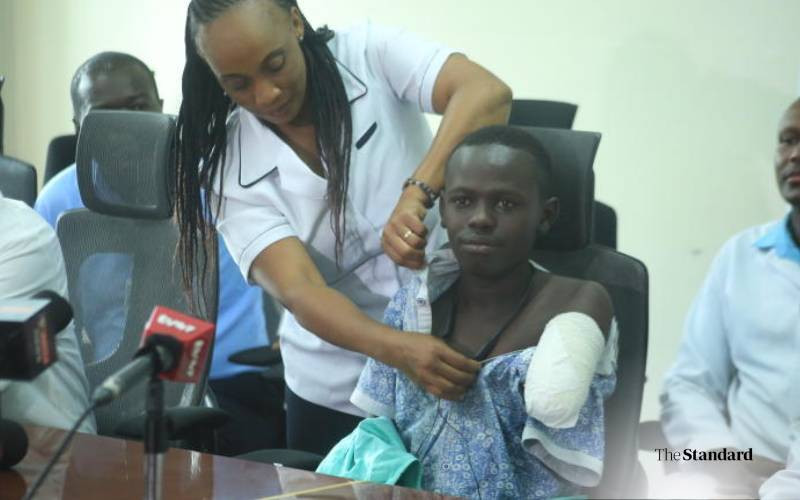
Kenyatta National Hospital (KNH) performed targeted sensory reinnervation (TSR) on two amputees, a four-year-old boy and a 43-year-old man, on 29 and 30 October 2026, according to Pulse Kenya. TSR reconnects nerves from an amputated limb to surviving skin so touch can be felt, but it does not regrow a limb or restore movement.
Targeted sensory reinnervation at KNH: what happened
Pulse Kenya reports that the operations were part of a knowledge-transfer programme led by Italian plastic and reconstructive surgeon Professor Alexander Gardetto, working with KNH specialists. Both patients were later discharged and are recovering at home. KNH described the operations as “significant milestones” in its reconstructive surgery programme.
The two patients
Jeremy, 4, from Kirinyaga County, lost his left hand in a chaff-cutter accident after an earlier reattachment failed. His operation lasted about five and a half hours. KNH calls him the youngest known TSR recipient worldwide.
Charles Mogire, 43, a painter from Ngong’, lost both arms in an electrical accident in November 2025. His roughly five-hour operation was a transhumeral (above-elbow) application aimed at restoring sensation in his right, dominant hand. KNH described it as the third such procedure performed globally. These “youngest” and “third globally” descriptions are KNH’s claims as reported by Pulse Kenya and have not been independently verified.
Who paid for the surgery?
The Social Health Authority (SHA) covered both operations, so the patients paid no out-of-pocket surgical costs, Pulse Kenya reports.
What is targeted sensory reinnervation, and what can it not do?
TSR is a microsurgical procedure that redirects the sensory nerves of a missing limb to nearby skin. The aim is to give the person a pathway for sensory information, which may help when using a suitably fitted prosthesis. As Pulse Kenya notes, it does not regrow an amputated limb or automatically restore movement.
KNH has done this before. In 2025 the hospital reported what it called the world’s first transhumeral TSR surgery, according to KNH; the case was also covered by Citizen Digital and Capital FM.
IMEA CPO Perspective
For prosthetists and orthotists in the Middle East, Africa and South Asia, the key point is access. A public hospital in East Africa has performed an advanced upper-limb nerve procedure on a child and an adult, with national health insurance paying. That suggests a possible future referral pathway between reconstructive surgeons and CPOs who fit upper-limb prostheses.
What remains unclear from the source is how the patients will be fitted with prostheses, and what outcomes follow. CPOs should treat these as early cases, not evidence of results. Services that fit upper-limb devices in the region may want to ask surgical partners how sensory outcomes will be assessed and when prosthetic assessment should begin. Readers may also want to see our report on Ottobock Kenya marking International P&O Day and more in upper limb news and O&P Africa News.
FAQ
What is targeted sensory reinnervation? A microsurgical procedure that reconnects nerves from an amputated limb to surviving skin so touch is felt as sensation from the missing limb.
Does TSR restore movement? No. It creates a pathway for sensory information; it does not regrow a limb or restore movement.
Who paid for the Kenyan surgeries? The Social Health Authority (SHA) covered both operations.
Suggested hyperlinks / sources
- Pulse Kenya: KNH performs rare nerve surgery on two amputees (10 November 2026)
- Kenyatta National Hospital: World’s first transhumeral TSR surgery (2025)
- Citizen Digital: KNH transhumeral TSR surgery
- Capital FM: Kenyan doctors restore sensation to amputated limb