 By
By
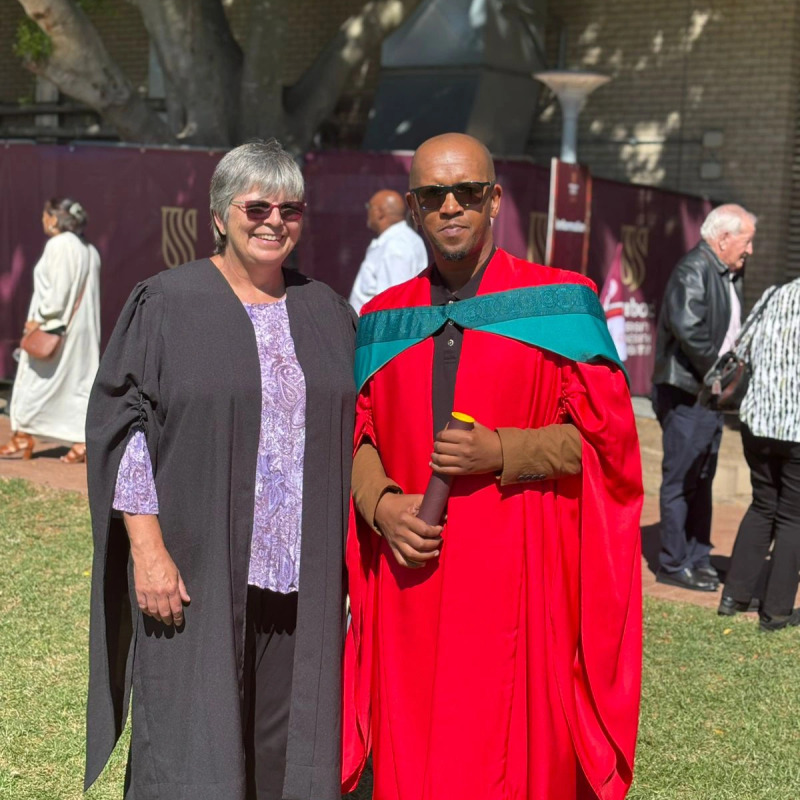
A new doctoral milestone at Stellenbosch University is drawing attention to the growing academic and clinical maturity of the orthotics and prosthetics profession in South Africa. On 26 March 2026, Dr Luphiwo Mduzana received his doctorate in health sciences rehabilitation, in a moment the university described as both professionally significant and personally hard won.
According to the university, Mduzana became the first black medical orthotist and prosthetist in South Africa to obtain a PhD. He currently heads the Department of Rehabilitation Medicine at Walter Sisulu University, and his achievement is already being framed as an important step for leadership, scholarship, and transformation within the profession.
His story is rooted in persistence as much as academic ambition. Growing up in Cala in the Eastern Cape, Mduzana said his background never defined the limits of what he could achieve. The PhD took nearly six years to complete, a journey shaped by family support, academic mentorship, and the disruption of the COVID-19 pandemic, which forced changes to parts of his research design and methodology.
For IMEA CPO readers, the real significance lies in the subject of his research. Mduzana’s doctoral work focused on developing clinical guidelines for lower-limb prosthetic prescription in South Africa. He noted that the country does not currently have a standardised national guideline for prescribing lower-limb prostheses, leaving many clinicians to rely on international guidance that may not fully reflect local healthcare realities, resource constraints, or patient needs.
That makes this more than a graduation story. It is also a story about building stronger clinical foundations for rehabilitation in Africa. Locally relevant prescription guidance can help clinicians make better-informed decisions about whether a person with amputation is an appropriate candidate for prosthetic rehabilitation and what form of intervention may best suit their circumstances. In practical terms, that can support more consistent decision-making, more context-sensitive care, and a stronger evidence base for service delivery. These implications are an inference drawn from the stated aims of Mduzana’s research.
Mduzana also said the work was designed with broader relevance for the Southern African Development Community in mind, suggesting that the framework could eventually be adopted or adapted beyond South Africa. That regional perspective is especially important in parts of the world where clinicians often work across uneven service environments and where the development of context-specific rehabilitation standards remains a pressing need. This regional significance is also an inference based on his comments about adaptation and collaboration.
Prof Lieketseng Ned, from Stellenbosch University’s Division of Disability and Rehabilitation Studies, described the achievement as a major milestone for the profession and said Mduzana is well positioned to help advance and strengthen orthotics and prosthetics academically in South Africa.
Mduzana himself hopes the doctorate will encourage younger practitioners to aim higher, pursue research, and step into leadership roles. That message matters. Across Africa, orthotics and prosthetics still needs more clinician-researchers, more locally grounded evidence, and more professionals helping shape policy, education, and practice standards from within the field itself. The article does not state all of these broader sector needs directly; this is an editorial inference based on the profession-building themes in the piece.
For the rehabilitation sector, the moment stands as a reminder that professional progress is not only measured in devices delivered or clinics opened. It is also measured in the development of research capacity, the strengthening of academic leadership, and the creation of guidance that better reflects the real conditions in which clinicians and patients live. In that sense, Mduzana’s PhD is both a personal achievement and a marker of where the profession in Southern Africa could go next.
- Stellenbosch University
- Original Stellenbosch University article
- Walter Sisulu University
- Division of Disability and Rehabilitation Studies, Stellenbosch University
- Prof Lieketseng Ned
- Southern African Development Community (SADC)
- World Health Organization rehabilitation
- International Society for Prosthetics and Orthotics