

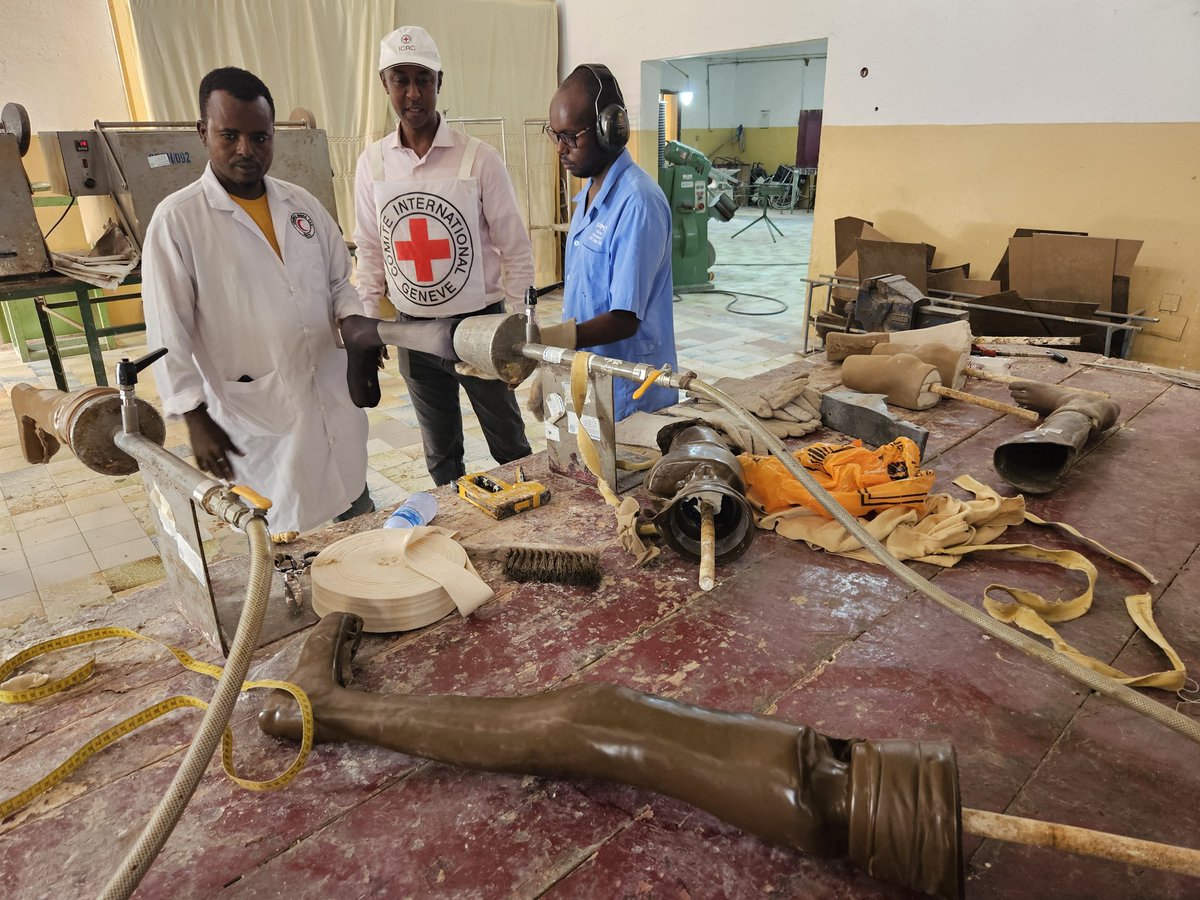
The International Committee of the Red Cross has released its Physical Rehabilitation Programme 2025 Annual Report, offering one of the clearest global pictures of how conflict, displacement, disability and fragile health systems are driving demand for prosthetic, orthotic and rehabilitation services.
For the orthotics and prosthetics sector across the Middle East, India and Africa, the report is more than an annual update. It is a warning that rehabilitation must be treated as an essential part of emergency health care, national health systems and long-term recovery — not as a secondary service delivered only after surgical care is complete.
The ICRC’s Physical Rehabilitation Programme, known as the PRP, was established in 1979 and has supported more than 300 projects in over 100 countries. The programme combines physical rehabilitation with social inclusion, helping people with disabilities access mobility services, education, employment, sport and community participation.
In 2025, the PRP supported 224 projects in 28 countries, reaching 254,506 service users worldwide. These services included 21,348 prostheses, 107,384 orthoses, 9,570 wheelchairs, 50,024 walking aids and more than 1.1 million physiotherapy sessions.
For IMEA CPOs, the message is clear: the demand for rehabilitation is expanding, but funding pressures, workforce shortages and conflict-related injuries are making service delivery increasingly difficult.
Rehabilitation in emergencies is now a frontline priority
One of the most important themes in the report is the ICRC’s emphasis on early rehabilitation as part of emergency medical care.
The PRP states that rehabilitation in emergencies is no longer limited to post-surgical care inside hospitals. It also includes follow-up after discharge, assistive technology distribution, preparedness before crisis peaks, and support for people with disabilities and chronic conditions displaced by conflict.
This is highly relevant for Gaza, Sudan, Syria, Yemen, the Democratic Republic of the Congo, Somalia, Afghanistan and other conflict-affected settings across the IMEA region. In these environments, delayed rehabilitation can lead to avoidable complications, contractures, pressure injuries, mobility loss, long-term disability and increased dependence.
For CPOs, this strengthens the case for earlier involvement in trauma pathways. Prosthetists, orthotists, physiotherapists and rehabilitation teams should not be brought in only after the acute phase. They should be part of multidisciplinary emergency planning from the start.
Gaza remains one of the clearest examples of urgent O&P need
The report highlights the severe impact of hostilities in Gaza on health-care facilities and rehabilitation access.
Despite the challenges, the ICRC-supported Artificial Limbs and Polio Centre in Gaza City continued to function as the sole provider of prosthetic and orthotic services. In 2025, the centre delivered 1,199 prosthetic and orthotic devices, 1,642 mobility aids and 10,477 physiotherapy sessions.
To address the lack of prosthetic and orthotic services in southern Gaza, a workshop run with the Palestine Red Crescent Society began pilot operations, with the aim of launching full services in 2026. The report also notes the development of a stump revision project in coordination with the ICRC field hospital in Rafah, reflecting the urgent need for post-amputation surgical care and pre-prosthetic management.
For IMEA CPO readers, Gaza demonstrates why prosthetic and orthotic care must be built into humanitarian surgical response. Amputation surgery, stump revision, early rehabilitation, psychosocial support, mobility aid provision and prosthetic fitting are all part of one continuum.
Sudan and South Sudan show how conflict multiplies rehabilitation demand
The report also gives significant attention to Sudan and South Sudan.
In Sudan, the conflict that began in April 2023 has led to a sharp rise in weapon-related injuries, including amputations and permanent disabilities. The ICRC’s long-standing partnership with Sudan’s National Authority for Prosthetics and Orthotics was disrupted for 18 months before resuming in June 2025. Services were restored at rehabilitation centres in Kassala, Kadugli, Damazine, Gadaref and Dongola.
In South Sudan, the Sudan conflict increased the number of refugees and returnees seeking rehabilitation support. The ICRC helped people access care by covering transport costs and arranging flights for those in need.
This is a major lesson for the wider region. Conflict does not only create injuries inside national borders. It also moves rehabilitation demand across borders, placing pressure on neighbouring countries, refugee-hosting communities and already fragile rehabilitation systems.
Africa: high need, limited workforce, fragile systems
Across Africa, the report shows both the scale of rehabilitation need and the continuing challenge of building sustainable services.
In East Africa, covering Ethiopia, Somalia, South Sudan and Sudan, the PRP recorded 25,019 service users, 4,746 prostheses, 7,584 orthoses, 1,924 wheelchairs, 11,993 walking aids and 143,912 physiotherapy sessions.
In West Africa, covering Benin, Côte d’Ivoire, Togo, Mali, Niger and Nigeria, the programme recorded 18,411 service users, 1,229 prostheses, 4,691 orthoses and 116,650 physiotherapy sessions.
In North and Central Africa, covering Cameroon, Central African Republic, Democratic Republic of the Congo and Libya, the programme recorded 3,891 service users, 1,232 prostheses, 1,639 orthoses and 17,428 physiotherapy sessions.
The report also highlights important developments in workforce training. In Mali, the ICRC completed a new prosthetics and orthotics training laboratory at the Institut National de Formation en Sciences de la Santé, with 23 students completing training in 2025. The first two prosthetics and orthotics positions were also published in the government’s annual job listing, signalling growing official recognition of the profession.
For African CPOs, this is an important point. Rehabilitation access cannot be solved by equipment alone. Countries need trained prosthetists, orthotists, physiotherapists, wheelchair service providers, managers, referral systems and sustainable supply chains.
Asia: Afghanistan remains the largest ICRC rehabilitation operation
The Asia section of the report is particularly important for IMEA readers because it includes Afghanistan, Bangladesh, India, Myanmar and Pakistan.
Across Asia, the PRP recorded 125,525 service users, 9,031 prostheses, 42,460 orthoses, 4,753 wheelchairs, 28,200 walking aids and 457,492 physiotherapy sessions.
Afghanistan remains one of the ICRC’s largest rehabilitation operations. In 2025, its seven physical rehabilitation centres registered 18,840 new patients, bringing the total number registered since 1988 to 290,509. The centres produced 4,162 prostheses and 28,743 orthoses, while 96,681 people received direct care.
The report also notes that Afghanistan continues to face a severe humanitarian crisis, restrictions affecting women and girls, forced deportations, landmine accidents and ongoing security threats. Vulnerable groups, including people with disabilities, remain disproportionately affected.
For the O&P sector, Afghanistan shows the importance of long-term rehabilitation infrastructure. A sustainable national rehabilitation system cannot be created quickly after a crisis. It requires decades of service development, training, local leadership and community trust.
India: ICRC phase-out raises questions about service continuity
The report notes that the PRP faced significant challenges in India due to austerity measures and uncertainty around its exit strategy. A final decision was made in September 2025 to end service provision by December 2025 and close all partnerships by 2026.
The ICRC ended its 14-year partnership with Voluntary Medicare Society in November 2025 and also ended its partnership with Mobility India’s Inclusive Development Centre in Assam as planned. However, the report warns that two artificial limb centres in Jammu and Srinagar may face service disruptions because of insufficient internal funding mechanisms.
For Bharat CPO and IMEA CPO readers, this is a significant development. It underlines the need for national and state-level rehabilitation systems to plan beyond international support. When humanitarian or development partners withdraw, local funding, government integration, institutional leadership and professional workforce planning become critical.
Near and Middle East: one of the largest regional rehabilitation burdens
The Near and Middle East section covers Iran, Iraq, Israel and the occupied territories, Lebanon, Syria and Yemen.
In this region, the PRP recorded 79,676 service users, including 8,538 people wounded by weapons and 2,756 people affected by mines or explosive remnants of war. Services included 4,870 prostheses, 50,896 orthoses, 2,307 wheelchairs, 5,549 walking aids and 378,418 physiotherapy sessions.
In Iraq, the report highlights a shift toward sustainable, locally led practices. The PRP prioritized capacity-building at reference centres in Nasiriya and Sadr Al-Qanat, where 79 prosthetists, orthotists and physiotherapists received specialized training. In Iraqi Kurdistan, the handover of the Erbil physical rehabilitation centre to the Directorate of Health progressed under a two-year memorandum of understanding. The bachelor’s programme in prosthetics and orthotics at Erbil Polytechnic University is also on track to graduate its second cohort by June 2026.
In Lebanon, the ICRC supported the Lebanese Red Cross physical rehabilitation centre in Aley and private rehabilitation centres in Tripoli, Sidon and Bekaa, while also promoting the role of physiotherapists in emergency response.
In Syria, the PRP reported a 25 per cent increase in service provision compared with the previous year, reflecting the country’s shifting needs, returnee movement, detainee support and expanded outreach into priority zones.
For the region, the numbers confirm that O&P and rehabilitation are not marginal services. They are central to humanitarian response, post-conflict recovery and health system resilience.
Technology and supply chains: Rehab’Impulse and the K3 foot
The report also highlights the ICRC’s technology work through Rehab’Impulse, the ICRC-owned brand under which assistive device components are distributed in the field.
The report states that all Rehab’Impulse products are now ISO-certified and CE-labelled, reflecting improvements in safety, performance, reliability and user confidence. This is particularly important for low-resource and humanitarian settings, where affordability must be balanced with quality and durability.
The ICRC also continues to prioritize its K3 dynamic foot, described as a major technological achievement. The report says many of the 20,000 lower-limb amputees fitted annually with ICRC-supported devices are young, active individuals who would benefit from more advanced technology. The K3 foot has ISO 10328 certification and has been tested to K3 level in France.
However, external distribution of the K3 foot has been paused while the ICRC evaluates a sustainable commercial model. For IMEA markets, this is worth watching closely. If made widely available through appropriate distribution channels, a low-cost, energy-storing K3 foot could have major relevance for active amputees in humanitarian, government and lower-income clinical settings.
Digital systems are becoming essential
Another major development is the PRP’s Digital Centre Management System, or DCMS.
Built on open-source platforms including OpenMRS and Odoo, the system supports electronic medical records, supply chains, stock management, purchasing and personnel management. In 2025, DCMS went live in centres in Syria and Iraq, and later in Pakistan and the Democratic Republic of the Congo. Additional centres in South Sudan, Somalia, Afghanistan, Myanmar, Gaza and Togo were expected to deploy the system in early 2026.
This is highly relevant for IMEA CPOs. Digital rehabilitation management is no longer just an administrative improvement. It is becoming essential for service quality, traceability, stock control, donor reporting, patient follow-up and national rehabilitation planning.
For clinics and rehabilitation centres in the region, the lesson is clear: digital transformation in O&P should not only focus on 3D scanning, CAD and printing. It must also include patient records, inventory systems, procurement visibility and outcome tracking.
Funding cuts are reshaping humanitarian rehabilitation
The report makes clear that 2025 was a difficult year. A significant budget reduction affected all PRP projects. The ICRC responded by reducing training activities and certain indirect costs, while trying to avoid direct cuts to essential services.
It also chose to reduce its geographic footprint rather than scale back the scope of activities everywhere. As a result, support to national partners in Bangladesh, Tajikistan, Libya and Colombia ended by the end of 2025.
For IMEA CPOs, this trend matters. International humanitarian funding is under pressure, and rehabilitation programmes are being asked to become more efficient, more local and more sustainable. Clinics, governments and professional associations should not assume that international partners will remain indefinitely.
The future will require stronger local ownership, national financing, professional education, regional supply chains and locally managed rehabilitation centres.
What this means for IMEA CPOs
The ICRC report carries several important messages for prosthetists, orthotists, rehabilitation leaders and policymakers across the Middle East, India and Africa.
First, rehabilitation must be integrated earlier into emergency care. Trauma surgery without rehabilitation planning leaves patients at risk of preventable long-term disability.
Second, O&P services must be linked to national health systems. Isolated workshops and donor-funded projects are not enough to meet long-term need.
Third, workforce development is critical. Countries need recognized education pathways, professional accreditation, job titles, government posts and continuing professional development.
Fourth, technology must be affordable, durable and appropriate for local conditions. The Rehab’Impulse model and the K3 foot project show the importance of balancing innovation with accessibility.
Fifth, digital systems are becoming central to service delivery. Patient management, stock control and procurement data are now part of quality rehabilitation.
Finally, social inclusion must remain part of rehabilitation. A prosthesis, orthosis or wheelchair is not the end point. Education, work, sport, psychosocial support and participation are part of true recovery.
A regional call to action
The ICRC’s 2025 Physical Rehabilitation Programme Annual Report is a reminder that the rehabilitation needs created by conflict and violence do not end when the wound is closed or the patient leaves hospital.
For IMEA CPOs, the report should be read as both evidence and instruction.
It shows the scale of need. It highlights the importance of early rehabilitation. It demonstrates the value of local partnerships. It warns of funding pressure. It reinforces the need for education, technology, digital systems and sustainable national planning.
Most importantly, it reminds the O&P profession that mobility is not simply a technical outcome. It is a humanitarian, social and economic necessity.
Across the Middle East, India and Africa, the challenge now is to ensure that every person affected by conflict, violence, disability or health-system breakdown has access not only to survival, but to movement, dignity and participation.
- International Committee of the Red Cross
- ICRC Physical Rehabilitation Programme
- Rehab’Impulse
- OpenMRS
- Odoo
- WHO Rehabilitation
- WHO Rehabilitation in Health Systems
- International Society for Prosthetics and Orthotics
- Palestine Red Crescent Society