

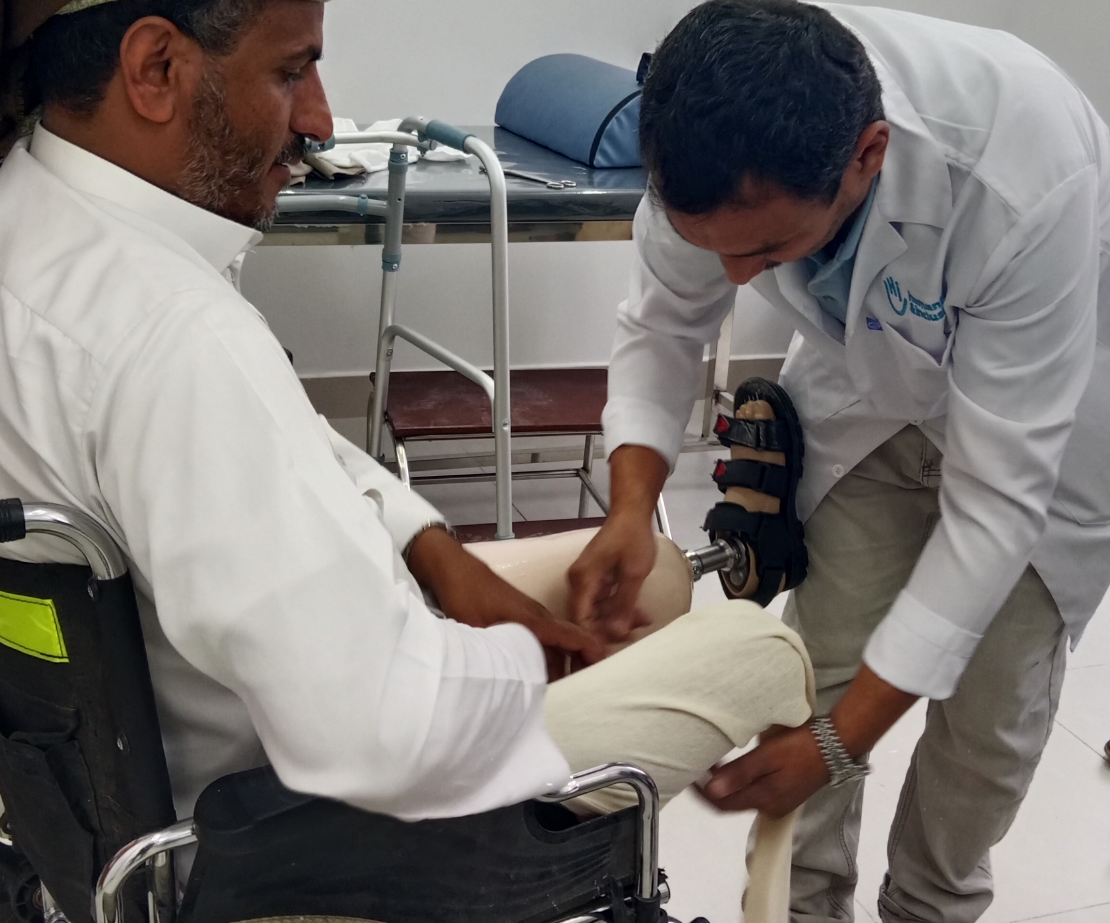
A new story from Humanity & Inclusion highlights the life-changing importance of prosthetic rehabilitation in Yemen, where conflict, poverty, workplace injuries and limited access to specialist services continue to create a high need for physical rehabilitation.
The article tells the story of Mohammed Yahya, a 40-year-old man from Saada, who underwent a bilateral below-knee amputation after a severe workplace accident on 1 July 2025. While operating an artesian well drilling rig, Mohammed suffered catastrophic trauma to both legs and was urgently evacuated to hospital in Sana’a. Surgeons were unable to save his legs, and bilateral amputation was required to save his life.
After the accident, Mohammed became dependent on his family for daily support. For any person with limb loss, the period after amputation can be physically, emotionally and socially overwhelming. In Yemen, where access to rehabilitation services can be limited by geography, insecurity, poverty and health system pressures, the challenge is even greater.
In January, Mohammed was referred to the Physical Rehabilitation Centre in Hajjah Governorate, where HI supported the fabrication of customised prosthetic limbs and provided rehabilitation care. His case demonstrates why prosthetic provision is not just about supplying a device. It requires assessment, measurement, fabrication, fitting, training, follow-up and a rehabilitation plan that matches the person’s body, environment and daily life.
For Mohammed, the clinical team used stubby prosthetics. These are shortened, non-articulated prosthetic limbs with a wider base of support. They are often used in rehabilitation for people with bilateral lower-limb amputation because they help lower the centre of gravity, improve balance and reduce the risk of falls during early walking and functional training.
In Mohammed’s case, HI reports that the stubbies were not simply a temporary training tool but the most appropriate definitive solution. For a bilateral amputee, full-length prostheses can significantly increase the energy required for walking and may raise the risk of falls, especially where proprioception is reduced and terrain is uneven. Shorter prosthetic limbs can offer a more stable, practical and energy-efficient option for daily life.
This is an important message for the wider prosthetics and orthotics profession across the Middle East, Africa and other low-resource settings. Prosthetic success is not always measured by whether a person can stand at full height in the most anatomically realistic device. It is measured by whether the person can move safely, independently and confidently in their own environment.
Mohammed’s rehabilitation focused on standing, dynamic balance, walking confidence and activities of daily living. Over time, he progressed from dependence to independent movement. According to HI, he is now able to walk using his prosthetic limbs and move around more confidently.
His story also highlights the continuing need for investment in rehabilitation services in Yemen. Organisations such as Humanity & Inclusion play a critical role in supporting people with disabilities and injury-related impairments, particularly in settings affected by conflict and humanitarian crisis. However, the demand for prosthetics, orthotics, physiotherapy and long-term rehabilitation remains far greater than the capacity of most systems to provide.
For O&P professionals, Mohammed’s case is a reminder that appropriate technology is not always the most complex technology. The right prosthetic solution must be clinically justified, culturally practical, safe for the user and compatible with the realities of the person’s home, work and community environment.
In Yemen and across the wider IMEA region, thousands of people with limb loss require more than a prosthetic limb. They require multidisciplinary rehabilitation, trained clinicians, reliable component supply, local fabrication capacity, long-term follow-up and social support. Mohammed’s return to walking shows what is possible when those elements come together.
His story is ultimately one of recovery, dignity and participation. After a devastating accident, personalised prosthetic care and rehabilitation have helped Mohammed regain mobility and rebuild a sense of independence. For the rehabilitation sector, it is also a powerful example of why prosthetics and orthotics must remain central to humanitarian health responses and disability inclusion.
- Original HI article: Mohammed walks again with prosthetics
- Humanity & Inclusion – Yemen
- Humanity & Inclusion – Rehabilitation
- World Health Organization – Rehabilitation
- International Society for Prosthetics and Orthotics