

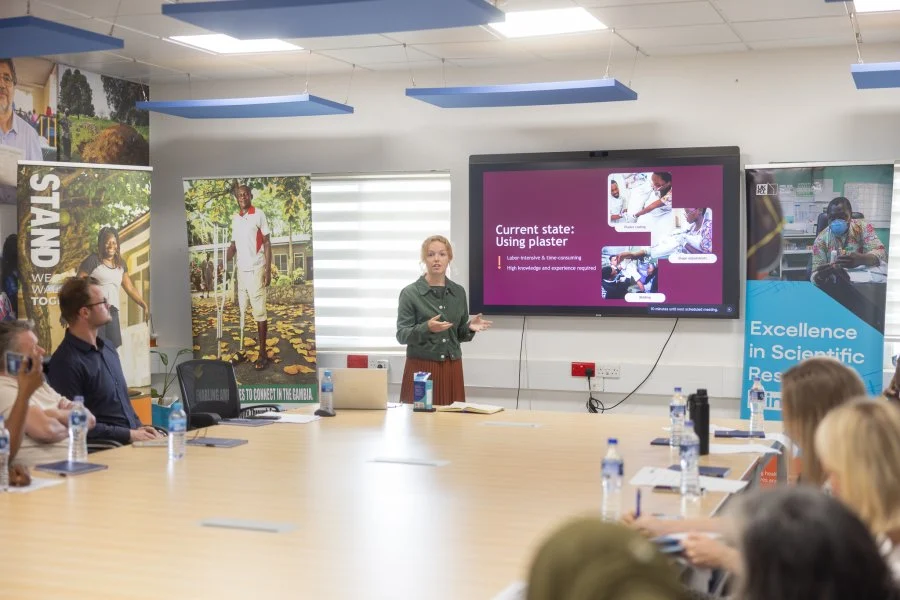
A landmark step forward for rehabilitation, health innovation, and access to assistive technology.
The Medical Research Council Unit The Gambia at LSHTM marked a significant milestone in advancing disability inclusion and rehabilitation with the launch of the country’s first pilot study on 3D printing of trans-tibial prosthetic sockets (a below-knee artificial leg that helps with safe and comfortable prosthetic use).
As a key technical and innovation partner, MRCG is contributing its research expertise, capacity, and resources to support the introduction and clinical evaluation of 3D-printed prosthetic socket technology in The Gambia. This initiative creates new opportunities to improve access to customised, affordable, and effective prosthetic solutions for people living with limb loss or damage.
Funded by the European Union, the project brings together STAND (a UK-based NGO), the Gambian National Rehabilitation Centre under the Directorate for Social Welfare, and 3D Lab Radboud (Radboudumc).
Speaking at the launch, Dr. Davis Nwakanma, Chief Operations Officer at MRCG, thanked the project team and partners for their contributions to the initiative.
“Our commitment goes beyond research. At MRC Unit The Gambia, we are dedicated to transforming healthcare through innovative technologies that save lives and can deliver meaningful impact,” he highlighted.
By integrating digital design, 3D printing, and rehabilitation expertise, the project aims to improve the accessibility, affordability, and customisation of prosthetic devices for people living with the challenge. It will also strengthen the skills of rehabilitation professionals through hands-on training covering the full prosthetic manufacturing workflow, from digital scanning and modelling to printing and fitting.
The European Union Ambassador to The Gambia, H.E. Immaculada Roca i Cortés, highlighted the importance of collaboration and innovation in promoting inclusion. Ensuring that people with disabilities have access to quality services and assistive technologies is central to the EU’s broader commitment to supporting sustainable development through partnerships.
“The European Union’s support aligns with its strategy for governance, economic growth, and sustainable development, emphasising technology transfer and capacity building to ensure the initiative’s benefits extend to local communities.”
Ebrima Jassey, Administrative Manager at the Gambian National Rehabilitation Centre, described the initiative as a “landmark moment for rehabilitation services in The Gambia, which brought innovation, digital technology, and local expertise to create more personalised, accessible, and effective prosthetic solutions for people in need.
For the MRCG, this initiative reflects its continued commitment to using research, innovation, and partnerships to address critical health challenges and contribute to a more inclusive future where technology supports improved health outcomes.