

Bionics have dominated prosthetics in recent times, but other technologies are also driving innovation. Andrew Wade reports.

Human use of prosthetics dates back to antiquity, the earliest evidence appearing in ancient Egypt and Iran around 3,000 BCE. Among the oldest confirmed devices is a big toe found attached to the mummy of Tabaketenmut, a priest’s daughter buried at a necropolis in Thebes. Made from wood and leather, the toe dates to between 950 and 710 BCE, its three-part construction suggesting function had a prominent role alongside form, helping Tabaketenmut to walk.
Naturally, prosthetics have evolved in tandem with technology. Functional devices that could mimic hand movements first appeared in the 1500s, with different materials and mechanisms improving comfort and utility.
In recent times, bionics have become more prevalent, with digital technology embedded in prosthetic devices, particularly those for upper limbs. Myoelectronic prosthetics can capture signals from residual muscles and convert them into robotic arm movements. While this leap in technology is undoubtedly exciting, it fails to address a fundamental issue, according to Fergal Mackie, founder and CEO of prosthetics startup Metacarpal. “There’s a stat that sort of haunts upper limb prosthetics, and that’s that half of devices are rejected,” Mackie told The Engineer. “Even the most expensive devices are getting rejected at a high rate.”
Robotics add capability, but often at the cost of reliability. Electronics need a power source, which adds weight and needs to be recharged. In most cases, a robotic arm must be kept dry. When it comes to an upper limb prosthesis relied upon around the clock, stripping back some of the complexity can offer different advantages. “The most popular prosthetic hand in the world is still a hook, and that’s for a vast variety of reasons,” said Mackie. “They are inherently really reliable and durable. And for a large part of the population, you know, these are injuries from trauma, so it tends to be people with heavier duty applications, manual labour, factory workers, things like that.”
Mackie’s interest in prosthetics stemmed from his time at Strathclyde University, where he studied Product Design Engineering. Following a skateboarding accident in 2020 that left him with two broken wrists, he gained some insights into the limitations that come with reduced limb function. “I was in two casts,” he said. “I really got a flavour of the things I could do and the things I couldn’t do. And I think that just triggered a general interest in prosthetics.”
Like many of his peers, Mackie was initially drawn towards robotics. His initial plan was to develop a low-cost robotic arm, but the stats around rejection and the large numbers of people still using hooks gave him pause for thought, ultimately leading the company in a different direction. “The mission of Metacarpal is to create something that’s fully mechanical but has the abilities of the robotic hands,” said Mackie. “To translate those bionic abilities into mechanisms, essentially inside the hand, that enable it to operate.”
The result is GEM (Grasp every moment), a fully mechanical, body-powered upper limb prosthetic. Launched by Metacarpal in January 2026, GEM uses a cable system that controls the opening and closing of the hand, guided around the user’s back to a harness on the opposite shoulder. By creating tension in that cable through shoulder or elbow movements, GEM’s grip can be enacted, while releasing tension loosens the grip.
The most popular prosthetic hand in the world is still a hook, and that’s for a vast variety of reasons
Fergal Mackie – CEO, Metacarpal
“Now that’s not new,” said Mackie. “Hooks work the same as that. And that’s what’s really intuitive, really easy to understand, because you can feel the pressure you’re applying. The pressure at the tips of the fingers is proportional to the tension that you feel in the harness. It’s like pulling on a bike brake. You know exactly how much force you’re applying to the bike brake because it’s immediate, you can feel it.”
Where GEM differs from other devices is its Reactive Grasp Technology, which allows its fingers to move independently. According to Mackie, with existing mechanical hands, all the fingers move together. The index finger and thumb do all the work and the other three digits simply get in the way – hence why so many people prefer a simple hook mechanism. To make the additional fingers practical rather than an inconvenience, they had to be able to move independently. “What we developed was essentially a differential mechanism,” said Mackie. “When you pull the cable in the hand, the fingers go tighter, but they can adjust and conform at different rates.”
GEM also features three different grip formations: pinch for fine control, power for lifting, and lateral for holding flat items like phones or books. Feedback from the fingertips is relayed instantly via a series of aluminium bronze pulleys that transmit the force to the user’s body, allowing for precise control. Some of these pulleys redirect force, while others amplify it. “There’s 11 pulleys inside the hand,” said Mackie. “So the forces going to these fingers and on the pulleys after that are enormous, and that’s a big reason why we went with alu-bronze…if we’d gone with bearings, we would have far exceeded the static load capabilities of any bearing system.”
As GEM is purely mechanical, there are no motors and no power source, features that add significant weight to robotic prosthetics and don’t tend to like water. The absence of electronics has allowed Metacarpal to build a much more durable device, one capable of taking on heavyweight tasks in all kinds of conditions. Mackie says each finger can hold about 10kg at the tip alone and up to 40kg at the base when hooked. “I suppose what we’ve been able to do is take all the weight that would have been attributed to all the motors and put that into making this thing really robust,” he said. “We’ve seen from our users that the overall durability of the hand is much higher because we haven’t had to compromise on the build.”
That build quality has been tested extensively at Edinburgh’s National Robotarium, where Metacarpal is based. GEM has also been put through its paces in the wild since 2024, with around 30 people working with the device over different periods, at home and in their workplaces. According to Mackie, it’s this real-world testing that invariably delivers the most valuable feedback. “The biggest durability testing is when you put it on the users,” said Mackie. “As much of the testing that we did in the workshop, there’s nothing that compares to the real world. Those are the guys that are going to tell you all the things that you missed in your testing.”

Radii is aiming to reduce the number of clinical visits needed to fit lower limb prosthetic devices – Radii Devices
User feedback is fundamental not only to the development of new types of prosthetics, but also for how prosthetics are fitted to individual wearers. For upper limbs, fit is crucial, but could perhaps be trumped by utility, where hooks and hands like Metacarpal’s can deliver precision control.
When it comes to lower limbs, fit becomes even more vital, as significant bodyweight and pressure is coming through the prosthetic. Ensuring a lower limb device is comfortable for the user is a multi-stage process that can require several clinical visits.
“If people are uncomfortable in their device, they will simply reject it,” Emilie Shillito, marketing and operations manager at Radii Devices, told The Engineer. “And that means there are a lot less people that are able to walk and live their life as they want to.”
Founded by CEO Joshua Steer in 2020 during his PhD at Southampton University, Radii Devices blends software and engineering expertise to improve the fit of lower limb prosthetics. Clinicians first upload patient scans to Radii’s web-based platform riiForm, which makes recommendations based on historical data. Digital tools allow the shape and fit of each prosthetic to be fine-tuned, helping clinicians deliver better outcomes in shorter timeframes.
“The traditional process would be a lot of using plaster casts, a lot of trial-and-error,” Shillito explained. “Whereas I guess the thing that we’re trying to fix is capturing a lot more data by having a clinician input a 3D scan of a limb.”
Riiform analyses the scan and makes suggestions on fit based on the time since amputation, as well as the size and shape of the limb. Importantly, the software platform is hardware agnostic. Radii does not develop its own scanning equipment and aims to integrate with any type of scanner. This includes smartphone-based scanning apps which are used increasingly in prosthetics, according to Shillito. These apps use photogrammetry or built-in LiDAR sensors to generate 3D models and have become a powerful tool for bringing digital healthcare into almost any clinical setting. “A lot of people just use a 3D phone scanner,” she said. “It’s cheap and efficient for them. “I think pretty much all scanners now you can upload via a QR (code) in our platform, and that scan just moves straight over.”
Digitisation feeds into the fabrication side too, where 3D printing is becoming more prevalent. Crafting and fitting prosthetics has traditionally sat somewhere between science and art form, and clinicians are understandably reluctant to cede total creative control. Nonetheless, many are now testing the digital waters, either with in-house or third-party printers. Helping medical professionals along that digital pathway is a key part of Radii’s remit.
“In terms of 3D printing, there’s lots of different equipment out there at different price points, a lot of clinics are really interested in it, just a bit hesitant in terms of how to adopt it,” said Shillito. “How do we make sure this is a smooth workflow for you and make that transition as easy as possible? Because there’s a lot of prosthetists that have been doing the same thing for 30 years…and they want to make sure they’re still delivering exceptional care to patients.”
Ultimately, the company’s aim is to speed up the fit and fabrication process, deliver prosthetics to patients faster and free up clinical capacity by minimising visits. “Typically, the NHS says that it takes four visits to fit a prosthetic completely from that kind of initial consultation,” said Shillito. “We would hope that we could cut a few appointments…and make that more like two visits.”

Using Radii’s technology clinicians upload patient scans to the Riiform web-based platform – Radii Devices
At the time of speaking to The Engineer, Radii was on the verge of completing an NHS clinical study, with patients rating the comfort of prosthetics developed with riiForm, and staff also feeding back on the platform. For now though, the bigger focus is on the US, where Radii works with a number of independent clinics and is establishing itself within the military veteran space, which has long been a driver of prosthetics demand. “We work very closely with the US Department of Veterans Affairs (VA),” said Shillito. “We work with them alongside HP Additive Manufacturing and a company called PVA Med…and various scanning companies, as a kind of digital prosthetics project to get digital prosthetics into VA clinics.”
Though Metacarpal and Radii operate at almost opposite ends of the prosthetics world – one focusing on upper limb hardware and the other on lower limb software – they share an overarching mission to reduce the rate of device rejection. Where GEM aims to enhance utility and durability, riiForm’s purpose is to improve comfort and speed up the fitting process. Ultimately, both are harnessing technology to improve outcomes for amputees, while also demonstrating that robotics is not the only game in town. “The robotic stuff is certainly a great technology,” said Mackie. “I suppose the point that we’re making is just that it’s not for everyone. And right now it’s the industry’s sole focus, and that’s overlooking a lot of people.”
Prosthetic arms for war casualties – November 1917
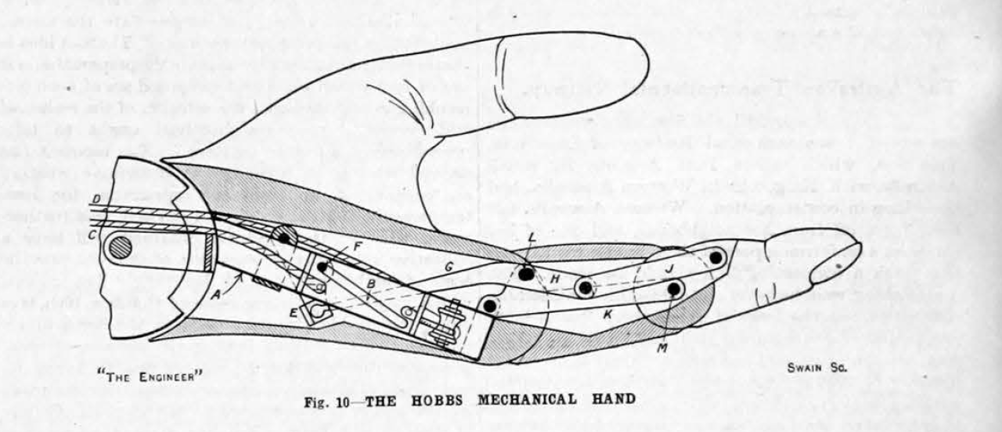
Written by prosthetics designer Edward Hobbs as the First World War raged, a 1917 article from The Engineer describes the function of an articulated arm to replace a limb which had been amputated at the shoulder. Held on by cross-straps and a waist belt, the arm contained an arrangement of levers, bearings and cables which allowed the user to move the forearm and flex the hand using the remaining shoulder muscles. This enabled the user to lift weights up to about 2lb; enough to handle a full glass of ‘liquid refreshment’ (probably about a pint, we’d imagine) or raise their hat.
‘For many years it had been considered absolutely impossible to do anything for a man who had lost his arm at the shoulder,’ Hobbs said, ‘whereas the Hobbs hand can be raised or lowered at the shoulder, flexed and extended, the wrist twisted and the hand clasped at will — without any assistance from the sound hand.’
Not unlike Metacarpal’s GEM and its different grip formations, the device came with interchangeable hands for different uses, with the ‘full clasping hand’ deemed the most popular and versatile. ‘With that hand a man can with a little training rapidly become fully proficient as a mechanical draftsman,’ Hobbs claimed, ‘can handle his knife, fork and spoon; tie his necktie or his bootlaces, light his cigarette, play cards or billiards, and a thousand or one things besides.’

Hobb’s mechanical hand – The Engineer
More From The Engineer
- Finalists Announced for MacRobert Award
- C2I 2025 Medical & Healthcare winner: PneumoRator
- Snail Inspired Microbots Set To Tackle Bowel Cancer