

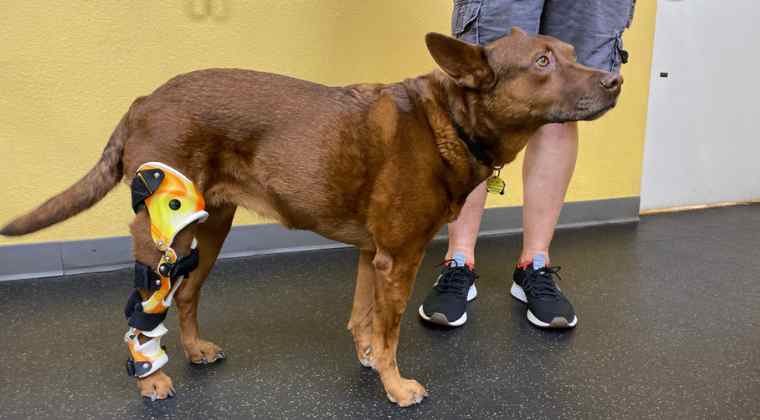
China’s expanding role in the veterinary orthotics and prosthetics market is raising important questions about affordability, quality, customisation and clinical reliability — questions that will feel very familiar to the human prosthetics and orthotics sector.
A recent analysis by Future Market Insights argues that Chinese manufacturers are beginning to reshape competition in veterinary orthotics and prosthetics, especially in standardised braces and mobility-support devices. The report projects that the global veterinary orthotics-prosthetics market will grow from USD 80.1 million in 2026 to USD 149 million by 2036, representing a compound annual growth rate of 6.4%.
For IMEA CPO readers, the animal rehabilitation market may seem like a niche topic. However, the underlying trends are highly relevant: lower-cost manufacturing, growing demand for mobility solutions, increasing use of digital fabrication and a renewed debate about when price matters — and when clinical quality matters more.
Veterinary O&P Is Becoming a Serious Rehabilitation Category
Veterinary orthotics and prosthetics has developed from a small specialist field into a more structured rehabilitation category. Animals affected by limb deformity, amputation, joint instability, ligament injury, arthritis, neurological impairment or post-surgical weakness may require braces, prosthetic limbs or mobility-support devices.
As pet ownership increases and owners become more willing to invest in animal healthcare, veterinary rehabilitation is expanding. This includes physiotherapy, hydrotherapy, mobility aids, orthopaedic surgery, pain management and custom external devices.
According to Future Market Insights, veterinary hospitals are expected to account for 38% of global demand in 2026, while braces are forecast to represent 42% of total product demand. These figures suggest that institutional buyers, not only individual pet owners, are becoming more important in shaping the market.
That shift matters because hospitals and rehabilitation centres usually make purchasing decisions differently from consumers. They are more likely to compare price, durability, fit, supplier support, clinical outcome and replacement needs over time.
Where China Is Taking Share
Future Market Insights identifies China as one of the fastest-growing markets in veterinary orthotics and prosthetics, with a projected 6.2% CAGR from 2026 to 2036. The drivers include growing veterinary infrastructure, rising disposable income, increasing pet healthcare spending and stronger domestic manufacturing capability.
The report argues that Chinese suppliers are especially competitive in standardised braces and support devices. These products are often easier to scale than complex custom prosthetic devices because they can be manufactured in repeated sizes or modular designs.
This is where China’s manufacturing advantages become visible:
- Large supplier networks
- Lower production costs
- Increasing precision fabrication capability
- Strong plastics, textile, metal and composite supply chains
- Ability to produce standardised products at competitive prices
- Expanding distribution partnerships
For budget-conscious veterinary hospitals and rehabilitation centres, lower-cost braces may be attractive, particularly for common conditions such as ligament injuries, joint instability, arthritis management and post-operative support.

The Limits of Price Competition
However, the article also makes clear that price alone does not define success in veterinary O&P.
Custom prosthetics remain a more complex category. Prosthetic devices usually require assessment, design, fitting, gait analysis, alignment, adjustment and follow-up. The clinical process is not simply a matter of supplying a manufactured product.
This is a key point for the wider O&P industry.
A cheaper device may reduce the initial purchase cost, but if it fails early, fits poorly, causes discomfort, requires frequent adjustment or does not support functional recovery, the total cost may be higher. In veterinary rehabilitation, this may mean lower owner satisfaction, reduced animal mobility, repeat clinic visits or device abandonment.
The same principle applies to human prosthetics and orthotics. Low-cost manufacturing can improve access, but only when combined with appropriate clinical assessment, fitting, training, follow-up and quality assurance.
Quality Versus Cost Is the Wrong Question
The real issue is not quality versus cost. The more useful question is: how can suppliers deliver clinically reliable products at a sustainable price?
This distinction matters for IMEA markets.
Across the Middle East, Africa, Central Asia and South Asia, many prosthetic and orthotic providers face the same dilemma. Imported premium products may be clinically strong but unaffordable for many patients or health systems. Low-cost alternatives may improve access, but only if they are safe, durable and supported by competent service delivery.
The goal should not be to reject low-cost manufacturing. The goal should be to define minimum standards, appropriate use cases and clear procurement criteria.
For veterinary O&P, that might mean distinguishing between:
- Standard braces for common support needs
- Semi-custom orthotic devices
- Fully custom prosthetic limbs
- Post-operative support products
- Long-term mobility solutions
- Devices requiring rehabilitation supervision
For human O&P, the same logic applies across prefabricated AFOs, diabetic footwear, spinal supports, prosthetic components, liners, sockets, paediatric devices and custom orthoses.
Lessons for Human Prosthetics and Orthotics
The veterinary market may provide an early view of how procurement behaviour is changing.
Buyers are no longer looking only at the lowest purchase price. Increasingly, they are assessing total value. This includes product durability, adjustment needs, training, delivery times, clinical reliability and after-sales support.
For human O&P suppliers, the message is clear: manufacturing cost is only one part of competitiveness.
Suppliers that want to serve IMEA markets effectively will need to show:
- Consistent product quality
- Appropriate material selection
- Clinical support and training
- Clear sizing and fitting guidance
- Documentation and quality control
- Repair and replacement pathways
- Regulatory awareness
- Local distributor support
- Value over the product life cycle
This is especially important for institutional procurement, where hospitals, NGOs, government programmes and rehabilitation centres must justify purchasing decisions.
China Is Not Only Competing on Price
One of the most important points in the Future Market Insights analysis is that China should not be viewed only as a low-cost competitor.
Chinese manufacturers are improving quality, investing in fabrication technologies and building stronger distribution relationships. In many product categories, the historical quality gap between low-cost and premium suppliers is narrowing.
For the O&P sector, this creates both opportunity and risk.
The opportunity is that more affordable devices and components may become available, supporting access in price-sensitive markets. The risk is that buyers may assume all lower-cost options are equivalent, when in reality clinical performance can vary widely between products and suppliers.
Professional evaluation remains essential.
In both veterinary and human O&P, clinicians and procurement teams should ask:
- Is the device suitable for the intended clinical use?
- What materials are used?
- How durable is the product?
- Can it be adjusted?
- What is the warranty or replacement policy?
- Is training provided?
- What evidence supports performance?
- Can the supplier provide consistent quality across batches?
- Is after-sales support available in the region?
These questions are especially important when products are used for mobility, weight-bearing, alignment or long-term rehabilitation.
Why This Matters for IMEA CPO
For IMEA CPO, the veterinary O&P story is relevant because it mirrors wider shifts in global rehabilitation supply chains.
The region already imports many prosthetic, orthotic, orthopaedic, mobility and assistive technology products from Europe, North America, Turkey, India, China and other Asian manufacturing centres. Procurement decisions are often shaped by budget limitations, tender rules, patient volume and service capacity.
As Chinese and other Asian manufacturers improve quality while maintaining cost advantages, IMEA providers may gain more options. But more options also create a need for better evaluation.
The future will not belong automatically to the cheapest product or the most expensive brand. It will belong to suppliers that can combine affordability, clinical reliability, documentation, training and local service support.
This applies whether the patient is a person with limb loss, a child needing an orthosis, a diabetic foot patient requiring offloading — or an animal needing a mobility device.
The Future: Affordable, Custom and Clinically Reliable
Veterinary orthotics and prosthetics may remain smaller than the human O&P sector, but it is becoming an important testing ground for several trends:
- Growth in custom and semi-custom rehabilitation devices
- Increased use of digital design and fabrication
- More price competition from Asian manufacturers
- Greater demand from hospitals and institutional buyers
- More focus on total value rather than initial purchase price
- A sharper distinction between standard products and complex custom care
For human O&P providers, the lesson is straightforward.
Cost matters. Access matters. But fitting, function, durability and follow-up matter too.
China’s growing role in veterinary O&P is not simply a story about disruption. It is a reminder that the global rehabilitation device market is changing. The winners will be those that can provide affordable products without compromising the clinical principles that make orthotics and prosthetics effective.
- Future Market Insights: China Device Disruption in Veterinary Orthotics-Prosthetics
- Future Market Insights: Veterinary Orthotics-Prosthetics Market
- American College of Veterinary Sports Medicine and Rehabilitation
- Canine Rehabilitation Institute
- WHO: Prosthetics and Orthotics Services
- WHO: Assistive Technology