

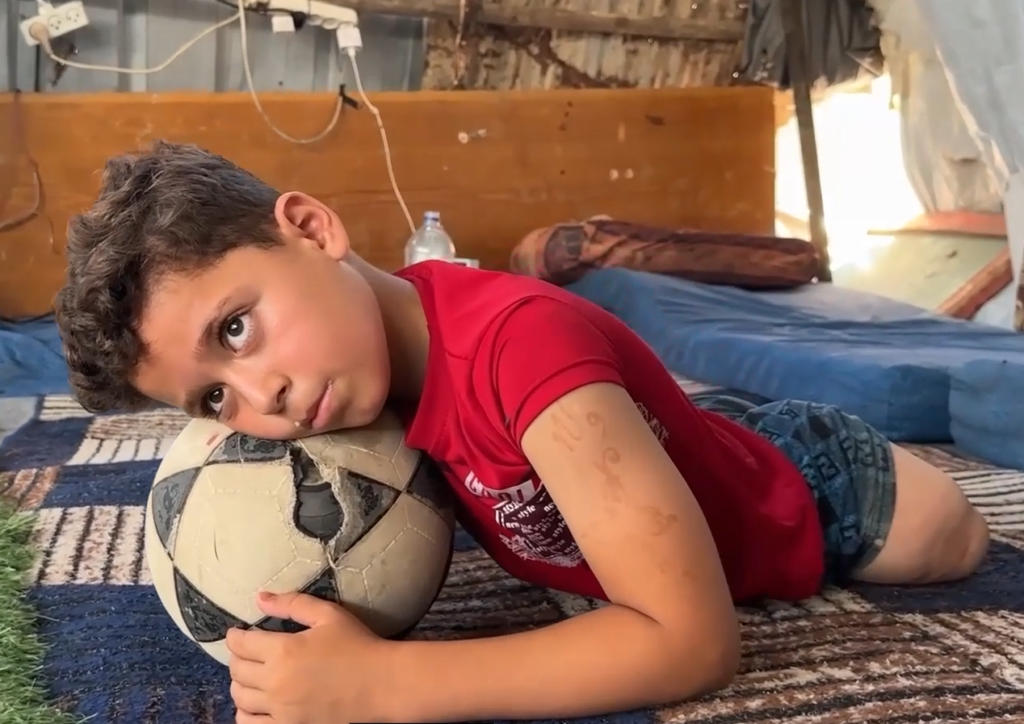
A young amputee in Gaza who dreams of receiving prosthetic limbs and playing football again has become a powerful reminder of the urgent need for paediatric prosthetics, rehabilitation and medical evacuation pathways for children with limb loss.
According to a report by Wake Up Singapore, ten-year-old Mohammed Saad Shaaban is living with his family in a tent in Halawa refugee camp in Jabalia, in the north of the Gaza Strip. Mohammed lost three limbs after reportedly being caught in a fire several years ago as a child. His mother declined to discuss the full details of the accident, but described the extreme difficulty of caring for him during years of displacement and war.
“My name is Mohammed Saad Shaaban. I am ten years old and in Grade 3. I hope to travel abroad, to wear prosthetic limbs, and to play football,” Mohammed said in footage cited by the report.
His dream is simple: to stand, move and play again.
A Child’s Dream in a Humanitarian Crisis
The image of Mohammed passing a football to his mother, playing with his brothers and friends, and balancing himself on the ball captures both the resilience of a child and the scale of the rehabilitation crisis in Gaza.
Football is not only a game. For many children, it is a symbol of normal life, confidence, friendship and freedom of movement. For a child with multiple limb loss, the possibility of playing again depends on far more than motivation. It requires specialist prosthetic assessment, carefully designed devices, rehabilitation therapy, skin care, follow-up, family support and a safe living environment.
Mohammed’s mother, Sundus Shaaban, told Wake Up Singapore that the family had been forced to flee around twelve times during the years of war. Each displacement raised the same painful question: how would she carry Mohammed and keep him safe?
For children with disabilities, displacement multiplies every challenge. Moving between shelters, camps and damaged environments can make mobility almost impossible. Basic hygiene, wound care, nutrition, transport and access to clinical review become harder. For amputee children, these conditions can directly affect health and prosthetic readiness.
Living Conditions Can Damage Rehabilitation Outcomes
One of the most concerning details in the report is the family’s description of life in the camp. Mohammed’s mother said the tents lack basic sanitary conditions and that the family lives among rats. She also said Mohammed undergoes further amputations around every six months because of keloid tissue and injuries linked to the harsh camp environment and rat bites on his lower limbs.
For rehabilitation professionals, this illustrates a critical point: prosthetic care cannot be separated from living conditions.
A child preparing for prosthetic fitting needs:
- Clean skin and wound care
- Stable residual limb condition
- Infection prevention
- Nutrition
- Pain management
- Safe housing
- Regular clinical review
- Access to therapy
- Family education
- Long-term follow-up
Without these basics, the pathway to prosthetic rehabilitation becomes far more difficult. Poor sanitation, repeated injury, infection risk and delayed treatment can all prevent a child from being fitted safely or progressing through therapy.
Gaza’s Child Amputee Crisis
Mohammed’s story sits within a much wider crisis.
UN agencies and humanitarian organisations have repeatedly warned that Gaza is home to an exceptionally large number of children with amputations and life-changing injuries. UNRWA Commissioner-General Philippe Lazzarini stated in December 2025 that Gaza hosts the largest group of child amputees in modern history. The statement also warned that children with serious injuries are struggling to access the treatment and rehabilitation they need.
UNICEF USA has reported that the Gaza Strip has the highest number of child amputees per capita in the world and cited WHO estimates that at least a quarter of those injured in Gaza have life-changing injuries requiring major rehabilitation. It also noted that severe limb injuries are a major driver of rehabilitation need.
These figures point to a crisis that is not only surgical or emergency-related. It is a long-term rehabilitation crisis.
Children who lose limbs need years of care. They outgrow prostheses. Sockets require adjustment. Components need repair or replacement. Walking patterns change. Pain, skin breakdown and psychological trauma must be addressed. For children with multiple limb loss, the level of clinical complexity is even higher.
Prosthetics Are Only One Part of Recovery
For Mohammed, travelling abroad for prosthetic treatment may offer a chance to receive specialist care that is currently difficult to access inside Gaza. His mother said the family is waiting for Gaza’s Ministry of Health to accelerate the procedures needed for him to leave the territory.
Medical evacuation has become a lifeline for some patients, but many remain unable to access treatment outside Gaza. Even when evacuation is possible, the rehabilitation pathway does not end with the first prosthesis.
A child with multiple limb loss may require:
- Multidisciplinary assessment
- Residual limb management
- Custom prosthetic design
- Upper and lower limb prosthetic training
- Physiotherapy
- Occupational therapy
- Psychological support
- Family training
- Assistive devices
- Wheelchair or mobility aid support
- Home and school adaptation
- Regular follow-up as the child grows
For children who want to return to sport, the pathway may eventually include activity-specific prosthetic training. But the first priority is safe mobility, daily function and health.
Why Paediatric Prosthetic Care Is Different
Paediatric prosthetics requires a different approach from adult prosthetic care.
Children grow. Their bodies change quickly. Their activity levels vary. They may not always understand discomfort or report early skin problems. Their devices need to support development, not simply replace lost structure.
A young child may need new sockets or devices repeatedly during growth. They also need rehabilitation that supports play, confidence, independence and social participation.
For a child like Mohammed, who has lost three limbs, the clinical pathway is even more demanding. It requires specialist expertise in multiple limb loss, careful sequencing of prosthetic fitting, adaptive training, energy conservation and psychological support.
In humanitarian settings, these needs are often extremely difficult to meet.
What This Means for IMEA Rehabilitation Providers
For IMEA CPO readers, Mohammed’s story is both heartbreaking and professionally important. It highlights why prosthetics and orthotics must be included in humanitarian health planning from the start.
In Gaza and other conflict-affected settings, rehabilitation cannot be treated as an optional second phase after emergency care. People who survive traumatic injury need immediate and long-term pathways into rehabilitation.
Key priorities include:
- Safe medical evacuation for complex cases
- Support for local prosthetic and orthotic services
- Supply of prosthetic components, orthotic materials and mobility aids
- Training and protection of rehabilitation professionals
- Paediatric rehabilitation pathways
- Psychological support for children and families
- Wheelchairs, crutches and temporary mobility devices
- Long-term repair and follow-up systems
- Coordination between hospitals, NGOs and international referral centres
The shortage of wheelchairs, prosthetic limbs and rehabilitation equipment reported in Gaza shows how quickly disability can become more disabling when assistive technology is unavailable.
Football, Dignity and the Right to Movement
Mohammed’s wish to play football again should not be dismissed as a child’s fantasy. For many amputees, sport represents the highest expression of rehabilitation: not only walking, but participating.
Football gives children identity, friendship and joy. For a child in a camp, it can also be a rare connection to ordinary childhood.
The aim of prosthetic rehabilitation is not only to restore standing or walking. It is to support participation in life. That may mean returning to school, playing with friends, helping at home or, one day, kicking a football again.
Mohammed’s dream is therefore a reminder of what rehabilitation is ultimately for.
A Call for Urgent Rehabilitation Access
Gaza’s child amputee crisis demands more than emergency response. It requires coordinated prosthetic, orthotic, rehabilitation and assistive technology support at scale.
Children like Mohammed need safe living conditions, medical care, evacuation pathways, specialist prosthetic services and long-term rehabilitation. They also need the chance to imagine a future beyond injury and displacement.
For the global rehabilitation community, his story is a call to action.
A child who says, “I love football,” is not only asking for a prosthetic limb. He is asking for the possibility of childhood, movement and hope.
- Wake Up Singapore: Young Gaza amputee dreams of travelling abroad for prosthetic limbs to play again
- UNRWA: Gaza hosts the largest group of child amputees in modern history
- UNICEF USA: UNICEF delivers wheelchairs for Gaza’s children
- WHO EMRO: Challenges of children amputees in Gaza
- WHO: Rehabilitation
- WHO: Prosthetics and Orthotics Services
- ICRC Physical Rehabilitation Programme