

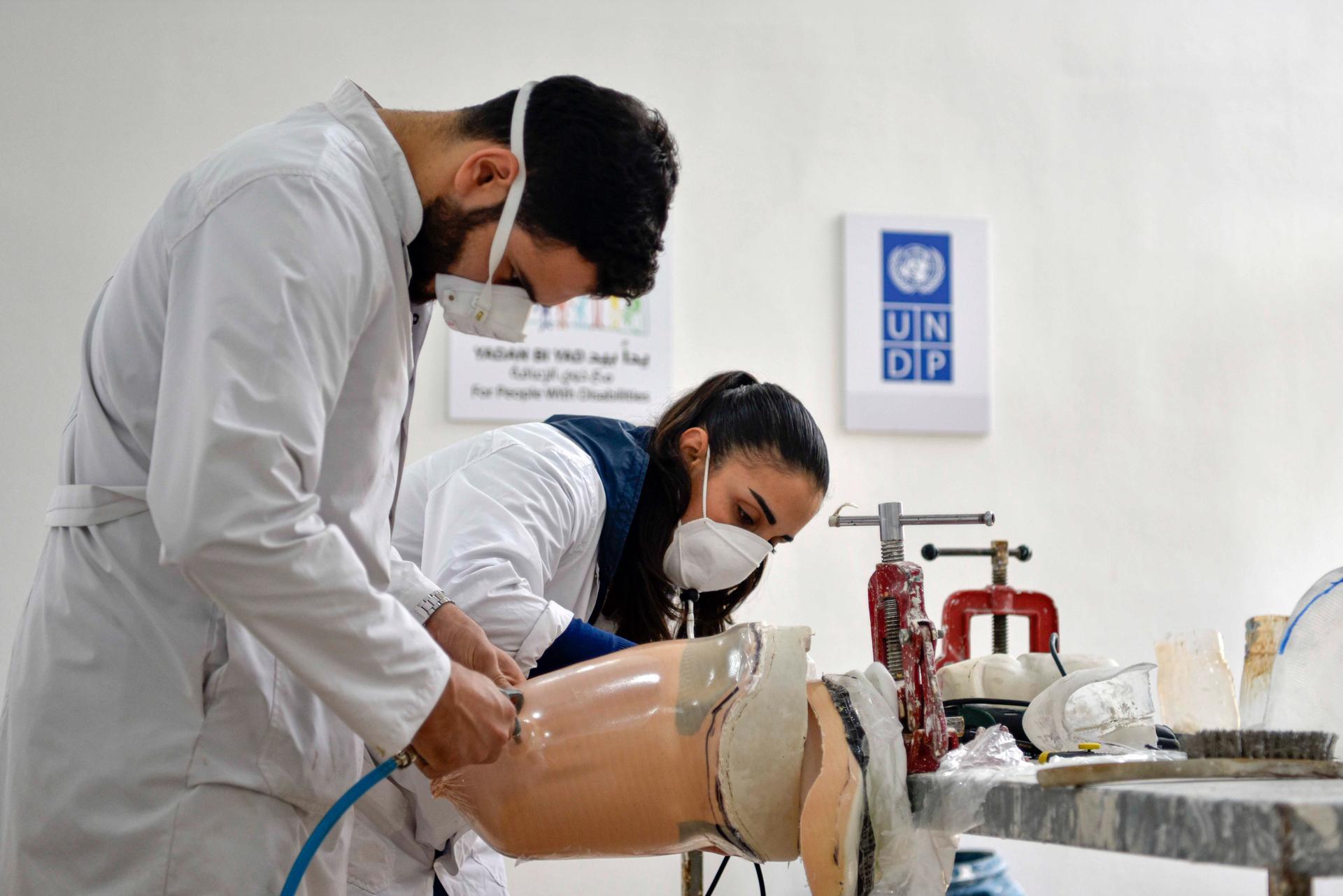
After more than a decade of supporting prosthetic services for people affected by conflict, the United Nations Development Programme has published a detailed account of how its Syria programme evolved from emergency device provision into a broader model of disability inclusion.
The experience offers important lessons for governments, humanitarian organisations and prosthetic and orthotic professionals working in conflict-affected and resource-constrained environments across the Middle East and wider IMEA region.
UNDP Syria began supporting the expansion of prosthetic services in 2015, as the country faced a sharp rise in traumatic injuries, amputations and permanent disabilities caused by explosive ordnance, landmines and remnants of war.
What started as an effort to provide prosthetic limbs gradually developed into a community-based system combining prosthetic service delivery, professional training, case management, psychosocial support, livelihoods assistance and disability-rights advocacy.
A growing need and an overstretched service system
The Syrian conflict created extensive demand for rehabilitation, particularly among civilians with lower-limb amputations.
However, the problem was not simply a lack of prosthetic workshops. Public, private and community-based services already existed, but their ability to respond was restricted by shortages of raw materials, disrupted supply chains, limited financing and insufficient numbers of trained prosthetic professionals.
Multidisciplinary rehabilitation pathways were also weak, while many people requiring prostheses came from vulnerable households that could not afford private care.
Without access to an appropriate prosthesis, people faced reduced mobility, dependence on relatives, exclusion from employment and greater vulnerability to poverty and social isolation. UNDP therefore viewed prosthetic care not only as a medical intervention, but as an issue of human rights, social protection and economic inclusion.
Building a community-based model
Before designing the intervention, UNDP mapped Syria’s public, private and community-based prosthetic services to understand the main gaps.
The analysis showed that establishing workshops alone would not solve the problem. The wider system also needed access to materials, financing, trained personnel, referrals and rehabilitation support.
Several options were considered, including strengthening public facilities, funding individuals to purchase private prostheses, supporting existing non-governmental workshops and establishing new community-based facilities.
The final approach combined immediate service delivery with local capacity development through community and NGO partners.
This allowed prosthetic care to be delivered relatively quickly while building the technical and managerial capabilities required to sustain services locally.
Appropriate technology rather than the cheapest solution
One of the most important principles of the programme was the use of appropriate technology.
UNDP did not aim to provide either the cheapest possible prosthesis or the most technologically advanced device. Instead, the goal was to deliver safe, functional and affordable solutions matched to the user’s mobility potential and the realities of the crisis environment.
This meant considering not only clinical performance, but also whether components could be maintained, repaired and replaced locally.
Market research was used to compare project production costs with the prices of similar prosthetic technologies available elsewhere.
National technical experts also helped assemble workshop equipment locally, including routers, infrared ovens, vacuum systems, workbenches, parallel bars and ramps. Local assembly reduced establishment costs and made it more feasible to reproduce the workshop model in several locations.
For O&P programmes across IMEA, this is a particularly important lesson. Advanced technology may offer excellent results, but only when the surrounding workforce, repair systems, supply chains and funding can support it.
Transparent beneficiary selection
With demand exceeding available resources, UNDP developed a documented and weighted beneficiary-selection process.
Priority was given to civilians, first-time prosthetic users, women, internally displaced people and individuals in age groups with greater potential to return to employment or livelihood activities.
The system combined clinical criteria with social vulnerability and programme considerations.
Transparent selection was important not only for fairness, but also for managing expectations among applicants and communities. Workshop teams needed to explain decisions respectfully while ensuring that prosthetic provision remained clinically safe and socially defensible.
Investing in people and management systems
UNDP’s experience demonstrated that prosthetic workshops cannot be treated merely as production units.
They require trained clinicians and technicians, but also effective systems for documentation, procurement, inventory control, beneficiary follow-up and workshop safety.
Technical staff received training from Syrian experts and, at different stages, regional and international Arabic-speaking prosthetic professionals.
Training also covered:
- Beneficiary records and data management
- Stock and procurement management
- Case follow-up
- Occupational health and safety
- Disability inclusion
- Gender-based violence awareness
- Environmental and social safeguards
- Communication with vulnerable service users
This broader approach was essential because prosthetic workshops contain machinery, dust, heat, chemicals and potentially hazardous materials. They also serve people who may have experienced conflict, displacement, trauma and prolonged exclusion.
Technical competence therefore had to be combined with safeguarding, communication and responsible workshop management.
Moving beyond device delivery
Over time, the Syrian programme increasingly treated prosthetic care as the beginning of an inclusion pathway rather than the end of a clinical procedure.
Services were connected to physiotherapy, psychosocial support, case management, peer activities, livelihood programmes and wider community participation.
This helped shift the programme away from simply counting the number of prostheses delivered.
The broader objective became enabling people with disabilities to move independently, return to work, participate in family and community life and exercise their rights.
For rehabilitation providers, this reinforces the importance of considering the complete patient journey. A technically successful prosthesis may still have limited impact if the user lacks rehabilitation, psychological support, transportation, employment opportunities or continuing access to repairs.
Major challenges faced by the programme
UNDP identified several recurring barriers.
One was the perception that prosthetic services were too clinical and should be handled exclusively by health organisations. The programme had to demonstrate that mobility services also affect livelihoods, social protection, dignity and recovery.
Another challenge concerned sustainability. Prosthetic care is expensive and recurrent, and questions were repeatedly raised about funding and exit strategies.
UNDP argued that sustainability must be viewed realistically in an active crisis. Some services remain necessary because they protect basic mobility, participation and human dignity, even when full financial independence is not immediately achievable.
Other obstacles included:
- A shortage of trained prosthetic professionals
- Migration and difficulty retaining qualified staff
- High costs for components and raw materials
- Sanctions and disrupted supply routes
- Managing beneficiary expectations
- Occupational and environmental risks inside workshops
Initial earmarked funding was an important enabling factor. Once donors and senior decision-makers saw the visible impact of restored mobility, support for the programme increased.
The project subsequently attracted backing from several international partners, including the European Union, Finland, Germany through KfW, Italy, Japan and Kuwait.
Lessons for other crisis and low-resource settings
UNDP cautions that the Syria model should not be copied without considering local conditions.
Where governments and national institutions can be supported directly, strengthening them may be more appropriate than establishing parallel community workshops.
Nevertheless, several principles can be transferred to other settings:
- Map existing services before creating new ones
- Identify whether the real bottleneck is equipment, materials, workforce, finance or referrals
- Select technology according to local repair and supply capabilities
- Use transparent beneficiary-selection criteria
- Invest in staff, management and safety systems
- Connect prosthetics with rehabilitation, livelihoods and psychosocial support
- Communicate using rights-based rather than pity-based narratives
These principles are highly relevant to prosthetic programmes responding to conflict, displacement and disaster across the Middle East, Africa and South Asia.
Transitioning towards national services
As Syria enters a new phase, UNDP is shifting its emphasis away from the predominantly community-based workshop model towards strengthening national prosthetic and rehabilitation services.
After around ten years of support, UNDP has exited three earlier workshops, while one workshop in Aleppo remains operational.
Future support will increasingly focus on Ministry of Health services, including the provision of raw materials, professional training and technology transfer.
UNDP also plans to introduce stronger digital systems. Electronic registration and a central dashboard could help track beneficiaries, workshop activity, outcomes and referrals across the country.
These systems were difficult to implement during earlier stages of the crisis, but improved digital case management may now support more consistent follow-up and provide evidence for the transition towards nationally led services.
A model based on mobility, dignity and participation
The Syria experience demonstrates that prosthetic care in a crisis cannot be reduced to manufacturing and distributing devices.
Successful programmes require service mapping, suitable technology, trained personnel, rehabilitation pathways, safe workshops, transparent decision-making and long-term links to national systems.
Most importantly, they must recognise that a prosthesis is not the final objective.
The objective is to enable a person to regain mobility, participate in society, support their family and live with greater independence and dignity.
For the IMEA rehabilitation sector, UNDP Syria’s experience provides a valuable example of how prosthetic services can move beyond short-term humanitarian delivery and become part of a wider strategy for disability inclusion, recovery and national capacity development.
- UNDP Syria: Scaling Prosthetic Services in Crisis — The Syria Case
- UNDP Syria
- UNDP Disability Inclusion
- World Health Organization: Rehabilitation
- WHO Standards for Prosthetics and Orthotics
- International Society for Prosthetics and Orthotics
- IMEA CPO