

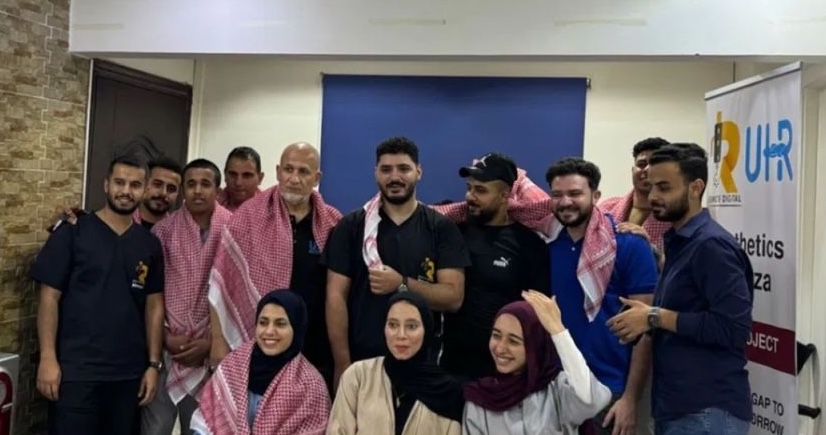
A regional prosthetics collaboration supporting wounded people from Gaza has completed the first phase of its third project in Cairo, according to an update shared by Jordanian prosthetics and digital fabrication specialist Rabee Naeem.
Naeem said he felt “proud, happy, and hopeful” after seeing the results achieved through the Relief Bridge initiative and the work of the Jordan Remote Digital team in supporting prosthetic provision in Cairo. He also thanked the individuals and organisations that contributed, cooperated and supported the project.
The project was made possible through cooperation with Qudra Orthotics & Prosthetics Lab Center in Cairo, which Naeem credited as central to the success and continuity of the work.
For the rehabilitation community across the Middle East, this update is significant because it shows how cross-border collaboration, remote digital support and local prosthetic workshop capacity can be combined to respond to one of the region’s most urgent rehabilitation crises.
Gaza’s rehabilitation needs have escalated sharply since the war began. Multiple humanitarian and media reports have described thousands of people living with limb loss and limited access to prosthetic care, rehabilitation services and assistive technology. Humanity & Inclusion reported in June 2025 that more than 6,000 prosthetic limbs were needed in Gaza, while also noting efforts to provide temporary prostheses, physiotherapy and psychological support through a rehabilitation centre in Khan Younis. (humanity-inclusion.org.uk)
Reuters has also reported severe shortages of artificial limbs, mobility aids, trained personnel and rehabilitation facilities for Gaza’s amputees, citing estimates of thousands of new amputees alongside people with pre-existing limb loss. (reuters.com)
Against this backdrop, the Cairo-based project highlights an important model for regional response. Many wounded Palestinians evacuated from Gaza require long-term prosthetic care outside the territory, while many others remain inside Gaza with limited access to specialist services. This creates a need for flexible rehabilitation pathways that can connect clinicians, technicians, digital designers, component suppliers and workshops across borders.
Remote digital prosthetics can play an important role in this type of work. Digital design, remote case review, online technical support and distributed fabrication can help specialist teams support local labs without every expert needing to be physically present. This is especially relevant when patients are displaced, clinical teams are working across different countries, and follow-up may be difficult.
Naeem’s professional background also reflects this digital direction. His public profile describes his work in prosthetics and digital fabrication, including experience with 3D-printed orthotic and prosthetic applications in Jordan. (linkedin.com)
The collaboration with Qudra Orthotics & Prosthetics Lab Center in Cairo is particularly important because prosthetic outcomes depend heavily on local fitting, alignment, adjustment and patient follow-up. Digital support can improve efficiency and coordination, but successful prosthetic care still requires hands-on clinical assessment, socket fitting, gait training and ongoing review.
For patients wounded in Gaza, prosthetic care is not a single device delivery. It is a long rehabilitation pathway. Many patients will need residual limb management, repeated fitting as swelling changes, physiotherapy, psychological support, mobility training and replacement or repair of components over time. Children and young adults may require even more frequent follow-up as they grow or as their functional needs change.
This is why continuity is one of the most important words in Naeem’s update. Humanitarian prosthetic projects often begin with an urgent fitting phase, but the long-term challenge is maintaining care after the first intervention. A sustainable pathway needs local partners, remote technical support, component access, data records and systems for review.
The broader Gaza prosthetics response has already shown the importance of regional and international partnerships. In 2024, reports described a Jordanian-led rapid prosthetic initiative involving mobile clinics and remote follow-up support, aimed at helping large numbers of Gaza amputees. (news.sky.com) Arab News also reported on the initiative, noting the role of UK-developed rapid-fitting technologies in supporting victims of the war. (arabnews.com)
The work described by Naeem adds another example of how regional expertise can be mobilised around Gaza’s rehabilitation needs. Jordan, Egypt and other countries in the region have a growing pool of prosthetists, orthotists, digital fabrication specialists and rehabilitation professionals who can help bridge gaps in care when local systems are overwhelmed.
For IMEA CPO readers, the lesson is clear. The future of humanitarian prosthetics in the region will not depend only on donated components or one-off missions. It will depend on connected networks of trained professionals, local workshops, digital workflows, remote technical collaboration and long-term rehabilitation planning.
Projects such as the Jordan Remote Digital and Qudra collaboration show how this model can begin to take shape. They also underline the importance of recognising prosthetic care as part of a wider rehabilitation ecosystem, not just an emergency response.
As Gaza’s wounded continue to need support in Cairo, Gaza and other locations across the region, the success and continuity of such projects will depend on sustained cooperation between clinicians, labs, donors, humanitarian partners and digital prosthetics teams.
Naeem’s message is ultimately one of professional pride and shared responsibility. The first phase of this third project has been completed, but the wider rehabilitation journey for Gaza’s wounded will continue for years.
Humanity & Inclusion: More than 6,000 prosthetic limbs needed in Gaza
Reuters: Gaza’s amputees face life in war zone with little treatment
Sky News: Thousands of Gaza amputees to get rapid prosthetic limbs using UK tech
Arab News: 14,000 Gaza amputees will get rapid prosthetic limbs using UK tech
Can’t be more proud, Dr. Shahd. Congratulations for this exclusive achievement. Your dedication, and tireless hard work have always set you apart, and it’s wonderful to see your efforts being celebrated. I’m incredibly proud of you and all you’ve achieved. Wishing you endless success, happiness, and many more milestones. You truly deserve every bit of this. Keep shining! 🌹❤️