

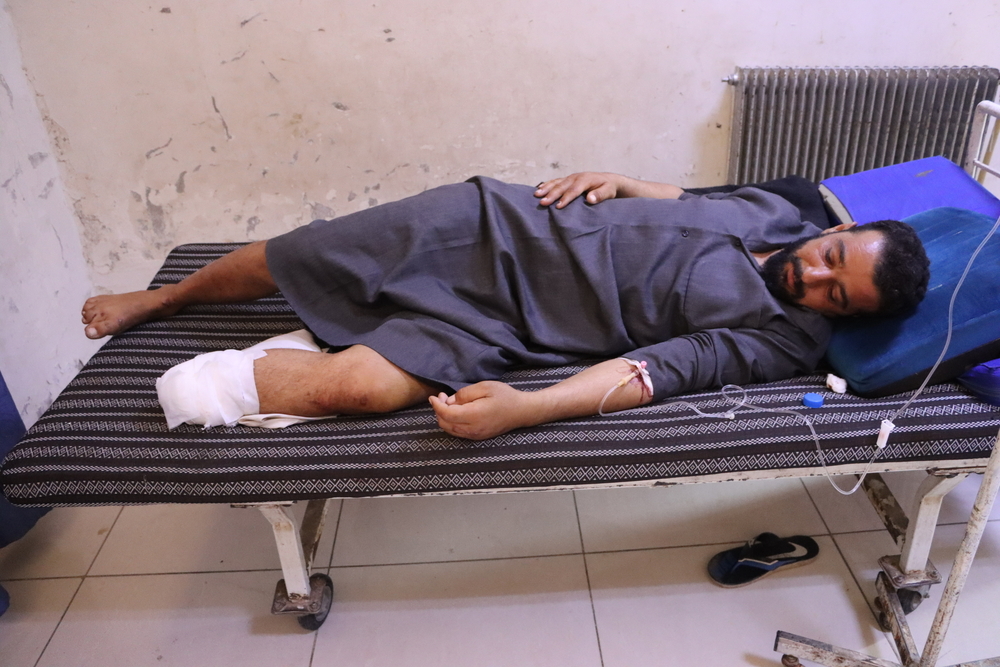
Explosive remnants of war continue to kill, injure and disable civilians across Syria’s Deir ez-Zor governorate, while survivors face severe shortages of emergency transport, specialist surgery, prosthetic care and long-term rehabilitation.
Between April 2025 and April 2026, teams from Médecins Sans Frontières and the local Directorate of Health treated more than 215 people injured by landmines, unexploded ordnance and abandoned explosives at Deir ez-Zor National Hospital.
Nearly half of the patients were children. Twenty-four people died from their injuries, while 58 underwent traumatic amputations, according to an MSF report highlighted by the Australasian Muslim Times.
The findings demonstrate that the consequences of Syria’s conflict are continuing long after fighting has moved away from some communities. For many survivors, reaching an emergency department is only the beginning of a lengthy and uncertain rehabilitation journey.
Civilians injured during everyday activities
Explosive contamination is not restricted to former front lines or military facilities.
People in Deir ez-Zor are reportedly being injured while farming, grazing livestock, collecting truffles, returning to damaged houses or moving through abandoned buildings. Children are particularly vulnerable when playing outdoors or investigating unfamiliar objects.
Economic hardship can force families to enter areas they know may be contaminated. Agricultural land and livestock are often essential sources of income, leaving people with the impossible choice between avoiding dangerous areas and providing food for their households.
The nationwide pattern is similar. Syria’s Health Sector reported that 501 of the 813 explosive-ordnance incidents recorded between December 2024 and October 2025 occurred on agricultural or grazing land. These incidents killed 329 people and injured another 530.
This makes explosive ordnance not only a security threat, but also a barrier to livelihoods, food production, population returns and economic recovery.
Deir ez-Zor among Syria’s most contaminated governorates
Deir ez-Zor remains one of the Syrian governorates most severely affected by landmines and explosive remnants of war.
The Health Sector identified Deir ez-Zor, Aleppo and Idlib as the three governorates most affected by explosive-ordnance contamination during 2025. Across Syria, 813 incidents caused 1,498 casualties between December 8, 2024 and October 31, 2025. The total included 563 deaths and 935 injuries, with children accounting for hundreds of the casualties.
WHO’s 2026 emergency appeal subsequently reported more than 870 explosive-ordnance incidents and over 1,600 casualties nationally, warning that contamination restricts access to land, healthcare and essential services while presenting a serious threat to displaced people and returning communities.
UNMAS has described explosive contamination in Syria as widespread and long-lasting, with landmines, unexploded ammunition and improvised explosive devices remaining in populated communities, agricultural areas and damaged infrastructure.
Emergency care begins with a dangerous journey
Many patients injured in remote parts of Deir ez-Zor must travel long distances before reaching specialist trauma care.
Ambulances may be unavailable, roads may be damaged or contaminated, and families may have to transport severely injured relatives using private vehicles. These delays increase the risk of blood loss, infection, preventable amputation and death.
Deir ez-Zor National Hospital is itself operating under considerable pressure.
MSF began supporting its emergency department in April 2025, providing emergency care, laboratory services, infection-control assistance, sterilisation, water and sanitation support, staff training and improvements to patient triage. The organisation also installed an X-ray machine and supported upgrades to waste-management facilities.
Despite this assistance, the number and complexity of blast injuries can exceed the hospital’s capacity. Shortages of specialist surgeons, medical equipment and post-discharge services further reduce the likelihood of a complete recovery.
Traumatic amputation requires a complete care pathway
The 58 traumatic amputations recorded at one hospital over a 12-month period represent a substantial future demand for prosthetic and rehabilitation services.
A person who undergoes an emergency amputation following a blast may require:
- Repeated wound debridement
- Infection management
- Residual-limb revision surgery
- Skin grafting or reconstructive surgery
- Contracture prevention
- Pain and phantom-limb management
- Physiotherapy and strengthening
- Prosthetic assessment and fitting
- Gait training or upper-limb rehabilitation
- Psychological and social support
- Long-term repairs and replacement devices
Blast injuries are often more complex than planned surgical amputations.
The residual limb may contain scar tissue, damaged nerves, bone fragments or compromised soft tissue. Patients can also have injuries to the opposite limb, upper body, vision or hearing that affect their ability to use a prosthesis.
A rapid artificial-limb fitting without adequate surgical preparation, rehabilitation and clinical follow-up is unlikely to provide a sustainable outcome.
Prosthetic and orthotic services remain severely limited
MSF reported a critical shortage of prosthetic specialists and rehabilitation services in Deir ez-Zor.
Survivors may be discharged after lifesaving treatment without access to a prosthetist, physiotherapist, orthotist or specialist mental-health professional. Some remain dependent on relatives because they cannot obtain an artificial limb or suitable mobility device.
One young farmer described in the report lost both legs above the knee after stepping on a landmine while working. He had previously supported himself through daily work but became largely dependent on his family after the injury, with no immediate access to prosthetic legs.
Bilateral transfemoral prosthetic rehabilitation is particularly demanding. It requires carefully prepared residual limbs, intensive physical therapy, high energy expenditure and appropriately selected components.
Not every bilateral amputee will initially be able to walk with prostheses. Wheelchairs, seating, home modifications and caregiver support must therefore be considered alongside artificial limbs.
Syria’s wider rehabilitation system remains under pressure
The needs in Deir ez-Zor reflect broader weaknesses within Syria’s health and rehabilitation systems.
WHO reported that many health facilities remain non-operational because of damaged or outdated equipment, shortages of medicines and limited human resources. Its 2026 appeal estimated that 16.5 million people required humanitarian assistance, including 10.3 million targeted for support.
A Health Sector assessment found that only 57% of Syrian hospitals and 23% of public health centres were fully functional in late 2025. It also estimated that 2.4 million people with disabilities required health assistance.
Funding shortages have directly affected rehabilitation access. The same assessment estimated that more than 141,000 required physical-rehabilitation sessions had not taken place, with only 31% of the targeted need reached.
These gaps leave people with amputations, spinal injuries, fractures and neurological conditions at risk of preventable complications and permanent loss of function.
Children require lifelong follow-up
The high proportion of children among the casualties is especially concerning.
A child who loses a limb may require repeated prosthetic sockets and component changes throughout growth. Their needs can change rapidly as limb length, body weight, activity and educational requirements develop.
Paediatric rehabilitation may include:
- Repeated socket replacement
- Monitoring of bone growth
- Management of residual-limb overgrowth
- Prevention of joint contractures
- School reintegration
- Adapted play and sport
- Psychological support
- Family and caregiver education
Children injured by explosive ordnance may also have lost relatives or witnessed the injury of other family members.
Rehabilitation should therefore be trauma-informed and coordinated with child-protection, education and mental-health services.
Orthotic needs extend beyond amputees
Not every blast survivor requires a prosthesis, but many may require orthotic intervention.
Fractures, peripheral-nerve damage, burns and soft-tissue injuries can lead to weakness, paralysis, joint instability or contracture. Patients may benefit from ankle-foot orthoses, knee-ankle-foot orthoses, upper-limb splints or spinal support.
Orthoses can support:
- Foot drop following nerve injury
- Unstable knees
- Fracture recovery
- Burn-contracture management
- Joint positioning
- Protection of weakened limbs
- Gradual return to standing and walking
Local rehabilitation planning should therefore include both prosthetic and orthotic workshop capacity.
A service focused only on people with amputations would overlook a much larger group living with serious but potentially manageable physical impairments.
Mine clearance and rehabilitation must advance together
MSF has called for urgent expansion of mine clearance and explosive-ordnance disposal across Deir ez-Zor.
Clearance is the most direct way to prevent new casualties, but it must be accompanied by risk education, emergency trauma capacity and comprehensive assistance for people who have already been injured.
A coordinated victim-assistance pathway should include:
- Emergency first aid and transport
- Trauma surgery and wound care
- Early physical rehabilitation
- Prosthetic, orthotic and wheelchair assessment
- Psychological and peer support
- Vocational and social reintegration
- Long-term repairs and clinical review
Mine action should also prioritise routes to hospitals, water systems, residential areas and agricultural land.
Explosive contamination has reportedly restricted humanitarian access to health facilities and essential infrastructure in Deir ez-Zor, making clearance necessary for both civilian safety and service delivery.
Regional and international support is required
Deir ez-Zor’s rehabilitation gap cannot be addressed through isolated device donations.
The governorate requires investment in professional training, workshop infrastructure, mobile services, physiotherapy, component supply and patient follow-up.
International support could help establish:
- A permanent prosthetic and orthotic centre
- Satellite assessment clinics
- Mobile rehabilitation teams
- Digital patient records
- Locally repairable component systems
- Training for Syrian prosthetists and orthotists
- Physiotherapy and occupational-therapy services
- Paediatric rehabilitation pathways
- Wheelchair and seating services
- Mental-health and livelihood support
Any imported technology should be selected according to local conditions.
Devices must be durable, affordable and repairable within Syria. Complex components that depend on overseas servicing or unavailable replacement parts may create further dependency.
Rehabilitation is essential to Syria’s recovery
Explosive ordnance leaves consequences that can continue for decades after a conflict.
A blast injury can remove a person’s ability to farm, work, study or support a family. When rehabilitation is unavailable, the economic and social effects spread through entire households and communities.
Mine clearance makes land safer. Trauma care saves lives. Prosthetic, orthotic and rehabilitation services allow survivors to rebuild those lives.
The experience of Deir ez-Zor demonstrates that these services must be funded as one connected humanitarian and recovery pathway.
Treating the emergency injury without supporting long-term mobility leaves survivors alive but excluded from independence, employment and community participation.
For the more than 215 patients treated at Deir ez-Zor National Hospital—and for the many others who may never have reached medical care—access to rehabilitation is not an optional stage after treatment.
It is a central part of survival and recovery.
- AMUST – Explosive ordnance continues to injure and kill civilians in Deir ez-Zor
- Médecins Sans Frontières
- United Nations Mine Action Service – Syria
- WHO – Syrian Arab Republic emergency appeal
- WHO – Rehabilitation
- International Committee of the Red Cross – Physical rehabilitation
- International Society for Prosthetics and Orthotics