

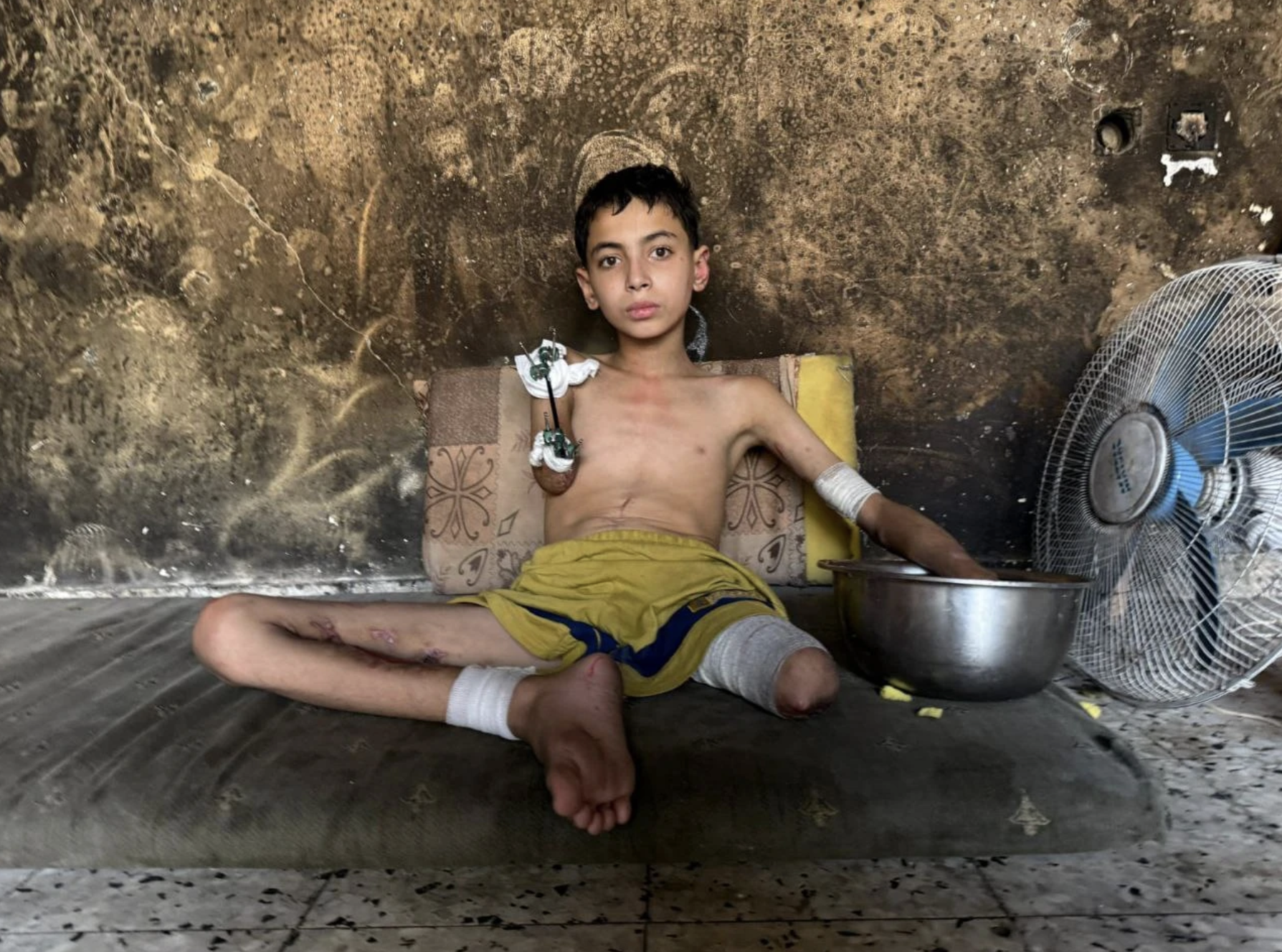
A British prosthetic company is calling for a rapid humanitarian programme to provide accessible upper-limb devices to children and adults who have undergone amputations during the war in Gaza.
Ewan Phillips, Chairman of Koalaa, said conventional prosthetic delivery models are proving extremely difficult to operate in Gaza because they depend on trained clinicians, accessible buildings, specialist equipment and a reliable supply of imported components.
Many of these foundations of care have been severely disrupted. Gaza has only a small number of practising prosthetists, while clinics have faced damage, insecurity and shortages of prosthetic materials. Recent reporting has described thousands of people waiting for devices and only a fraction of the identified need being met.
Koalaa argues that lightweight, modular upper-limb prostheses could provide an earlier and more mobile form of support while comprehensive clinical and rehabilitation services are rebuilt.
Blast injuries have created complex upper-limb needs
Much of the international attention around Gaza’s amputation crisis has focused on lower-limb loss and the urgent need to restore walking.
Upper-limb amputees face a different but equally significant loss of independence.
An arm or hand is involved in almost every daily activity, including:
- Eating and drinking
- Washing and dressing
- Writing and using a phone
- Carrying objects
- Preparing food
- Returning to school
- Performing paid work
- Caring for children
- Participating in play and sport
Children may be particularly affected because limb loss occurs while they are still developing physically, emotionally and socially.
A child with an upper-limb amputation may require repeated device adjustments and replacements as they grow. Rehabilitation must also consider school participation, self-care, body image, trauma and the child’s changing functional priorities.
UN agencies and humanitarian organisations have described Gaza as facing an exceptionally large population of child amputees, while access to prostheses and rehabilitation has remained far below demand.
Traditional prosthetic pathways are difficult to operate
A conventional upper-limb prosthetic pathway may require several clinic visits involving:
- Residual-limb assessment
- Measurement or casting
- Socket fabrication
- Trial fitting
- Component assembly
- Functional training
- Adjustments
- Repairs and follow-up
More advanced devices may also depend on electrical power, batteries, specialist software, imported components and highly trained professionals.
These requirements are challenging even in a stable healthcare system.
In Gaza, movement is restricted, buildings may be damaged or unsafe, electricity is unreliable and clinicians are working under extreme pressure. Prosthetic centres have also struggled to obtain raw materials and replacement parts.
For some patients, travelling repeatedly to a fixed clinic may be impossible because of injury, displacement, insecurity or the cost and availability of transport.
The result is that a patient may be medically ready to begin using a prosthesis but remain without a device for months.
A prosthetic kit designed to travel to the patient
Koalaa’s proposed response is based on soft, modular prosthetic arms that can be transported in compact kits and fitted outside a conventional workshop.
The company says its below-elbow sleeves can be fitted rapidly and adjusted without the machinery normally required to manufacture a rigid custom socket. Koalaa has previously trained regional partners to complete some fittings in approximately 15 minutes.
The approach could allow teams to take prosthetic kits into:
- Displacement camps
- Field hospitals
- Community centres
- Temporary shelters
- Patients’ homes
- Mobile rehabilitation clinics
This does not eliminate the need for clinical oversight or rehabilitation expertise.
Patients still require wound healing, pain assessment, review of the residual limb and referral when there are infections, contractures or surgical complications. However, a simpler fitting model may allow appropriately trained teams to reach more people than a service that depends entirely on a fixed prosthetic workshop.
Modular systems may suit growing children
A major challenge in paediatric prosthetics is that children quickly outgrow sockets and components.
A device that fits today may become uncomfortable or unusable as the child’s arm changes in length and circumference. Conventional replacement can require another series of clinical and manufacturing appointments.
Koalaa says its modular system can be adjusted and adapted, potentially reducing the time and infrastructure needed to respond to growth.
This could be particularly valuable in Gaza, where children may be displaced several times and may not be able to return to the same clinician or centre.
A modular approach can also allow different task-specific attachments to be introduced according to the child’s goals, such as holding a bicycle handle, playing a game or completing a school activity.
The success of such a device should be measured by whether it improves meaningful participation rather than whether it visually resembles a natural arm.
Restoring Hope demonstrated a mobile delivery model
Koalaa previously worked with partners connected to Jordan’s Restoring Hope initiative, which was established in 2024 to support people with amputations in Gaza.
The initiative used mobile clinics connected to Jordanian field hospitals and combined prosthetic fitting with rehabilitation support. Restoring Hope reports that more than 500 injured people received prosthetic limbs and physiotherapy during its earlier operations in Khan Younis.
Koalaa has said that its contribution helped provide upper-limb solutions to hundreds of amputees through these mobile services.
The wider Restoring Hope programme has since continued to expand. By July 2026, Jordanian reporting stated that the initiative had supported more than 1,200 prosthetic fittings, including lower-limb services delivered through field hospitals.
These figures cover the wider programme and should not be interpreted as Koalaa upper-limb fittings alone.
The experience nevertheless shows that mobile prosthetic services can operate in Gaza when there is coordination between humanitarian organisations, field hospitals, trained teams and dependable supplies.
Koalaa estimates a rapid response could be affordable
Phillips argues that the cost of supplying an initial soft prosthetic arm to Gaza’s upper-limb amputees would be small when compared with the tens of billions of dollars likely to be required for wider reconstruction.
Based on Koalaa’s own estimates, an initial programme covering the identified upper-limb amputee population could cost approximately $2 million, followed by annual costs of around $500,000 to $600,000 for replacement devices and ongoing support.
These are company estimates rather than independently verified programme budgets.
The final cost would depend on:
- The verified number and amputation level of potential users
- Clinical screening requirements
- Transport and access arrangements
- Training and staffing
- Paediatric replacement rates
- Follow-up and rehabilitation
- Customs and logistics
- Device loss or damage
- Monitoring and outcome evaluation
However, the figures illustrate the relatively modest scale of prosthetic investment compared with major hospital and infrastructure reconstruction.
Early access can protect independence
Upper-limb amputees are often required to wait until the residual limb is fully stable before receiving a definitive custom prosthesis.
During that waiting period, patients may lose strength, confidence and independence. They may become reliant on family members for tasks they previously managed alone.
An early-stage device can provide functional assistance while the patient awaits further surgery, a definitive prosthesis or access to a specialist centre.
Potential early benefits include:
- Encouraging use of the affected side
- Supporting two-handed activities
- Reducing reliance on caregivers
- Enabling return to school
- Improving confidence
- Helping the user explore functional goals
- Preparing the patient for future prosthetic choices
A soft or modular prosthesis will not suit every patient or replace all types of upper-limb technology.
Some users may later require body-powered, myoelectric or more specialised devices. Others may choose not to use a prosthesis for every activity.
The important principle is that patients should be offered timely, informed choices rather than being left without support because a definitive solution is unavailable.
Simple fitting must not become unregulated fitting
The ability to fit a device outside a clinic is a major advantage during conflict, but it also raises questions about training, quality and patient safety.
A humanitarian programme should establish clear criteria covering:
- When a wound is ready for fitting
- Which amputation levels are suitable
- Who can complete the fitting
- When a prosthetist or surgeon must be consulted
- How pressure and skin problems are monitored
- How children are reviewed during growth
- How devices are repaired or replaced
- How outcomes and complications are recorded
Community workers and rehabilitation assistants may be trained to undertake defined elements of the service, but they should have access to professional supervision and referral pathways.
A scalable model should reduce unnecessary dependence on specialists without removing clinical accountability.
Local training is essential
The long-term objective should not be repeated dependence on visiting international teams.
Palestinian rehabilitation workers, therapists, nurses and community organisations should be trained to assess suitable users, fit devices, provide functional instruction and manage follow-up.
A sustainable programme could involve:
- Training a core Palestinian clinical team
- Supplying standardised mobile fitting kits
- Establishing remote support from experienced prosthetists
- Creating a digital patient and device register
- Holding replacement stock inside the region
- Developing a pathway for complex clinical cases
- Measuring functional and patient-reported outcomes
Regional partners in Jordan could also provide training, logistics and technical support where access allows.
Koalaa’s previous work with Restoring Hope indicates that this type of regional capacity-building model is possible.
Upper-limb care must include rehabilitation and trauma support
A prosthetic arm does not, by itself, resolve the impact of limb loss.
Patients may require occupational therapy to relearn self-care and two-handed activities. Children may need support returning to school, while adults may require vocational retraining.
Many amputees have also survived the deaths or injuries of family members, displacement and repeated attacks.
Upper-limb rehabilitation should therefore include:
- Occupational therapy
- Functional task training
- Pain management
- Scar and residual-limb care
- Psychological support
- Peer mentoring
- School reintegration
- Vocational rehabilitation
- Family and caregiver education
The device should be introduced as one element of a wider recovery pathway.
Humanitarian procurement should allow more than one solution
Gaza’s amputation burden is too large and diverse to be addressed through a single prosthetic technology.
The response will require a range of solutions, including:
- Simple early-stage prostheses
- Soft and modular arms
- Conventional body-powered devices
- Custom rigid sockets
- Myoelectric systems for selected patients
- Lower-limb prostheses
- Orthoses and splints
- Wheelchairs and mobility aids
- Surgical and therapeutic rehabilitation
Humanitarian organisations should avoid assuming that every patient needs the most advanced device or that the least expensive device will always be sufficient.
Prescription should be based on the user’s clinical status, age, goals, environment and access to maintenance.
Koalaa’s model is particularly relevant because it addresses a gap between receiving no prosthesis and waiting for a fully customised service that may not be accessible.
No amputee should be left waiting unnecessarily
The continued difficulty of accessing prosthetic care in Gaza is not solely a technology problem.
Suitable solutions already exist. The barriers involve humanitarian access, funding, transport, trained personnel and permission to move essential supplies.
Koalaa’s proposal demonstrates how a compact and mobile upper-limb programme could bypass some—but not all—of these constraints.
It cannot replace the rebuilding of Palestinian prosthetic centres or the development of a fully staffed rehabilitation system.
It could, however, give many children and adults an earlier opportunity to regain useful function while longer-term services are restored.
For Gaza’s upper-limb amputees, the choice should not be between waiting indefinitely and receiving no care.
A coordinated humanitarian response can provide immediate, practical solutions while building the clinical and local capacity required for lifelong rehabilitation.
- Koalaa – Soft upper-limb prosthetics
- Restoring Hope Society
- Arab News – Restoring Hope supports more than 1,200 Gaza amputees
- Petra – Jordanian field hospital prosthetic services in Gaza
- Associated Press – Gaza amputees face severe prosthetic shortages
- UNRWA
- World Health Organization – Rehabilitation
- International Society for Prosthetics and Orthotics