

Karachi-based Bioniks has reportedly been ranked among the world’s top ten prosthetics companies, giving Pakistan a prominent position within the rapidly developing international market for digitally manufactured and sensor-controlled artificial limbs.
The recognition, reported by Pakistani startup publication DealBeat, places Bioniks alongside international businesses developing advanced prosthetic technologies. It is an important milestone for a company that has built its identity around combining artificial intelligence, three-dimensional scanning, digital manufacturing and remote service delivery with a focus on affordability.
For Pakistan’s orthotics and prosthetics community, the significance extends beyond a single company or ranking. Bioniks demonstrates that advanced assistive technology can be designed and developed within South Asia, shaped around the economic and access challenges experienced by users in low- and middle-income countries.
From Karachi startup to international recognition
Founded in 2016, Bioniks began with the objective of making functional upper-limb prostheses more accessible to people who could not afford comparable imported systems.
The company uses digital scanning and computer-assisted design to create customised prosthetic arms and hands. Its model also incorporates remote communication and app-based services, potentially reducing the number of journeys required from users who live far from specialist prosthetic facilities.
According to the Zero Project’s profile of Bioniks, the company had expanded from 15 employees in 2021 to approximately 50 by the middle of 2024. It had supplied around 700 prostheses by that point, compared with approximately 200 beneficiaries in 2021.
More recent reports have placed the number of customised limbs provided by the company above 1,000. Different figures may reflect different reporting periods and definitions, but they indicate a business that has progressed beyond early prototyping into repeat production and clinical delivery.
Digital technology built around access
The wider prosthetics industry has invested heavily in multi-articulating hands, pattern recognition, lightweight materials and digital fabrication. However, advanced upper-limb systems can remain financially or geographically inaccessible to many potential users.
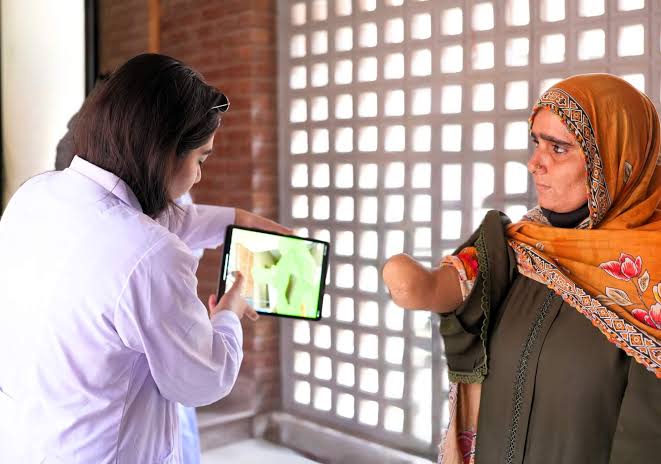
Bioniks’ approach attempts to narrow this gap through a locally developed digital workflow. A three-dimensional scan of the residual limb can be used to create a customised model, after which the prosthesis is designed and manufactured using computer-assisted processes.
The company’s smartphone-based workflow is intended to enable users or partner healthcare providers to submit information remotely. Digital files can then be reviewed by the Bioniks team before the device is manufactured and delivered.
This approach does not remove the need for professional assessment, socket fitting, alignment, functional training or follow-up. Upper-limb prosthetic success depends on much more than producing a mechanical hand. Residual-limb condition, socket comfort, control strategy, occupational requirements, user expectations and rehabilitation support all influence whether a device is adopted successfully.
Nevertheless, digital processes can make it easier to connect specialist design and manufacturing capacity in Karachi with users and clinical partners elsewhere.
Developing the Zindagi product family
Bioniks has developed several upper-limb prosthetic options under its Zindagi range. These include the Zindagi 2.0 and Zindagi X, with models offering different combinations of control, appearance, materials and digital connectivity.
The company describes Zindagi X as an app-calibrated system that supports remote troubleshooting and switching between operating modes. It uses 3D-printed carbon-fibre material and includes a screen displaying battery charge. Custom colours and themes allow the device to reflect the wearer’s identity rather than attempting only to imitate a natural limb.
This emphasis on personalisation is particularly important for children and younger users. A prosthesis can be presented as a visible expression of identity and technology rather than something that must always be concealed beneath a cosmetic glove.
At the same time, the clinical value of any upper-limb system must be judged through comfort, durability, control reliability, maintainability and meaningful use in daily activities. The most sophisticated hand provides limited benefit if the socket is uncomfortable, repairs are unavailable or the user does not receive adequate training.
Zero Project Award strengthened Bioniks’ global profile
Bioniks received further international recognition when it became the first Pakistani startup to win a Zero Project Award in 2025.
The Zero Project identifies innovations that support the rights and inclusion of people with disabilities. Bioniks was selected from hundreds of nominations for its work in making advanced prosthetic technology more affordable and accessible.
The award connected the company with an international network of disability organisations, technology developers, policymakers and potential partners. It also recognised that prosthetic provision should ultimately be measured by participation and inclusion—not solely by the technical characteristics of the device.
Extending the model beyond Pakistan
Bioniks has also attracted attention for providing prosthetic arms to children affected by the conflict in Gaza. The company announced a mobile, AI-supported limb facility intended to bring scanning and manufacturing capacity closer to amputees affected by the humanitarian crisis.
Delivering prosthetic services in a conflict or disaster environment is highly complex. Children require continued review as they grow, while all users need access to repairs, replacement sockets, training and clinical follow-up. A successful mobile service must therefore be integrated into a sustainable rehabilitation pathway rather than treated as a one-time device distribution programme.
Even with these challenges, the initiative illustrates the potential for technology developed in Pakistan to support rehabilitation needs across the wider IMEA region.
A milestone—and the beginning of a larger challenge
Being recognised among leading global prosthetics companies can open opportunities for Bioniks to build clinical partnerships, attract investment and expand internationally. It also brings greater responsibility.
As the company grows, it will need to maintain consistent clinical standards, document outcomes, strengthen regulatory compliance and ensure that users can access repairs and long-term support. Peer-reviewed research and independently reported clinical data would further help practitioners evaluate its technologies.
For Pakistan, Bioniks offers evidence that the country can become more than a market for imported prosthetic components. It can participate in the design, production and export of advanced rehabilitation technology.
The company’s rise from a Karachi startup to a globally recognised prosthetics innovator is therefore an important moment for the entire region—showing what can emerge when engineering, digital manufacturing and social purpose are directed towards an urgent unmet need.
- DealBeat report on Bioniks’ global recognition
- Bioniks official website
- Bioniks Zindagi X prosthetic arm
- Bioniks profile in the Zero Project database
- Bioniks receives the Zero Project Award – Arab News Pakistan
- Bioniks’ work in Pakistan and beyond – 2030 Solutions