

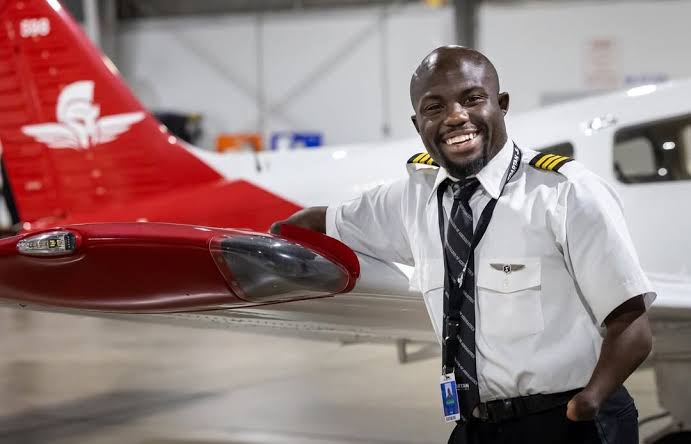
Born in Nigeria without fully formed hands or feet, Zachary “Zack” Anglin would go on to achieve something aviation authorities and training institutions had never previously encountered: qualifying as a commercial pilot and flight instructor with a quadruple limb difference.
His journey from Nigeria to a family farm in Wisconsin, and eventually to the cockpit of a training aircraft in Oklahoma, is a powerful example of what can happen when determination is supported by goal-specific prosthetic care, an inclusive educational institution and a regulatory pathway that assesses ability rather than making assumptions about disability.
Anglin is widely recognised as the world’s first licensed commercial pilot and flight instructor with a quadruple limb difference.
Growing up through adaptation
Anglin was adopted as a young child and raised in Wisconsin as part of a large family. Growing up with 18 siblings meant that participation—not exemption—became part of his everyday life.
He watched his brothers and sisters climb trees, ride horses, play games and work around the family farm. Instead of accepting that these activities were unavailable to him, he developed his own ways of joining them.
Anglin describes himself as a quadruple amputee, although his limb difference is congenital rather than the result of surgical amputation. He has said that he did not fully recognise himself as different until around the age of eight because he had been concentrating on keeping up with his siblings.
His interest in aviation also began during childhood. While travelling with his father to collect his mother from the airport, he watched aircraft taking off and landing. The idea that aeroplanes connected families across long distances gave flight a meaning that extended beyond the aircraft itself.
He decided that he wanted to become a pilot.
Rejection from flight schools and regulators
Turning that childhood ambition into a career proved extremely difficult.
Anglin applied to numerous flight schools but repeatedly encountered rejection. Aviation training demands rapid and reliable operation of flight controls, switches, pedals, radios and emergency systems. Schools struggled to imagine how a person without hands or feet could meet those requirements.
Eventually, Spartan College of Aeronautics and Technology in Tulsa, Oklahoma, agreed to assess his potential and admitted him to its flight programme.
Admission, however, was only the first barrier. Anglin also needed medical approval from the United States Federal Aviation Administration. Reports of his journey state that his application was rejected five times before he was given an opportunity to demonstrate his functional ability.
The eventual pathway involved a Statement of Demonstrated Ability, commonly known as a SODA.
Under this process, the FAA can assess a person with a static or non-progressive condition according to whether they can safely perform the required duties. The assessment can include a practical or medical flight test and may specify operating limitations where necessary.
Anglin passed the demonstration, proving that he could operate the aircraft safely.
Prosthetics designed for the cockpit
Anglin’s achievement was not simply a matter of fitting standard prosthetic limbs and entering an aircraft. His devices had to function reliably in a tightly defined and safety-critical workplace.
According to Hanger Clinic, prosthetist Scott Stromberg, CPO, worked with Anglin to custom-fit his prostheses and ensure that they performed effectively inside the cockpit.
The fitting process had to consider far more than basic standing or walking. Anglin needed to position himself securely, interact with controls, maintain contact during turbulence and manage the aircraft consistently across normal and abnormal situations.
This is an important lesson for prosthetists and orthotists. Successful prosthetic care should not be defined only by whether a person can walk across a clinic or open and close a terminal device. The real objective is participation in the activities, education and employment that matter to the individual.
For one person, that may mean returning to agricultural work. For another, it may mean handling tools, caring for children, operating machinery or competing in sport. For Anglin, it meant controlling an aircraft.
Occupational goals should therefore influence component selection, socket design, suspension, interface materials, durability and training from the beginning of the rehabilitation process.
Making history in 2019
After gaining the necessary approvals and completing his training, Anglin earned his aviation qualifications in 2019. He became a licensed commercial pilot and certified flight instructor, establishing a precedent for other aspiring pilots with limb loss or limb difference.
He later returned to Spartan College as an instructor.
Reports indicate that Anglin has since trained more than 200 aspiring pilots. His role is particularly significant because he is no longer merely the recipient of an institutional accommodation. He is now responsible for teaching, assessing and preparing other students to meet professional aviation standards.
He has also become a mentor to other people with limb differences who are considering aviation careers. Having navigated medical certification, adaptive equipment, flight training and repeated rejection, Anglin can offer practical guidance that was unavailable when he began.
A lesson for rehabilitation across IMEA
Anglin’s Nigerian origins give his story particular relevance across the IMEA region, where children with congenital limb differences may still face restricted access to surgery, prosthetic services, inclusive education and vocational opportunities.
The principal barrier is not always the physical condition itself. It may be an institution that automatically rejects an application, a regulatory system without an individual assessment process, or a rehabilitation plan that aims only for basic independence rather than education and employment.
Anglin’s journey required several elements to come together:
- A family that expected participation and independence
- A college prepared to evaluate his ability
- A prosthetist willing to design around a demanding occupational goal
- A regulator with a route for demonstrating functional competence
- Training and persistence from Anglin himself
His achievement should not be reduced to a story of personal determination alone. Persistence mattered enormously, but so did professional skill, adaptive technology and institutions that eventually provided a fair opportunity.
Inclusive rehabilitation succeeds when the question changes from “Can a person with this disability do the job?” to “What abilities must be demonstrated, and what adaptations will allow a fair assessment?”
Today, Anglin is not simply flying aircraft. He is teaching others to fly and helping create a pathway for those who follow him.
As he has expressed it: “The word impossible is an illusion behind the word possible.”
- Zack Anglin’s story – Hanger Clinic
- Spartan College of Aeronautics and Technology
- FAA Statement of Demonstrated Ability guidance
- Federal Aviation Administration
- Rising Africa: Commercial pilot with no hands or feet
- Zachary Anglin: The Amputee Pilot Who Rewrote Possibility