

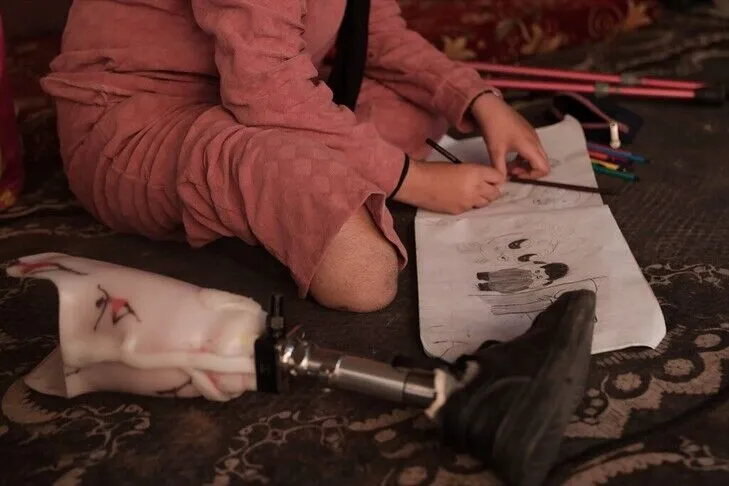
Four-year-old Jamalat Dabban spends her days inside a displacement tent in Gaza, waiting for a prosthetic leg that could help her stand, walk and play with other children again.
Jamalat’s journey highlights the urgent need for gaza prosthetics for children affected by conflict.
Every day, she dreams about gaza prosthetics that will help her play freely in her surroundings.
Her story is a reminder of the critical importance of gaza prosthetics for children facing similar hardships.
Jamalat dreams of receiving gaza prosthetics that would allow her to regain her independence and enjoy childhood activities.
This hope for gaza prosthetics fuels her determination to overcome daily challenges.
As she navigates her environment, the need for gaza prosthetics is ever-present in her mind.
Jamalat lost her left leg following an Israeli attack on a neighbouring tent on 11 May 2026, according to an Anadolu Agency report. Her family had already been displaced from Beit Lahia in northern Gaza and was living in the tent when the attack occurred.
Her mother, Rasha, and her brother were also injured, but Jamalat’s injuries were so severe that doctors had to amputate her leg.
The situation emphasizes the urgent demand for gaza prosthetics in the region.
Understanding the importance of gaza prosthetics can foster more support for affected families.
Advocacy for gaza prosthetics can lead to significant improvements in the lives of children like Jamalat.
Increasing awareness about the need for gaza prosthetics is crucial for recovery efforts.
The hope for gaza prosthetics gives her strength as she faces each day with courage and resilience.
Now living on sandy ground, the young girl moves around using her hands and occasionally tries to pull herself upright by holding one of the tent poles. She depends on her mother for many everyday activities and is unable to run or play as she did before her injury.
Rasha told Anadolu that her daughter looks at photographs taken before the amputation and asks for her leg to be returned so that she can play with her brother.
Her story illustrates the physical and psychological consequences of childhood limb loss, while also highlighting the enormous pressure facing Gaza’s depleted prosthetic and rehabilitation services.
More than 6,000 amputations reported
The Importance of gaza prosthetics for Children
Gaza’s Prosthetics and Paralysis Rehabilitation Center told Anadolu that more than 6,000 amputations had been recorded through a health-information system developed with the International Committee of the Red Cross.
Hosni Muhanna, the centre’s media and public-relations officer, said children represent approximately 25% of its beneficiaries. He warned that restrictions on the entry of materials, equipment and components were limiting local prosthetic production and increasing waiting times.
The centre has reportedly experienced shortages of even basic fabrication materials, including plaster used during traditional casting and manufacturing processes.
Separate figures published by the United Nations earlier in 2026 described a similarly severe situation. A February OCHA humanitarian-response report stated that cumulative amputations since October 2023 had exceeded 5,000, with a further 496 amputations reported following the October 2025 ceasefire.
OCHA said only 300 artificial limbs had entered Gaza through the Health Cluster framework during that period. The agency also reported that prostheses and other assistive products continued to face restrictions as items classified as “dual use.”
The figures should not be treated as directly interchangeable because they refer to different reporting periods, patient groups and data systems. They nevertheless demonstrate a wide gap between the number of people requiring support and the number of prosthetic devices reaching Gaza.
Childhood limb loss requires continuing care
For a four-year-old, receiving an initial prosthesis is only one stage of a much longer rehabilitation process.
Children grow rapidly, and their sockets and other prosthetic components must be reviewed and replaced regularly. Changes in height, body weight, residual-limb shape and activity can affect comfort, alignment and safety.
A child such as Jamalat would ordinarily require access to coordinated services including:
- Residual-limb and wound assessment
- Age-appropriate prosthetic prescription
- Socket fitting and alignment
- Physiotherapy and gait training
- Occupational therapy where required
- Psychological and family support
- Regular adjustment and replacement as the child grows
- Monitoring of the sound limb, posture and musculoskeletal development
These requirements become considerably more difficult in an environment affected by displacement, damaged healthcare infrastructure, material shortages and disrupted follow-up.
Walking on sand and uneven ground also presents different demands from walking inside a clinic. Prosthetic rehabilitation must consider the child’s actual surroundings, access to footwear, ability to keep the residual limb and socket clean, and whether the family can return for adjustments.
Nutrition and general health are also relevant to wound healing, strength and rehabilitation. A prosthetic limb cannot deliver its intended benefit without the clinical services and living conditions needed to support its use.
Rehabilitation services under pressure
For many, access to gaza prosthetics is a vital part of their rehabilitation journey.
Support for local efforts to produce gaza prosthetics can alleviate some of the burden.
Innovative solutions for producing gaza prosthetics are essential for long-term support.
Developing resources for gaza prosthetics can significantly impact children’s futures.
The World Health Organization’s 2026 emergency appeal reported more than 5,000 amputations and said the scale of life-changing injuries was placing exceptional pressure on surgical and rehabilitation services.
WHO also reported that Gaza’s health system had been severely degraded, with only around half of its hospitals partially functioning at the beginning of 2026. Restrictions and lengthy clearance procedures continued to delay the delivery of essential medical supplies and equipment.
Within this environment, Gaza’s prosthetists, orthotists, physiotherapists and rehabilitation teams face the challenge of serving thousands of people while working with limited materials, damaged infrastructure and uncertain supply chains.
International assistance therefore needs to extend beyond donations of finished limbs. Sustainable support must include prosthetic components, fabrication materials, workshop equipment, repair tools, rehabilitation supplies and technical assistance for local professionals.
Device donations must also be coordinated with clinicians inside Gaza. Prostheses require individual assessment and fitting; they are not standard products that can be distributed according to age or amputation level alone.
A child’s wish to play again
For Jamalat, the immediate ambition is simple: to walk, run and play again.
Achieving that goal requires safe access to a suitably prescribed prosthesis, but also physiotherapy, psychological support, stable follow-up and replacement devices throughout childhood.
Her experience represents one family’s loss, but it also draws attention to thousands of people in Gaza requiring lifelong rehabilitation. Meeting that need will depend on reliable humanitarian access, restoration of local services and sustained support for the Palestinian professionals continuing to provide care.
- Anadolu Agency: Four-year-old Gazan girl waits for a prosthetic leg
- OCHA: Gaza Humanitarian Response Situation Report No. 69
- WHO: 2026 Health Emergency Appeal for the occupied Palestinian territory
- UNICEF: Gaza Child-Focused Assessment Report