

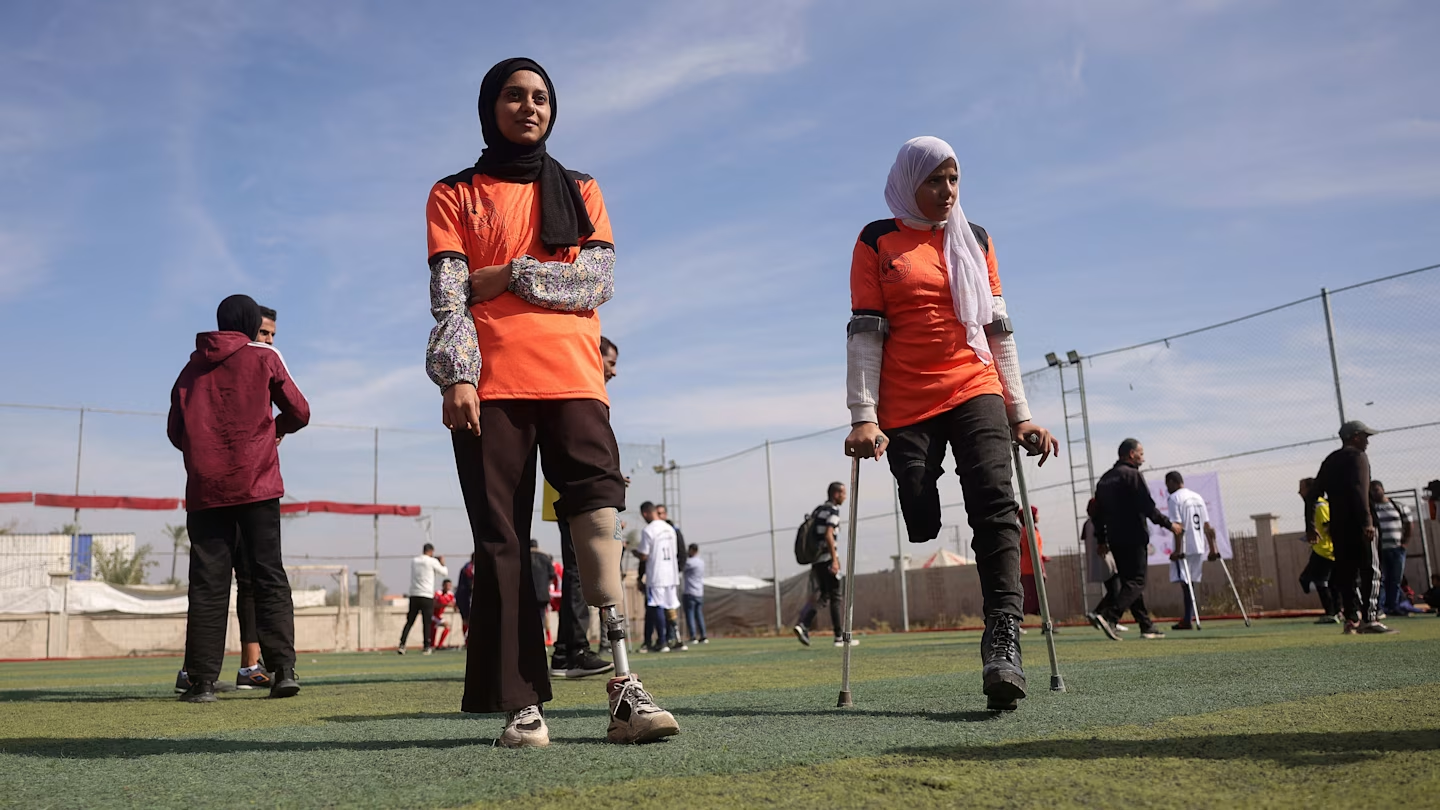
When Rozan Khera woke to explosions at her family home in Gaza City, she repeatedly tried to stand but fell to the floor. It was only after crawling towards the door that she realised her left leg had been severed.
The 24-year-old had been a committed runner before her injury. Her father, a football coach, lost both feet in the same attack, while her eight-year-old niece lost a hand in a separate strike on the family home that killed 23 relatives.
Khera has since found a way to return to physical activity and process some of her trauma through the Palestine Amputee Football Association, where she participates in Gaza amputee football.
“If I accept myself then others will accept me,” she told the Financial Times.
Her ambition is to obtain a running prosthesis, compete in the Paralympics and eventually establish a specialist centre for people with disabilities alongside her father.
Through her journey, she hopes to inspire others and bring awareness to the importance of Gaza amputee football in promoting resilience and recovery.
Football as physical and social rehabilitation
The Palestine Amputee Football Association was established in 2018 to support people who had experienced limb loss during earlier conflicts.
Its activities were interrupted after October 2023 but resumed in December 2024, while attacks and mass displacement were continuing. The organisation now operates three training centres in Gaza and reportedly supports approximately 180 players.
Fouad Abu Ghalyoun, the association’s president, describes its role as restoring confidence and giving participants temporary relief from the pressures of displacement, disability and daily survival.
Transport to training is sometimes provided using donkey-drawn carts travelling through streets obstructed by rubble. Many football grounds have been destroyed or converted into displacement sites, leaving the association with few suitable places to play.
Despite these barriers, the programme conducts weekly youth activities and several sessions for children.
Amputee football is normally played by outfield players with lower-limb absence using forearm crutches, while goalkeepers generally have upper-limb absence. This creates opportunities for many people with unilateral limb loss, but it cannot accommodate every pattern of injury.
People with bilateral or multiple-limb loss may require different adapted sporting formats, equipment and levels of support. Dr Ahmed Musa, director of the International Committee of the Red Cross’s physical rehabilitation programme in Gaza, told the FT that multiple-limb loss represents a substantial proportion of the injuries his team encounters.
Shortage of appropriate sporting equipment
Even the crutches required for football are difficult to obtain.
PAFA has received some crutches through aid organisations, but Abu Ghalyoun said they are not necessarily designed to withstand the lateral loading, repeated impacts and rapid movement associated with sport.
Everyday walking aids can bend, fracture or lose their tips when used intensively on a football pitch. Adaptive-sport programmes therefore require properly selected equipment, maintenance capacity and replacement parts—not simply any available mobility aid.
Players may also need clinical assessment, strength and balance preparation, skin monitoring and advice on protecting the sound limb. Access to sport should complement, rather than replace, prosthetic rehabilitation and continuing clinical care.
The value of the programme nevertheless extends beyond exercise. Training brings together people with shared experiences, creates peer support and enables participants to see themselves as athletes rather than only as patients or recipients of aid.
More than 5,000 amputations
The World Health Organization has reported more than 5,000 amputations in Gaza since October 2023. Its 2026 Health Emergency Appeal estimated that approximately 25% of more than 171,000 injured people had sustained life-changing injuries.
Figures cited by the Financial Times indicate that at least one-fifth of those who have undergone amputations are children. The United Nations has described Gaza as having the world’s highest number of child amputees relative to its population.
These figures represent a long-term rehabilitation requirement extending well beyond emergency surgery. Children require new sockets and components as they grow, while adults may need repeated adjustments, replacement devices and treatment for associated injuries.
In February 2026, OCHA reported that only 300 artificial limbs had entered Gaza through the UN-coordinated Health Cluster framework, despite thousands of recorded amputations.
Prosthetic production threatened by material shortages
Gaza’s remaining prosthetic services are struggling to obtain the materials required for local fabrication.
Musa said the ICRC programme was running out of plaster of Paris. In conventional P&O workflows, plaster is used for casting, producing positive models and shaping sockets or orthoses. Restrictions on its entry because of its potential construction uses have therefore directly affected clinical production.
The Qatar-funded Sheikh Hamad Hospital for Rehabilitation and Artificial Limbs has reportedly exhausted its pre-conflict material stocks and has a waiting list of around 600 people.
A programme involving advanced upper-limb prostheses was also suspended after supplies stopped entering Gaza.
The absence of materials means people may remain dependent on wheelchairs or crutches even after their wounds have healed and they are clinically ready to begin prosthetic rehabilitation.
Seventeen-year-old Jihad Rajeh, who lost a foot in an air strike, was medically evacuated to northern Sinai in Egypt after months of waiting. While he believed a prosthesis could eventually address his lower-limb loss, severe injuries to both hands created a more urgent risk of further amputation.
His case illustrates the complexity of rehabilitation following blast trauma. Many patients require treatment for multiple injuries rather than an isolated prosthetic prescription.
Could digital fabrication provide another route?
Ahmed al-Absi, head of the prosthetics department at Sheikh Hamad Hospital, said his team was investigating whether patients could be scanned in Gaza and their devices manufactured in Egypt.
This type of distributed digital workflow could reduce dependence on some stages of traditional plaster-based production. A three-dimensional scan could be transferred electronically for socket design and fabrication outside Gaza, with the finished device subsequently returned.
However, the approach would still require trained clinicians inside Gaza to assess the patient, confirm that the residual limb is ready, review the design, fit and align the prosthesis and undertake adjustments.
Digital production also depends on reliable communications, compatible software, quality control and an agreed process for responding when a socket does not fit. It would not eliminate the need for local rehabilitation expertise or access to prosthetic components.
Keeping a sporting ambition alive
For Khera, football provides a connection to the athletic identity she had before her injury and a pathway towards future ambitions.
Her objective is not limited to receiving an everyday prosthesis. She wants to run again, participate in competitive sport and help create services for other people with disabilities.
The Palestine Amputee Football Association is keeping such ambitions visible under exceptionally difficult conditions. Its work demonstrates how adaptive sport can contribute to confidence, peer support and social participation.
But football alone cannot resolve Gaza’s rehabilitation crisis. Players and other people with limb loss require suitable prostheses, appropriate crutches, physiotherapy, psychosocial care and dependable lifelong follow-up.
Restoring those services will require the consistent entry of fabrication materials and medical equipment, support for Gaza’s rehabilitation professionals and investment in both conventional and digital production pathways.
- Financial Times: The Gazan Amputees Turning to Football
- WHO: 2026 Health Emergency Appeal for the Occupied Palestinian Territory
- OCHA: Gaza Humanitarian Response Situation Report No. 69
- ICRC: Gaza Physical Rehabilitation and Recovery
- The Korea Times: Palestinian Amputee Footballers Seek a Global Stage