

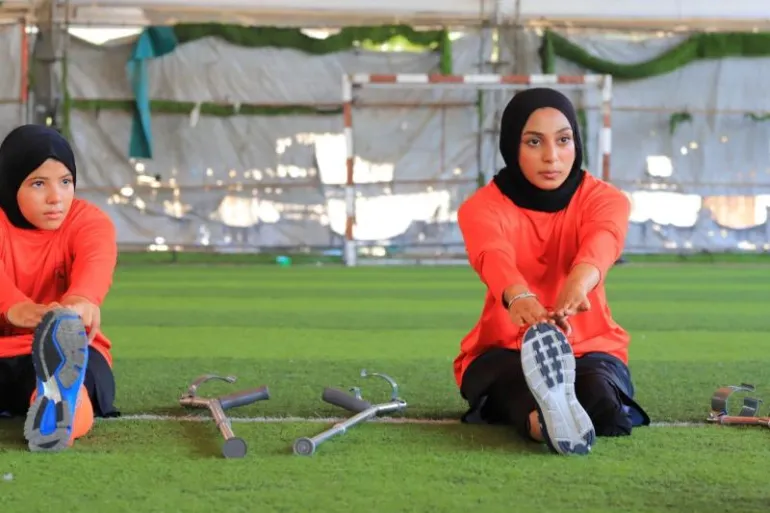
For 24-year-old Palestinian athlete Shurouq Khaira, running was once central to her identity. She had won a national youth title and hoped to represent Palestine internationally.
That future changed in November 2023 when an attack on her family’s home in Gaza City caused injuries that required a right transtibial amputation. Her father underwent bilateral lower-limb amputations following the same attack.
Almost three years later, Shurouq is still waiting for a prosthesis.
Her experience, documented in an Al Jazeera feature on Gaza’s amputees, demonstrates why amputation rehabilitation cannot be reduced to the eventual delivery of an artificial limb. It depends on timely surgery, wound management, rehabilitation, accessible transport, suitable accommodation, psychological support and the availability of trained prosthetic and orthotic professionals.
In Gaza, almost every part of that pathway has been disrupted.
Rehabilitation among tents, sand and rubble
Shurouq’s family now lives in a tent after losing its home. Darkness, unstable ground and the absence of accessible sanitation make ordinary activities difficult. Outside the tent, crutches are poorly suited to streets covered in sand and rubble.
Attending physiotherapy can require travelling several kilometres. With transport scarce and expensive, Shurouq sometimes attempts the journey on one leg, only to arrive too late for her appointment.
The built environment creates similar barriers for wheelchair users. Eighteen-year-old Shireen Abu al-Qumsan, who underwent bilateral lower-limb amputations after being injured in May 2025, told Al Jazeera that damaged roads make independent wheelchair mobility extremely difficult. She continues to wait for prostheses and for permission to receive treatment outside Gaza.
These are not secondary inconveniences. Repeated falls, missed rehabilitation appointments and prolonged immobility can contribute to contractures, muscle weakness, pressure injuries, pain and declining independence.
More than 5,000 amputations estimated
The scale of need is extraordinary. The Gaza Ministry of Health has reported approximately 6,000 amputations since October 2023. A World Health Organization technical assessment published in May 2026 estimated that more than 5,000 limb amputations had occurred, with children representing around one in five cases.
WHO estimated that 43,011 people were living with potentially life-changing conflict-related injuries, including amputations, spinal cord injuries, traumatic brain injuries, major burns and severe extremity injuries.
Among 2,277 amputees evaluated between September 2024 and May 2026, only 502 had been fitted with prostheses. Seventy-six percent of the recorded amputations involved lower limbs, while 225 people required revision surgery to prepare or improve their residual limbs.
Only eight prosthetists were reported to be working within Gaza.
This imbalance between clinical need and professional capacity means that even the arrival of additional prosthetic components would not immediately resolve the waiting list. Assessment, casting or scanning, socket fabrication, alignment, gait training, adjustment and long-term follow-up all require skilled personnel and functioning facilities.
Essential materials remain difficult to obtain
Prosthetic production has also been affected by restrictions on materials entering Gaza. Items reportedly affected include thermoplastics, silicone, plaster products and mechanical joints—basic materials used in sockets, liners, orthoses and prosthetic assemblies.
According to WHO, no rehabilitation equipment intended for facilities entered Gaza between May 2024 and April 14, 2026. Pending shipments of assistive products had waited an average of 136 days, while one consignment had reportedly remained unresolved for 526 days.
An August 2026 humanitarian report from the UN Office for the Coordination of Humanitarian Affairs confirmed that the entry of rehabilitation equipment, supplies and assistive products continued to face significant constraints.
Clinicians have attempted to respond by creating temporary crutches and improvised mobility devices from plastic pipes, wood and recovered aluminium. Such ingenuity may provide immediate mobility, but improvised prostheses cannot replace clinically prescribed devices made to the individual’s anatomy, weight, activity level and environment.
Poor socket fit can cause friction, swelling, skin breakdown and ulceration. In a setting where wound care and revision surgery are already difficult to access, these complications can stop a person from using a limb and create further risks of infection or hospitalisation.
Rehabilitation delays have lasting consequences
Prolonged waits also affect the eventual success of prosthetic fitting. Without early rehabilitation, patients can develop joint stiffness, muscle atrophy, reduced range of movement and poor balance.
The psychological consequences are equally important. Young survivors must adjust to limb loss while also experiencing bereavement, displacement, insecurity and the destruction of their homes, schools and communities. Comprehensive care therefore requires physical rehabilitation alongside psychological and social support.
WHO reported that no rehabilitation facility in Gaza was fully functional as of April 2026. More than 400 patients were waiting for specialist rehabilitation beds, while 50 rehabilitation professionals had reportedly been killed since October 2023.
Prostheses must be part of a complete pathway
Gaza urgently needs prosthetic components, wheelchairs, crutches and rehabilitation equipment—but products alone are insufficient.
The response must also protect and expand the local rehabilitation workforce, restore workshops, facilitate specialist training and establish reliable systems for patient assessment, referral and follow-up. Paediatric amputees will require repeated socket replacement and component changes as they grow, turning today’s emergency into a long-term service obligation.
For Shurouq, receiving a suitable prosthesis could mean more than walking again. With specialist rehabilitation and access to an appropriate running prosthesis, it could offer a route back to sport and to an identity interrupted by war.
The objective should not simply be to count how many limbs are distributed. It should be to rebuild sustainable rehabilitation services that allow each person to recover mobility, independence and the possibility of pursuing a future.
- Al Jazeera: Gaza amputees struggle under blockade and rubble
- WHO: Estimating Trauma Rehabilitation Needs in Gaza – May 2026
- OCHA: Humanitarian Situation Report – 14 August 2026
- International Committee of the Red Cross – Israel and the occupied territories