

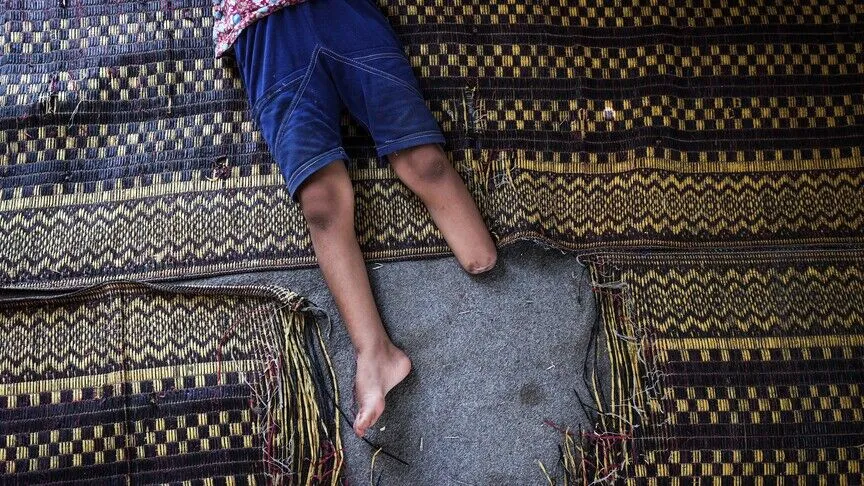
An Adidas campaign intended to promote more inclusive footwear has generated criticism from Palestinian amputees, who say the initiative presents a stark contrast with the severe shortage of prosthetic limbs, components and rehabilitation services in Gaza.
The local Israeli campaign featured Shalev Biton, an athlete and former Israeli soldier who lost his left leg during the May 2021 Israel–Gaza conflict. Biton appeared as part of a promotion for Adidas’s Single Shoe service, which allows people who need only one shoe—including some amputees and people with limb differences—to purchase one rather than paying for a complete pair.
According to Anadolu Agency, Palestinians with amputations have questioned the decision to feature a former Israeli soldier at a time when thousands of people injured during the war in Gaza remain unable to obtain appropriate prosthetic care.
Adidas subsequently apologised for the distress caused and said the promotion had been organised locally rather than as part of a global campaign.
An inclusive service enters a deeply unequal context
The Single Shoe concept addresses a genuine and frequently overlooked problem. Many unilateral amputees use only one conventional shoe on their sound foot but are still required to purchase footwear in pairs.
According to a report by Gulf News, the service was launched across 23 European countries and enables eligible customers to buy a single shoe for half the price of a pair. Adidas reportedly intends to expand it into further markets in Europe, Asia and the Middle East.
Biton was one of 11 athletes with disabilities featured in the Israeli initiative. Following extensive rehabilitation, he returned to running with a prosthetic limb.
The accessibility principle behind the service has not been the main focus of criticism. Instead, the controversy concerns who was selected to represent it and the wider circumstances in which the campaign appeared.
For amputees in Gaza, images celebrating one person’s recovery and access to adaptive footwear were viewed alongside their own experiences of damaged hospitals, exhausted prosthetic supplies, delayed humanitarian shipments and limited access to surgery and rehabilitation.
Palestinian amputees describe unmet needs
Anadolu interviewed several Palestinians who had lost limbs during Israeli attacks.
Fourteen-year-old Omar Haliwa reportedly lost a leg while collecting water. He told the news agency that repeated efforts to obtain an appropriate prosthesis had been affected by shortages of raw materials at Gaza’s prosthetic centres.
Kifah al-Fakhouri, who lost a leg in an attack on a Gaza City café, said locally available prostheses could be too heavy or unsuitable for daily use. She called for access to modern joints, replacement components and devices capable of supporting greater independence.
Ahmed Jawadi al-Balawi told Anadolu that his prosthesis had worn out and required maintenance. His experience highlights an important reality familiar to prosthetists and orthotists: providing an initial device is only one stage of care.
A prosthetic limb requires clinical assessment, appropriate component selection, socket management, gait training, maintenance and eventual replacement. These needs become even more urgent in an environment characterised by damaged roads, rubble, displacement and limited access to transport.
WHO documents severe rehabilitation constraints
Figures reported by different organisations vary because assessments have been conducted at different times and with incomplete access to patients.
Gaza’s Health Ministry told Anadolu that more than 8,000 Palestinians had lost limbs during the war, including more than 3,000 children. A May 2026 technical report from the World Health Organization provides a more conservative estimate of over 5,000 amputations since October 2023 and says approximately one in five amputees is a child.
WHO estimated that 43,011 people—around 2% of Gaza’s pre-conflict population—were living with potentially life-changing injuries as of April 2026.
Among 2,277 amputees evaluated between September 2024 and May 2026, only 502 had been fitted with prostheses. WHO identified just eight prosthetists working in Gaza at the time of reporting.
The organisation also found that no rehabilitation facilities were fully functional and that all were operating under serious staffing, equipment or supply constraints. Eighteen shipments containing assistive products were pending as of April 2026, with an average waiting time of 136 days. The items awaiting entry included prosthetic limbs, wheelchairs and rehabilitation equipment.
These figures help explain why an apparently positive disability-inclusion campaign generated such a strong response.
Adidas apologises following backlash
After the campaign spread online and prompted boycott calls, Adidas acknowledged that an image used in the local initiative had caused concern and strong reactions.
The company said it had not intended to cause offence, apologised to those affected and described the promotion as a local activation rather than a global campaign. It also said it would continue listening and working to ensure that its actions reflected its stated commitment to inclusion.
Reports also described online abuse directed towards Biton following the controversy. Criticism of a company’s campaign or choice of representative should not become harassment of an individual with a disability.
The episode nevertheless demonstrates why disability marketing cannot be separated from context. Representation is not only about including a person with limb loss in an advertisement. Organisations must also consider whose experience is being highlighted, whose remains invisible and how a campaign may be understood by communities directly affected by conflict.
An opportunity for meaningful action
Adidas’s Single Shoe service could offer practical value to amputees if it becomes widely and equitably available. The controversy also creates an opportunity for the company and other international brands to move beyond statements of inclusion.
Potential action could include:
- Extending single-shoe access to Palestinian and humanitarian markets
- Supporting suitable footwear provision for amputees
- Funding prosthetic components, workshop materials and repair programmes
- Supporting training for prosthetists, orthotists and rehabilitation professionals
- Partnering with established humanitarian and disability organisations
- Including Palestinian amputees in future consultation and programme design
- Supporting long-term rehabilitation rather than one-time product donations
Any intervention must be coordinated with clinicians and humanitarian organisations to ensure that supplies match assessed needs and can be maintained locally.
For the international P&O community, the debate is ultimately about more than one advertisement. It exposes the difference between disability visibility and genuine access.
An amputee may appear prominently in a global brand campaign while thousands of others remain without sockets, knees, feet, liners, crutches, wheelchairs or rehabilitation. Inclusive representation has value, but its credibility is strongest when accompanied by practical measures that expand access to care.
- Anadolu Agency: Gaza Amputees Challenge Adidas Over Former Israeli Soldier
- WHO: Estimating Trauma Rehabilitation Needs in Gaza—May 2026
- Gulf News: Adidas Campaign Draws Backlash and Apology
- WHO: Occupied Palestinian Territory