

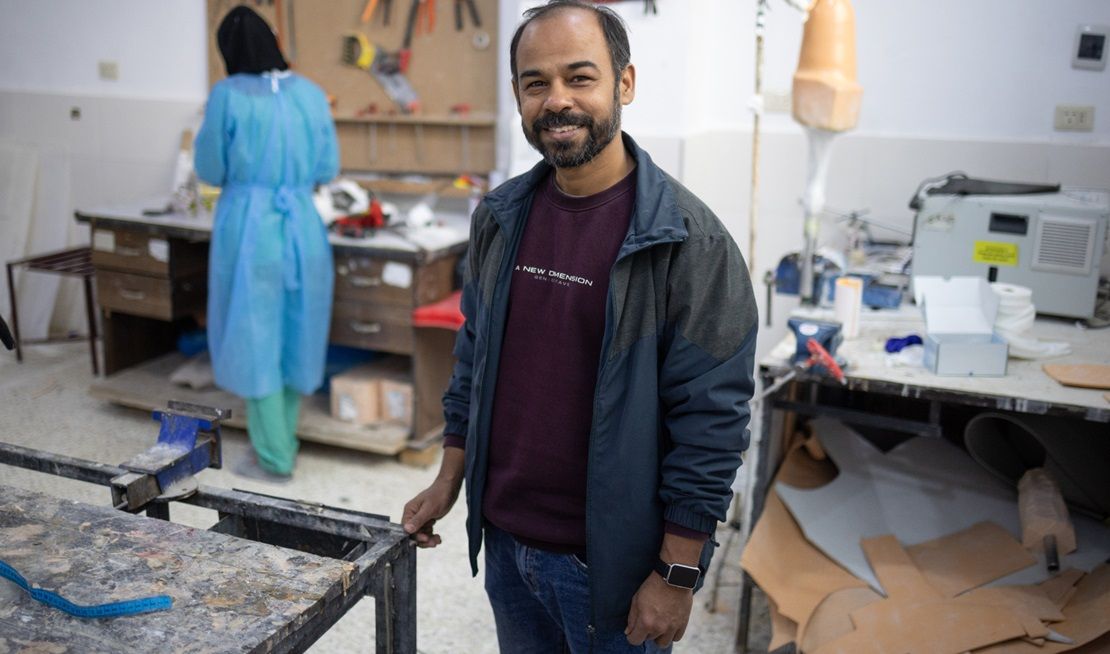
At Raqqa National Hospital in northern Syria, prosthetists and rehabilitation professionals are helping children and adults recover mobility despite complex injuries, limited technology and the continuing consequences of years of conflict.
A field account published by Humanity & Inclusion follows Yeti Niraula, a senior prosthetics and orthotics technical officer who has worked in northern Syria since January 2023. Based in Raqqa, Niraula supports patients at different stages of prosthetic provision—from initial assessment and socket fitting to gait training, alignment adjustments and final delivery.
His account provides a detailed picture of what humanitarian prosthetic care involves beyond manufacturing a device. During one working week, the team supported approximately 20 people with widely different clinical needs.
Progressing from stubbies to full-length prostheses
Among the patients was Sida, a 12-year-old girl from Deir ez-Zor who underwent bilateral lower-limb amputations at knee level following an airstrike in 2016.
Approximately 18 months before her latest appointment, Sida received short training prostheses, commonly known as stubbies. These can help a person with bilateral lower-limb absence develop balance, confidence and initial mobility while maintaining a lower centre of gravity.
During her return to Raqqa National Hospital, she was fitted with longer prostheses incorporating improved knee joints and restoring her closer to her expected height. Following a week of training, she completed a final gait session and was able to walk using the prosthetic knees with a more natural gait pattern.
The case illustrates how prosthetic rehabilitation can progress in stages. For bilateral users, moving from short prostheses to full-length devices changes balance, energy requirements and the control needed to walk safely. The components alone do not produce the outcome: structured gait training and repeated clinical review remain essential.
Clinical skill compensating for limited technology
The team also fitted 16-year-old Nazah, who was born with bilateral lower-limb deficiencies. Her prostheses required several follow-up appointments to adjust foot alignment and address pressure and pain experienced during walking.
Niraula described working with limited component and manufacturing options. In Nazah’s case, the team used a shaped wooden block to connect the socket and prosthetic foot. Obtaining the correct alignment with this type of construction was technically challenging, but the team achieved a positive walking outcome after repeated adjustments.
The case demonstrates the clinical resourcefulness frequently required in humanitarian settings. Modern components and digital manufacturing can make some processes more repeatable, but many services continue to rely on manual fabrication and the practical judgement of prosthetists and orthotists.
Access to dependable materials, modular alignment systems, workshop equipment and replacement parts could help clinicians reduce production difficulties and make future adjustment and repair easier.
Complex residual limbs require realistic goals
Several people attending the centre had highly complex residual limbs, including fixed knee flexion, adherent scarring, short residual segments and sensitive areas at the end of the limb.
For two transtibial users, the team designed prostheses using external side joints and thigh sections to provide additional stability. One was a 65-year-old man whose personal goal was relatively modest but meaningful: he wanted to move around his home.
After two weeks of training, he was able to walk on a smooth surface using one walking stick. His progress was accompanied by pressure, blistering and pain, reinforcing the need to introduce loading gradually and to inspect the skin carefully.
The patient subsequently experienced socket looseness as his residual-limb volume reduced. Although an additional prosthetic sock was initially used to improve the fit, the team ultimately decided to recast the socket before delivering the definitive prosthesis.
Residual-limb volume change is common among first-time prosthetic users. In Raqqa, however, an additional appointment is not simply a clinical inconvenience. It can create further transport, accommodation and subsistence costs for patients already travelling long distances.
Distance remains a barrier to successful rehabilitation
One patient travelled from Kobani for prosthetic training. When pain and a blister required the session to be stopped, the distance from home made arranging continued care more difficult.
Niraula suggested that temporary accommodation near the hospital could enable people travelling from other areas to complete their training without repeated journeys. In its absence, rehabilitation programmes may be shortened or interrupted, even when further clinical sessions would be beneficial.
This highlights an important lesson for humanitarian prosthetic services: access cannot be measured solely by the number of devices delivered. Transport, accommodation, repairs and the ability to return for adjustment all influence whether a prosthesis is ultimately used.
Pain also needs comprehensive assessment. One long-term user returned with severe residual-limb pain and had stopped using a prosthesis supplied in 2019. The team continued pain-management sessions. Such cases may require investigation of socket fit, skin condition, neuroma, musculoskeletal loading, phantom-limb pain and psychosocial factors rather than assuming a single cause.
Rehabilitation needs remain extensive
Humanity & Inclusion’s Syria programme provides rehabilitation services and prosthetic and orthotic care through local medical facilities in areas including Raqqa, Deir ez-Zor, Aleppo, Homs and Rural Damascus.
The organisation reports that approximately 15.6 million people in Syria require humanitarian assistance and more than 5.5 million remain internally displaced. Damaged infrastructure, economic hardship, insecurity and explosive-ordnance contamination continue to restrict access to health and rehabilitation services.
The work in Raqqa demonstrates what prosthetic rehabilitation looks like under these conditions: careful assessment, repeated socket modification, pain management, gait training and realistic goals delivered despite shortages and significant access barriers.
- Humanity & Inclusion: Prosthetic Rehabilitation in Raqqa
- Humanity & Inclusion’s Work in Syria
- Humanity & Inclusion: Rehabilitation Programmes
- UN OCHA: Syria 2026 Humanitarian Needs and Response Plan
- WHO: Access to Assistive Technology and Rehabilitation in Humanitarian Crises