

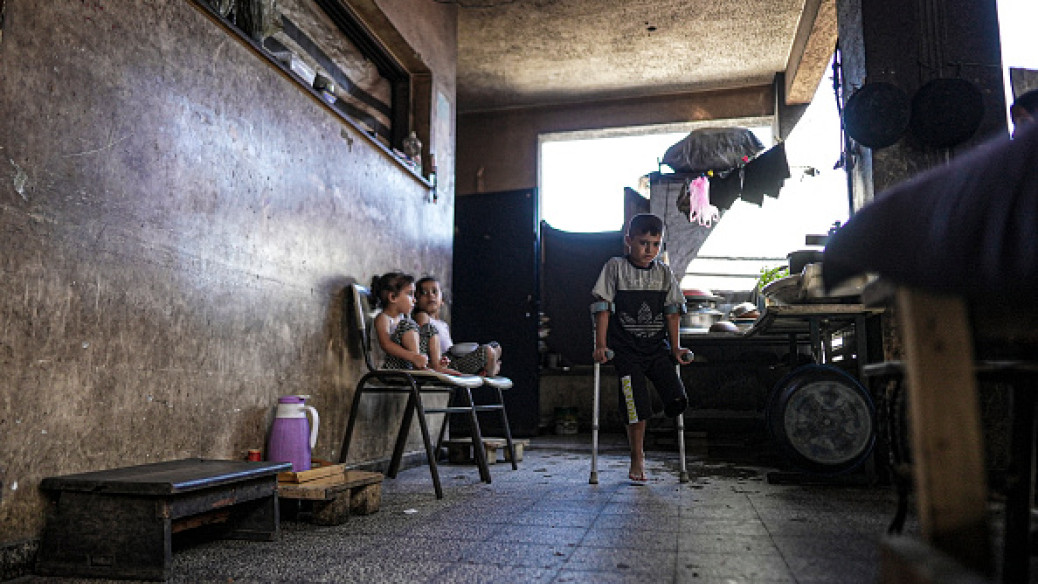
More than 900 wheelchairs donated for injured children in Gaza have reportedly remained in warehouses in Jordan for over a year, despite the growing need for paediatric mobility devices and rehabilitation support.
The wheelchairs were supplied by the Australian organisations Kids on Wheels Alliance and Wheelchairs for Kids. Two consignments arrived in Jordan in February 2025, followed by another shipment in October 2025.
According to reporting by The New Arab and ABC News Australia, the devices are being held at facilities operated by the Jordan Hashemite Charity Organisation, which coordinates humanitarian assistance entering Gaza through Jordan.
The charity organisation says an application to transport the first shipment was initially rejected and later remained pending. An Israeli government source disputed that an application had been rejected, while the Israeli authority responsible for coordinating aid access, COGAT, told ABC that thousands of wheelchairs had entered Gaza without quantitative restrictions.
COGAT did not, however, provide a specific explanation for the continued delay affecting these particular consignments.
The conflicting accounts leave hundreds of donated mobility devices outside Gaza while rehabilitation services inside the territory face an extreme mismatch between clinical need and available resources.
The wheelchairs were designed for difficult environments
The donated wheelchairs are not standard hospital transport chairs. Wheelchairs for Kids manufactures adjustable devices intended for children living in environments where roads, pavements and conventional accessibility infrastructure may be limited.
Their design includes features intended to improve stability on uneven ground. The chairs can also be adjusted as a child grows, potentially extending their useful life when regular replacement is difficult.
These characteristics are particularly relevant in Gaza. Extensive damage to roads, buildings and public infrastructure has created an environment in which wheelchair users may need to navigate rubble, sand, damaged entrances and crowded temporary shelters.
A fragile or poorly configured wheelchair can quickly become unusable under these conditions. Tyres, bearings, foot supports, cushions and frames may require frequent inspection and repair.
A suitable chair can support mobility, positioning and participation, but only when it is correctly selected, fitted and maintained.
Gaza’s rehabilitation needs extend far beyond prosthetic limbs
The wheelchair delay comes amid a much broader rehabilitation crisis.
In its May 2026 report, Estimating Trauma Rehabilitation Needs in Gaza, the World Health Organization estimated that approximately 43,000 people had sustained potentially life-changing injuries. Up to one quarter were believed to be children.
The report estimated that more than 5,000 people had undergone amputations, with children accounting for approximately one in five amputees.
WHO also calculated that around 32,835 mobility products were required as of December 2025. These included wheelchairs, crutches, walking frames and canes. Only about one third of the estimated requirement had been supported at that point.
Between September 2024 and May 2026, approximately 2,277 people with amputations were evaluated, but only 502 had received prosthetic devices. Just eight prosthetists were reportedly working in Gaza, illustrating the enormous pressure on the remaining P&O workforce.
IMEA CPO has previously examined the consequences of this shortage in its report on Gaza’s child amputees and the lack of appropriate prosthetic care.
Wheelchairs and prostheses perform complementary roles
For children with amputations, receiving a wheelchair does not mean abandoning the goal of prosthetic rehabilitation.
Wheelchairs and prostheses frequently perform complementary roles within the same rehabilitation pathway. A child may require a wheelchair while wounds heal, before a prosthesis can be fitted or during periods when a residual limb is painful or swollen.
Children may also need wheelchair mobility when:
- A prosthesis has been outgrown or damaged
- Skin breakdown prevents safe socket use
- Further surgery is required
- Long distances would cause excessive fatigue
- Malnutrition or illness reduces physical endurance
- The environment is unsafe for prosthetic walking
- The child has additional injuries affecting balance or strength
A wheelchair can therefore protect the residual limb, conserve energy and allow continued access to school, healthcare and family activities.
For children with spinal-cord injuries, traumatic brain injuries, multiple fractures or bilateral limb loss, a wheelchair may be their primary means of mobility rather than a temporary intervention.
The clinical question should not be whether a child receives a wheelchair or a prosthesis. It should be which combination of mobility devices, therapy and environmental support provides the safest route to participation.
Delivery alone is not enough
Getting the wheelchairs into Gaza would be an important first step, but distributing them without assessment and follow-up could create additional problems.
Paediatric wheelchair provision should consider seat width and depth, pelvic stability, foot support, posture, pressure distribution, propulsion ability and the child’s home and school environments. Children with weak trunk control may require customised seating or additional support.
An incorrectly sized chair can contribute to pain, poor posture, pressure injuries and reduced independence. A chair that is too wide may be difficult to propel, while one that is too narrow can create harmful pressure and become unusable as the child grows.
Provision should therefore include:
- Individual assessment and prescription
- Appropriate seating and pressure-relieving cushions
- Adjustment by trained rehabilitation personnel
- Mobility and transfer training
- Education for parents and caregivers
- Access to spare parts and repair services
- Regular review as the child grows or their condition changes
Local repair capacity is especially important. An OCHA-supported rehabilitation initiative in Gaza has demonstrated how mobile workshops, locally fabricated components and 3D printing can help repair or adapt damaged assistive products when conventional supply chains are disrupted.
Delays affect the entire rehabilitation supply chain
WHO reported that no rehabilitation equipment entered Gaza between May 2024 and 14 April 2026. By April 2026, four assistive-product shipments had reportedly been rejected and 18 remained pending.
The average waiting time for pending shipments was 136 days, while one shipment had been delayed for 526 days.
These delays affect more than complete wheelchairs or prosthetic limbs. Rehabilitation services depend on a continuous supply of cushions, tyres, tubes, bearings, crutches, walking-frame components, socket materials, liners, joints, fasteners and workshop tools.
Without spare parts, a donated wheelchair may become unusable after a minor mechanical failure. Without prosthetic materials and components, clinicians cannot convert assessments into completed fittings.
The result is a cycle in which patients are identified, evaluated and placed on waiting lists, but local teams lack the equipment or materials needed to complete treatment.
Children require continuity, not one-time donations
The UNICEF disability situation assessment for the State of Palestine describes the near-total disruption of rehabilitation, healthcare, education and protection services affecting children and young people with disabilities in Gaza.
For injured children, this disruption will have lifelong consequences.
A child who receives a wheelchair today will require adjustments as they grow. A child fitted with a prosthesis will need replacement sockets, new components, therapy and regular clinical review. Some will require revision surgery, pain management, psychological care and support returning to school.
International donations can help address immediate shortages, but sustainable outcomes depend on strengthening Palestinian rehabilitation professionals, clinical services and repair workshops.
Transparent and predictable humanitarian approval processes are also essential. When a shipment is delayed, organisations need a clear explanation, an appeal mechanism and a realistic route for resolving technical or security concerns.
The immediate priority should be to determine why these wheelchairs remain in Jordan and establish a safe route for their delivery. That process should be accompanied by coordinated assessment, fitting, training and follow-up inside Gaza.
For hundreds of children, a wheelchair is not simply a donated object. It can be the difference between remaining confined to a shelter and being able to reach healthcare, return to learning or participate in family and community life.
- The New Arab – More than 900 wheelchairs remain outside Gaza
- ABC News Australia – Donated wheelchairs remain in Jordan
- WHO – Estimating Trauma Rehabilitation Needs in Gaza
- UNICEF – Disability Situation Assessment for the State of Palestine
- OCHA – Tailored assistive-product solutions for children in Gaza
- Wheelchairs for Kids
- IMEA CPO – Gaza’s Child Amputees Face a Critical Shortage of Prosthetic Care
- IMEA CPO – Gaza Faces a Prosthetic Workforce Crisis