

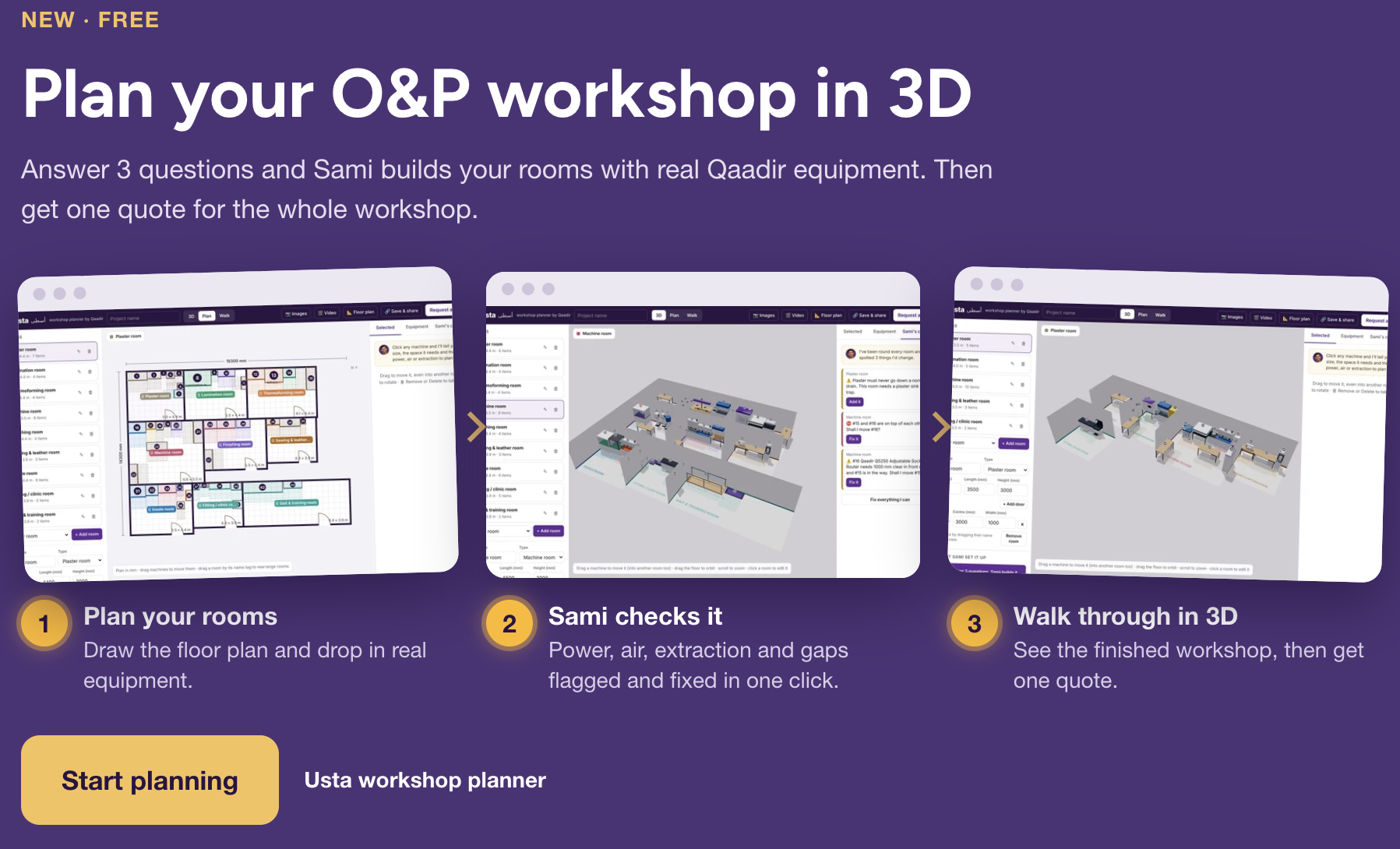
Qaadir, the Ras Al Khaimah-based supplier of orthotic, prosthetic and rehabilitation equipment, has launched Usta, a free browser-based tool that lets O&P services plan a workshop room by room in 3D. The name comes from usta (أسطى), the word used in workshops from Egypt to Iraq for a master craftsman.
The tool runs on Qaadir’s website and needs no download or sign-up. Users answer three questions, covering what the workshop will make, how many technicians it will employ and roughly how much floor space is available, and Usta generates a starting layout. A virtual guide called Sami, presented as an AI character, leads users through the process.
What the planner does
Usta covers the rooms of a typical O&P department: plaster, lamination, thermoforming, machine, finishing, sewing, insole, fitting and gait rooms. Equipment from Qaadir’s catalogue is placed at its listed footprint, with a typical size used where a manufacturer specification is not yet available.
The planner checks each layout for common problems. It flags machines that block doors, equipment placed in another machine’s working space, rooms with grinders but no dust extraction, lamination areas without fume extraction, and plaster rooms without a plaster trap. Users can export rendered images, a walkthrough video and a dimensioned floor plan with an equipment list, and request a quote for the whole layout.
The interface is in English at launch. Qaadir says Arabic, French, Urdu and Hindi versions of its launch material will follow.
IMEA CPO Perspective
Workshop layout is one of the least discussed decisions in O&P service development, yet it shapes productivity and safety for the life of a facility. New and expanding services across the Gulf, Iraq, North Africa and South Asia often plan workshops without specialist support, and problems such as missing extraction or poorly placed plaster drainage are expensive to fix once walls and services are in place.
Free planning tools can help clinical leads present a clearer case to hospital boards, ministries and donors, particularly for humanitarian and rebuild projects where time is short. They are a starting point rather than a substitute for professional review: electrical loads, ventilation design and local building regulations still need qualified input before construction.
Disclosure: Qaadir and IMEA CPO share the same founder, Hugh Sheridan.