 By
By
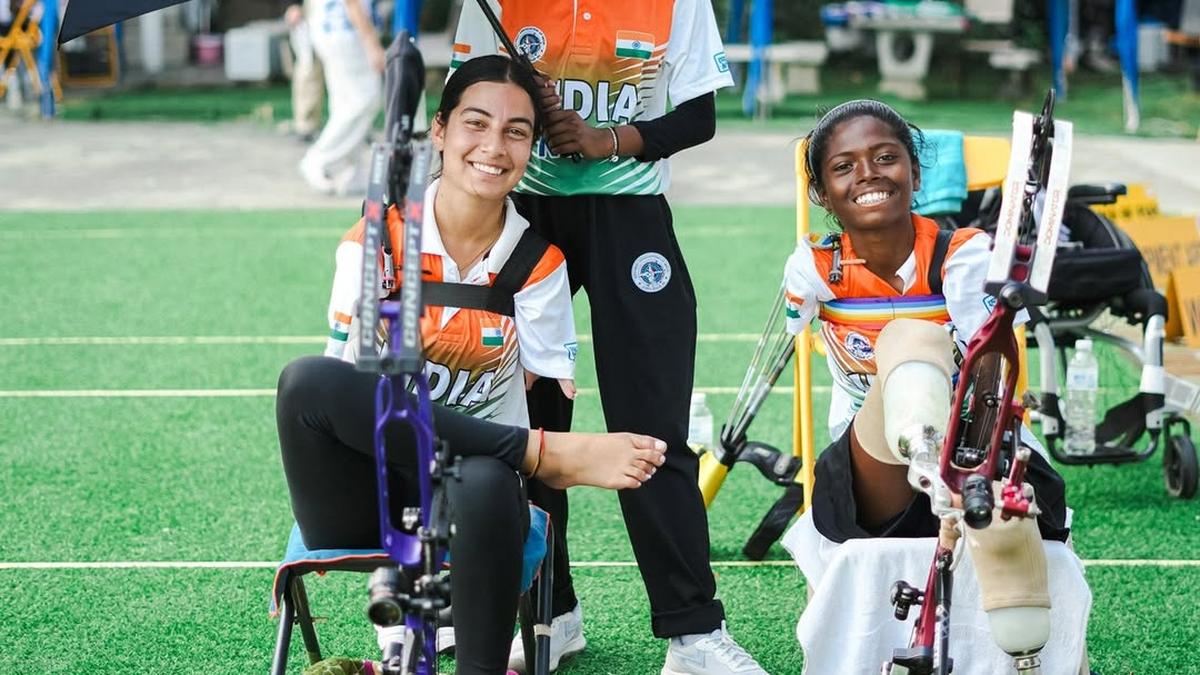
India’s Payal Nag produced one of the standout results of the Bangkok 2026 Hyundai World Archery Para Series, defeating reigning world champion and world number one Sheetal Devi to win the compound women’s gold medal. World Archery reported that Nag beat her fellow Indian 139-136 in the final, marking the 18-year-old’s first international medal.
The result is significant not only because it came against one of para archery’s biggest names, but because it underlines how quickly Nag is rising. Just days earlier, World Archery had noted that Sheetal Devi topped compound women’s qualification in Bangkok with 698 points, while Nag, described by World Archery as the first quadruple amputee in the history of the sport, was among four Indian archers in the top six.
According to World Archery’s event report, the final turned when Devi “failed to hit the middle” in the third and fourth ends, allowing Nag to seize control of the match. The two had already combined to win compound women’s team gold for India before meeting in the individual final, giving the Bangkok event an added layer of significance for Indian para archery.
For IMEA CPO readers, the deeper story is Nag’s wider rise rather than a single upset. In a feature published last month, World Archery described how Nag lost all four limbs after a live-wire accident at the age of seven and later took up archery under coach Kuldeep Vedwan, who developed a custom mechanism to adapt the bow to her prosthetic and shoulder-based technique. That feature also noted that Nag made history at the Dubai 2025 Asian Youth Para Games as India’s and the world’s first quadruple amputee archer to compete internationally.
Her progress since then has been rapid. World Archery said Nag had already made an impact at the Indian Para Archery Championships in 2025 and again in 2026, including finishing on the podium, while Bangkok now gives her a first senior international title-level breakthrough. That progression matters because it suggests India’s para archery pipeline is deepening even beyond the already high-profile success of Sheetal Devi.
The broader Bangkok event also reinforced India’s strength in para archery. World Archery reported that Toman Kumar won compound men’s gold, Bhawna took recurve women’s gold, and India dominated the medal table while also winning every team gold final it contested. In that context, Nag’s win was both a personal milestone and part of a wider Indian statement ahead of the Asian Para Games in October 2026, where World Archery expects India and China to battle near the top of the medal standings.
For orthotics, prosthetics, and rehabilitation audiences, the result also carries a wider visibility value. Para sport does not replace the need for daily access to rehabilitation, adaptive equipment, assistive services, and inclusive systems, but achievements like this can change public expectations of what disabled athletes can do at elite level. In Nag’s case, the story is especially powerful because it combines innovation in adaptive technique, coaching, and competitive performance rather than relying only on inspiration. That is an inference from the reporting and athlete profile, but it is well supported by the way World Archery has documented her development.
The final also says something important about the current state of women’s para compound archery in India. Sheetal Devi remains one of the sport’s most prominent names, but Nag’s victory shows that India’s elite level is becoming more competitive internally as well as internationally. For the sport, that is usually a positive sign. Stronger domestic rivalry tends to raise standards, sharpen performance under pressure, and strengthen medal prospects at major championships. This is an inference, but it follows directly from the Bangkok result and the recent trajectory of both athletes.
Why this matters
Payal Nag’s victory in Bangkok is more than a surprise final. It is a sign that India’s para archery talent base is still expanding, and that one of the sport’s newest international athletes is already capable of beating the world’s best. With the 2026 Asian Para Games ahead and LA28 on the longer horizon, Nag now looks like another major name to watch.