 By
By
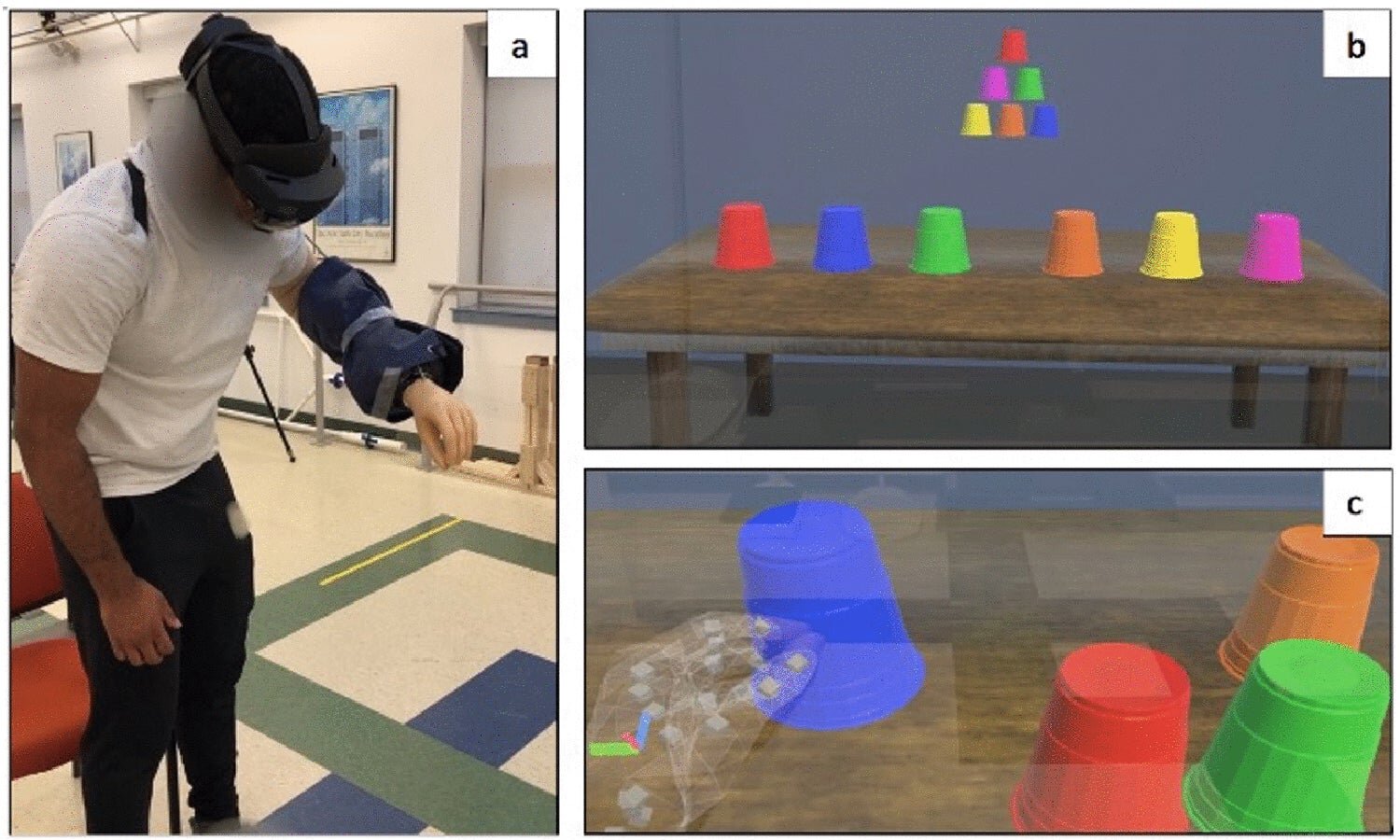
A new study from the University of Rhode Island suggests that augmented reality (AR) could help make upper-limb prosthesis training more engaging while also supporting faster improvement in functional task performance. The work focused on training for body-powered upper-limb prostheses, using an AR game called ARm-Strong to make repetitive practice more motivating for users.
The project was led by Susan D’Andrea, an associate professor of kinesiology at the University of Rhode Island College of Health Sciences. URI says the study set out to address a familiar rehabilitation problem: prosthesis users often need extensive training, but the repetitive nature of that training can make it difficult to sustain motivation and long-term engagement.
According to the published PLOS One paper, the feasibility study involved 32 healthy participants using a body-powered bypass prosthesis rather than people with limb loss directly. Participants were divided into three groups, with one using AR only, one using AR plus functional-task training, and one using functional-task training only. The researchers found that all groups improved, but participants using AR showed higher feelings of engagement, engrossment, and motivation, and both AR groups improved more quickly than the non-AR comparison group.
That distinction matters. The study does not show that AR training alone is already a proven replacement for conventional prosthetic rehabilitation in clinical practice. It was a feasibility study in non-amputee participants, designed to test whether this kind of training environment could support motor learning and improve the user experience. The authors conclude that AR-based training appears to be an engaging and motivating option and that motor learning can be achieved through this approach, but they also note the need for further work in actual prosthesis users.
For IMEA CPO readers, the value of the study lies in a practical rehabilitation question that often gets less attention than hardware itself: how do you help users train effectively enough to get real benefit from a prosthesis? Advanced devices can only deliver value if patients are able to use them confidently and consistently. An AR-based system that makes repetitive training more interesting could therefore matter not because it is flashy, but because it may improve adherence and early skill development. That is an inference from the study findings, but it is well supported by the results on engagement and faster improvement.
The research also reflects a wider shift in rehabilitation technology. Increasingly, innovation is not only about new prosthetic components, but also about training environments, feedback systems, and digital tools that help users learn more effectively. URI’s report describes ARm-Strong as a way to overlay game-like digital tasks onto real-world prosthesis movements, giving users a more interactive and accessible practice environment.
That could be particularly relevant in upper-limb rehabilitation, where abandonment rates have historically been a concern and where early frustration can affect long-term device use. The study does not claim to solve that problem on its own, but it adds evidence that training design may be just as important as device design in improving outcomes. That is an inference, but it follows logically from the study’s focus on engagement and the established challenge of sustained prosthesis use.
The next step will be whether similar benefits can be demonstrated in amputee users and in clinical rehabilitation settings outside a controlled feasibility study. Until then, the strongest takeaway is that augmented reality appears to be a promising tool for making prosthesis training more motivating and potentially more efficient, especially in the early stages of skill acquisition.