 By
By
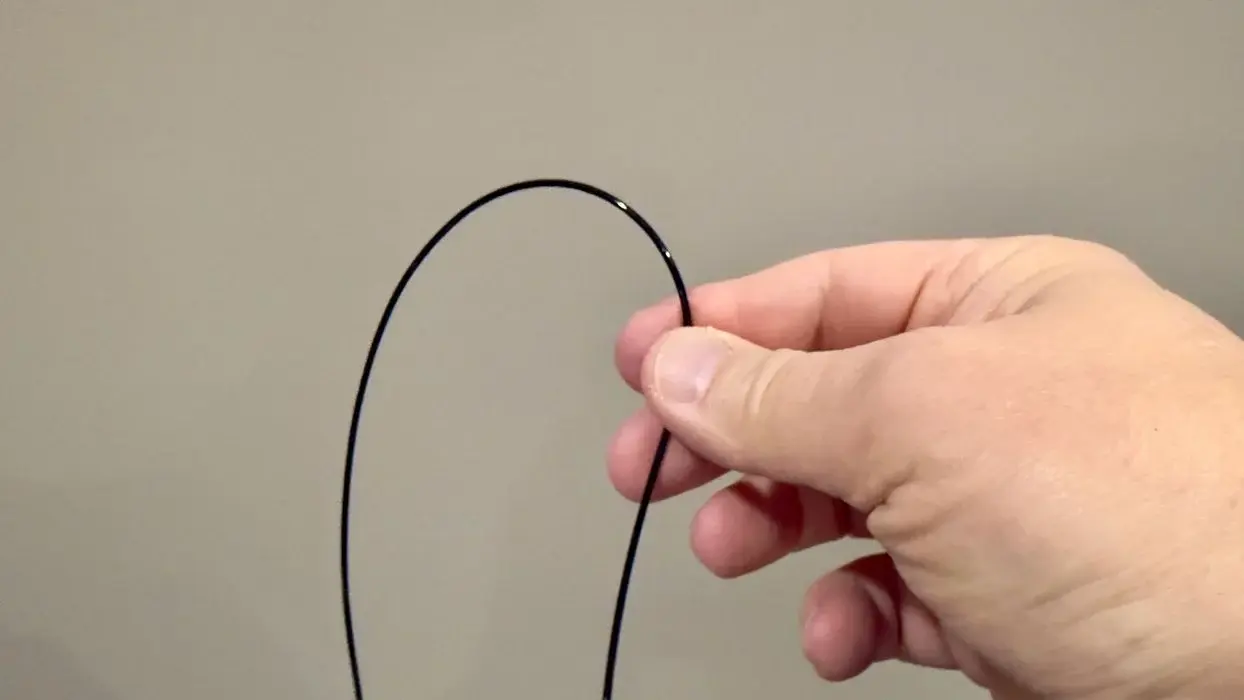
Here’s everything you need to know about durometer measurements for 3D printer filaments.
So you want to print some TPU? Make a flexible object? Congratulations, this is entirely possible to do, although it often takes some special measures on your FFF 3D printer due to the spaghetti-like nature of some TPUs.
Wait, “some TPUs”? There’s more than one?
Yes. TPU filament comes in a wide range of hardness. It’s a bit weird to talk about “hardness” when the filament is soft, but it’s really a measurement: less hard means it is softer.
When shopping for 3D printer filament, you will encounter specifications like “95A”, “85A”, or “40D”. What do all these mean?
They are the official measurement of the hardness of the material, performed with a specific measurement method and rated on the Shore scale.
There are two Shore scales in 3D printing, A and D. Why two? It’s because some materials are so soft that a single measurement apparatus can’t measure super soft materials and also relatively hard materials. Both measurement methods involve pushing an indenter into the material with a specific force and measuring how far in it goes, a device called a durometer. The two scales use different indenters and forces, so the results are completely different. It would be possible to measure a material in each scale.
The Shore D scale is intended for more rigid, but still flexible materials, while the Shore A scale is used to measure much softer materials. The Shore A measurement uses a blunter indenter; otherwise, it would simply penetrate into the material rather than deforming it.
The results of both measurements are converted into a 0-100 scale, called Shore units. A rating of zero means the material is extremely soft, and the indenter went in a great distance. A rating of 100 means the indenter didn’t push in at all.
So, generally, a higher number on both scales means the material is harder, and a smaller number means softer.
There is also a Shore 00 scale in addition to A and D, but it’s used for extremely soft materials, like gels. These are so soft that they would never be used in a 3D printer filament, so you don’t have to worry about Shore 00.
Here are some guidelines for what to expect when encountering different Shore ratings for filaments:
Shore A (commonly used for TPU filament specifications):
- 60A–70A: very soft / “gummy”; can be hard to feed; often needs direct drive and slow speeds
- 80A–88A: flexible but printable on many setups
- 90A–95A: “stiffer TPU”; easiest flexible to print; still bends but less spaghetti-like
- 50D–65D: semi-rigid plastics (some nylons, PP blends, etc.)
- 70D–85D+: rigid, engineering-plastic territory
I have seen the D scale used for some TPUs. For example, I have a spool of Fiberlogy 40D TPU. That corresponds to something close to Shore 85A, as an example.
This is why 3D printer manufacturers usually say “do not use TPU in the AMS”. That said, I’ve started to see some vendors make “AMS compatible” TPU. That’s simply a TPU material that is a bit harder, perhaps 95A or higher. While these materials are technically flexible, they likely are not sufficiently flexible for most flexible applications.
One more thing: there is another characteristic about flexible materials you should be concerned with: elastic or plastic properties. A plastic material will bend but not return to its original shape. An elastomer can be bent but will return to its original shape. This means that, for example, if you were 3D printing a hinge, you’d want an elastomer rather than a plastic material. The good news is that TPUs are in fact elastomers.