

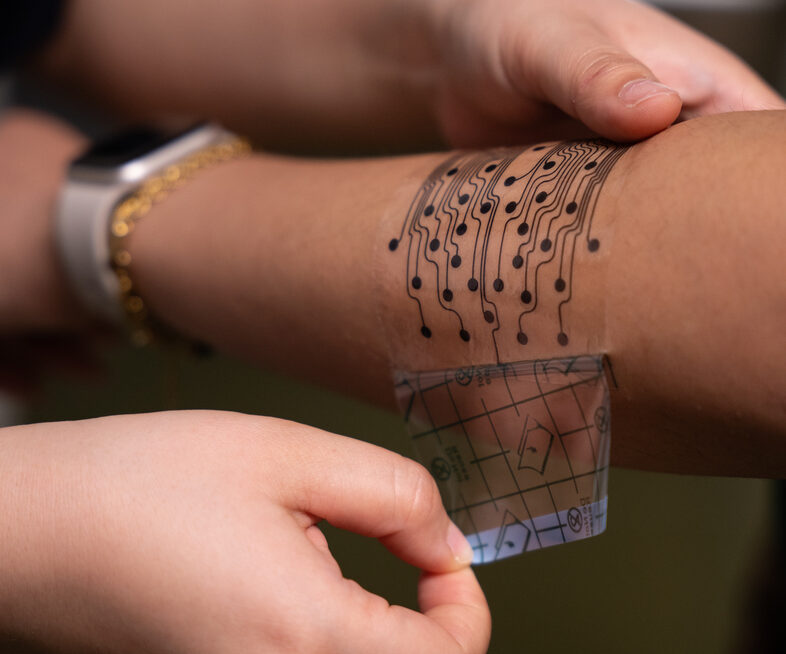
A new stretchable wearable sensor platform developed at Michigan State University is attracting attention for its potential to improve the way artificial intelligence systems interpret muscle signals for prosthetic control.
The platform, called AdapSkin, is designed to collect biological data from the skin more reliably than conventional rigid sensors. According to Design World, the sensor uses soft, flexible electronics that conform closely to the body, helping maintain stable contact during movement.
For prosthetics, this is highly relevant. Many AI-driven and myoelectric prosthetic systems depend on detecting small electrical signals from muscles. If those signals are distorted by poor electrode contact, movement artefact, sweat, skin changes or inconsistent placement, even advanced control algorithms can struggle.
AdapSkin’s key message is simple: better prosthetic control may begin with better signal capture.
Why the Skin–Sensor Interface Matters
Most myoelectric upper limb prostheses use surface electromyography, often called sEMG, to detect electrical activity produced by muscle contraction. These signals can be used to control a prosthetic hand, wrist or arm.
However, the skin–sensor interface remains a major technical challenge.
Traditional electrodes may lose stable contact as the user moves. They may also perform differently depending on skin texture, limb shape, sweat, tissue condition and age. This can produce noisy or inconsistent data, making it harder for control systems to interpret the user’s intended movement.
The Design World report notes that AdapSkin was developed to address these challenges by using a stretchable sensor platform that can better conform to different skin conditions. In testing, the technology reportedly improved gesture recognition accuracy in older adults from around 60% to more than 97%. (Design World)
AI Is Only as Good as the Input Data
The prosthetics sector often discusses artificial intelligence in terms of smarter algorithms, machine learning and more intuitive device control. These are important developments, but AdapSkin highlights a more fundamental point.
AI systems need good data.
If the sensor does not capture stable, accurate and repeatable muscle signals, the control system may misinterpret the user’s intention. That can lead to delayed response, unintended movements, user frustration and reduced confidence.
This is especially important in upper limb prosthetics, where users may need fine motor control for tasks such as holding a cup, handling a phone, opening a door, preparing food or managing personal care. Reliable control is not a luxury. It directly affects whether a prosthesis is used in daily life.
A recent review of AI in upper limb prosthetics notes that the field is moving from traditional myoelectric control towards more advanced sensor-fused systems, with AI-based approaches aiming to improve control accuracy and reduce user effort. However, the same direction of travel increases the importance of reliable sensing and real-world usability. (Springer)
Dense Electrode Arrays and Subtle Movement Recognition
According to the Design World report, AdapSkin uses dense arrays of electrodes to create a more detailed map of muscle activity. This can help distinguish more subtle intended movements, including individual finger motions. (Design World)
This is important because upper limb prosthetic control is often limited by the number and quality of control signals available. A user may have several intended movements, but only limited muscle sites that can be detected reliably through the socket or sensor interface.
If stretchable, high-density sensors can capture richer muscle activity patterns, future prosthetic systems may be able to support more natural and flexible control strategies.
Relevance for Older Adults and Complex Users
One of the notable aspects of the AdapSkin work is its relevance to older adults.
Many wearable and prosthetic technologies are developed and tested primarily on younger users or controlled laboratory populations. In real clinical practice, many prosthetic users are older, may have vascular disease, diabetes, fragile skin, scarring, volume fluctuation or other tissue-related challenges.
Older skin can be thinner, less elastic and more difficult for conventional electrodes to interface with consistently. That makes sensor design particularly important.
For IMEA regions, this matters because the causes of limb loss and disability vary widely. Clinics may see users with traumatic amputations, conflict-related injuries, burns, congenital limb differences, diabetic limb loss, vascular disease and neurological conditions. A sensor platform that can perform across different skin conditions and age groups could be valuable if it proves durable, affordable and clinically practical.
Potential Beyond Prosthetic Hands
AdapSkin may also have applications beyond prosthetic control.
Design World reports that the sensor platform could support stroke rehabilitation and neuromuscular monitoring by giving clinicians clearer information about muscle function over time. (Design World)
For rehabilitation systems across the Middle East, Africa, Central Asia and South Asia, possible future applications could include:
- Upper limb prosthetic training
- Myoelectric control calibration
- Stroke rehabilitation monitoring
- Neuromuscular assessment
- Remote rehabilitation follow-up
- Assistive robotics
- Human-machine interface research
- Therapy outcome tracking
These applications would require clinical validation, regulatory pathways and practical service models, but they show why sensor development is becoming central to the future of rehabilitation technology.
Why This Matters for IMEA Markets
Across IMEA regions, there is growing interest in advanced prosthetics, AI-assisted rehabilitation, 3D printing, digital fabrication and local assistive technology innovation. At the same time, many services face cost pressure, limited reimbursement, variable technical support and shortages of highly specialised clinicians.
For these markets, a technology like AdapSkin raises two different but connected questions.
First, how can advanced sensing improve prosthetic function and user confidence?
Second, how can such technologies become affordable, maintainable and suitable for local conditions?
The second question is crucial. IMEA markets often include heat, humidity, dust, long travel distances for follow-up, limited repair infrastructure and wide differences in patient income. A sensor that works well in the laboratory must also be able to survive real-world prosthetic use.
Lessons for Regional Innovators
For regional universities, startups, prosthetic manufacturers and assistive technology developers, AdapSkin offers an important lesson: prosthetic innovation is not only about the hand, motor, socket or algorithm.
It is about the interface between the person and the technology.
Future prosthetic control systems will need to combine:
- Comfortable and stable skin contact
- Reliable sEMG or other biological signal capture
- Adaptation to sweat and movement
- Compatibility with prosthetic sockets and liners
- Low training burden for users
- Robust electronics
- Affordable manufacturing
- Easy calibration for clinicians
- Practical cleaning and maintenance
- Long-term durability
These factors are especially important in emerging and mixed-resource healthcare systems, where devices must perform reliably without constant high-level technical support.
From Research Platform to Clinical Reality
Although AdapSkin is promising, several questions remain before similar sensor platforms become routine in prosthetic care.
Clinicians and manufacturers will need to evaluate:
- Performance during full-day prosthetic use
- Stability inside or alongside a prosthetic socket
- Resistance to sweat and heat
- Durability over repeated donning and doffing
- Cleaning and hygiene
- User comfort
- Integration with commercial prosthetic hands
- Cost
- Maintenance requirements
- Regulatory approval
- Training needs for clinicians and users
For IMEA adoption, affordability and serviceability will be particularly important. A sophisticated sensor that cannot be repaired locally or is too expensive for most users may remain limited to research or premium private practice.
Better Control Starts at the Interface
AdapSkin is a reminder that AI-controlled prosthetics will not be transformed by algorithms alone.
The prosthesis must first understand the user’s intention. That understanding begins at the body interface — where skin, muscle, sensor, socket and control system meet.
For IMEA CPO readers, the development is relevant because it points towards the next phase of prosthetic innovation: softer, smarter and more adaptive interfaces that can support more intuitive control.
If technologies like AdapSkin can be translated into robust, affordable and clinically practical systems, they could help improve prosthetic use not only in advanced research centres, but also in the diverse clinical environments of the Middle East, Africa, Central Asia and South Asia.
The future of AI prosthetics may depend less on making devices look more futuristic, and more on making the connection between body and device work better.
- Design World: AdapSkin stretchable sensor improves AI-driven prosthetic control
- Michigan State University College of Engineering
- Michigan State University Institute for Quantitative Health Science and Engineering
- Device journal
- Springer: Advances in upper limb prosthetics empowered by artificial intelligence
- World Health Organization: Assistive Technology
- World Health Organization: Rehabilitation
- WHO Standards for Prosthetics and Orthotics