

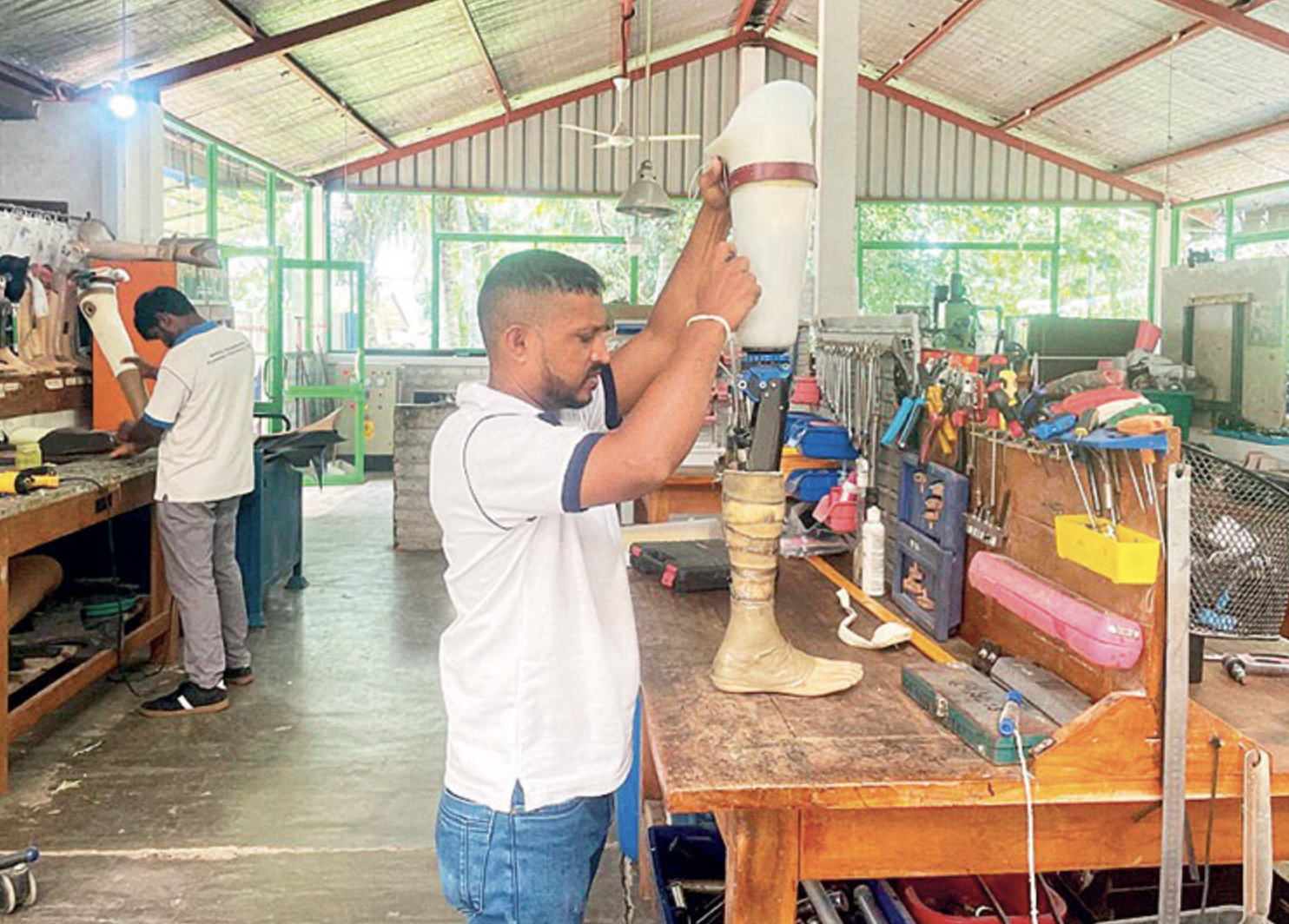
For thousands of people in Sri Lanka living with limb loss and physical disability, access to appropriate prosthetic and rehabilitation services can still be difficult. Travel distance, cost, limited specialist services and the need for long-term follow-up can all prevent patients from receiving the care they need.
Against this background, the Meththa Rehabilitation Foundation Guarantee Limited has become an important voluntary rehabilitation provider in Sri Lanka, offering prosthetic, orthotic, mobility and rehabilitation support to people from vulnerable communities.
According to a recent feature in The Island, the organisation’s work has developed over more than three decades from a small diaspora-led initiative into a rehabilitation network serving communities across the island.
From UK-Supported Prosthetic Recycling to Island-Wide Services
The roots of the Foundation go back to 1994, when expatriate Sri Lankan professionals in the United Kingdom identified the shortage of rehabilitation services available to disabled people in Sri Lanka. Drawing on expertise in rehabilitation medicine and allied healthcare, they established Meththa Foundation-UK with the aim of providing affordable, high-quality prosthetic and rehabilitation services.
The original model included recycling and repurposing high-quality prosthetic components donated from the UK’s National Health Service. Over time, that approach evolved into a wider rehabilitation service model.
Clinical services began in Sri Lanka in 1995 through a mobile outreach programme, initially supporting injured soldiers and later expanding to civilians affected by conflict, disability and land mine injuries. In 2010, the Sri Lankan arm was formally registered as Meththa Rehabilitation Foundation Guarantee Limited, strengthening its ability to deliver sustainable services across the country.
Four Rehabilitation Centres and a Hub-and-Spoke Model
Today, the Foundation operates four rehabilitation centres in:
- Mahawa
- Mankulam
- Balapitiya
- Kilinochchi
These centres provide prosthetic and orthotic services, posture and mobility support, limb repairs and rehabilitation assistance to patients from different social and economic backgrounds.
Recognising that many disabled people live in remote areas with limited access to healthcare, the Foundation also established a mobile outreach service in 2011. Its “hub and spoke” model allows rehabilitation teams to travel to underserved communities, helping reduce the barrier of distance for patients who may otherwise be unable to access care.
For IMEA CPO readers, this is a particularly relevant model. Across many parts of the Middle East, Africa, Central Asia and South Asia, the challenge is not only the availability of prosthetic components, but also the delivery of continuing rehabilitation services outside major cities.
Significant Service Delivery in 2025
The Foundation’s 2025 activity demonstrates the scale of demand for accessible prosthetic and rehabilitation services in Sri Lanka.
According to the report, during 2025 the organisation recorded approximately:
- 2,000 patient contacts
- 350 new artificial limbs
- 850 limb repairs
- 800 other rehabilitation devices
These figures highlight an important point: repairs and follow-up are a major part of prosthetic service delivery. In many low- and middle-income settings, the ability to repair and maintain existing limbs can be just as important as the ability to provide new devices.
For users, these interventions represent more than medical treatment. They can determine whether someone returns to school, work, family life and community participation.
Local Innovation for Sri Lankan Conditions
One of the Foundation’s most important contributions has been its focus on affordable prosthetic technologies suited to local conditions.
The organisation has developed a modular below-knee artificial limb system manufactured largely from locally sourced materials. It has also designed low-cost prosthetic knee components intended to reduce financial pressure on patients while maintaining quality and function.
This type of local innovation is highly relevant for the wider IMEA region.
Many rehabilitation systems face similar problems: imported components can be expensive, supply chains may be unreliable, and patients often cannot afford premium devices. Locally appropriate component design can reduce dependence on imports and help make prosthetic rehabilitation more sustainable.
The Foundation’s approach also reflects an important principle for O&P development: innovation does not always mean high-cost technology. In many settings, the most valuable innovation is affordable, repairable, locally maintainable and clinically useful.
Free and Subsidised Care for Patients in Need
The Island report notes that service users are encouraged to donate what they can, but for many patients who cannot pay, services are provided free. The Foundation’s work is supported by international grants, fundraising and donations facilitated through Meththa Foundation-UK.
This mixed funding model reflects the reality of prosthetic care in many countries. Where government provision, insurance or personal income cannot fully cover rehabilitation needs, voluntary and charitable organisations often play an essential role.
However, this also creates a sustainability challenge. The Foundation reportedly operates with annual expenditure of around Rs. 30 million in Sri Lanka and remains reliant on donors, charitable trusts and well-wishers to maintain services.
For policymakers and donors, the message is clear: prosthetic rehabilitation requires continuing investment, not only occasional device distribution.
Training the Local Rehabilitation Workforce
Another important element of the Foundation’s work is workforce development.
Sri Lanka, like many countries in the region, faces a shortage of trained rehabilitation professionals. To address this, Meththa Foundation has established an apprentice-based vocational training programme to recruit and train young people as prosthetists, orthotists and rehabilitation technicians. Several locally trained staff now work across the Foundation’s centres.
This is a critical lesson for other rehabilitation programmes.
A prosthetic service cannot be sustained by equipment and donations alone. It needs trained people who can assess patients, fabricate devices, make repairs, adjust sockets, support gait training and provide follow-up care.
Workforce development must therefore be part of any serious national or charitable rehabilitation strategy.
Potential Collaboration With Government Hospitals
The report states that discussions have taken place with health authorities regarding the possible use of Meththa-designed prosthetic components within government hospitals. Such collaboration could help expand access to affordable rehabilitation services across Sri Lanka.
This is an area worth watching.
If locally developed components can be safely and effectively integrated into public-sector services, the impact could extend beyond Meththa’s own centres. It could support wider availability of affordable prosthetic care, especially for patients who depend on government hospitals.
For IMEA countries, the Sri Lankan example raises a broader question: how can voluntary organisations, public hospitals and local manufacturers work together to scale prosthetic access without compromising quality?
The Ongoing Challenge of Follow-Up Care
The Foundation’s experience also shows that prosthetic rehabilitation does not end when a limb is delivered.
The report notes that while many educated amputees successfully return to productive lives after rehabilitation support, poorer and less educated amputees often face ongoing barriers, particularly around transport and the cost of accessing follow-up care.
This is a common issue across the region.
Patients may receive an artificial limb, but later struggle with socket discomfort, component wear, broken straps, changes in residual limb volume or alignment problems. Without follow-up, these issues can lead to reduced use, pain, skin damage and device abandonment.
Meththa’s plan to expand mobile services and community outreach is therefore not an optional extra. It is central to long-term prosthetic success.
A Model for Community-Based Prosthetic Rehabilitation
The Meththa Rehabilitation Foundation demonstrates several principles that are relevant to prosthetic and orthotic services across IMEA regions:
- Build services close to communities, not only in capital cities
- Combine centre-based care with mobile outreach
- Prioritise repairs and follow-up as much as new limbs
- Develop locally appropriate and affordable technology
- Train local staff to sustain services
- Use charitable support to reach patients who cannot pay
- Collaborate with public health systems where possible
- Measure success through mobility, independence and social participation
These principles are especially important in countries where access to rehabilitation is limited by cost, geography and workforce shortages.
Restoring Mobility, Independence and Hope
Meththa Rehabilitation Foundation’s work shows that prosthetic care is not simply a technical service. It is a pathway back to independence.
For a person with limb loss, an artificial limb can mean returning to work, caring for family, attending school, participating in community life and regaining confidence. For people with physical disabilities in remote or low-income settings, access to rehabilitation can change the direction of their lives.
As Sri Lanka continues to strengthen its healthcare and social welfare systems, organisations such as Meththa Foundation show how community-based service delivery, local innovation and long-term commitment can make a measurable difference.
For IMEA CPO readers, the Foundation’s experience is a reminder that the future of prosthetic care in the region will depend not only on advanced technology, but also on affordability, outreach, local skills and continuity of care.
- The Island: Meththa Rehabilitation Foundation – Restoring Mobility, Dignity and Hope Across Sri Lanka
- Meththa Foundation Sri Lanka / UK
- World Health Organization: Rehabilitation
- World Health Organization: Assistive Technology
- WHO Standards for Prosthetics and Orthotics
- International Society for Prosthetics and Orthotics