

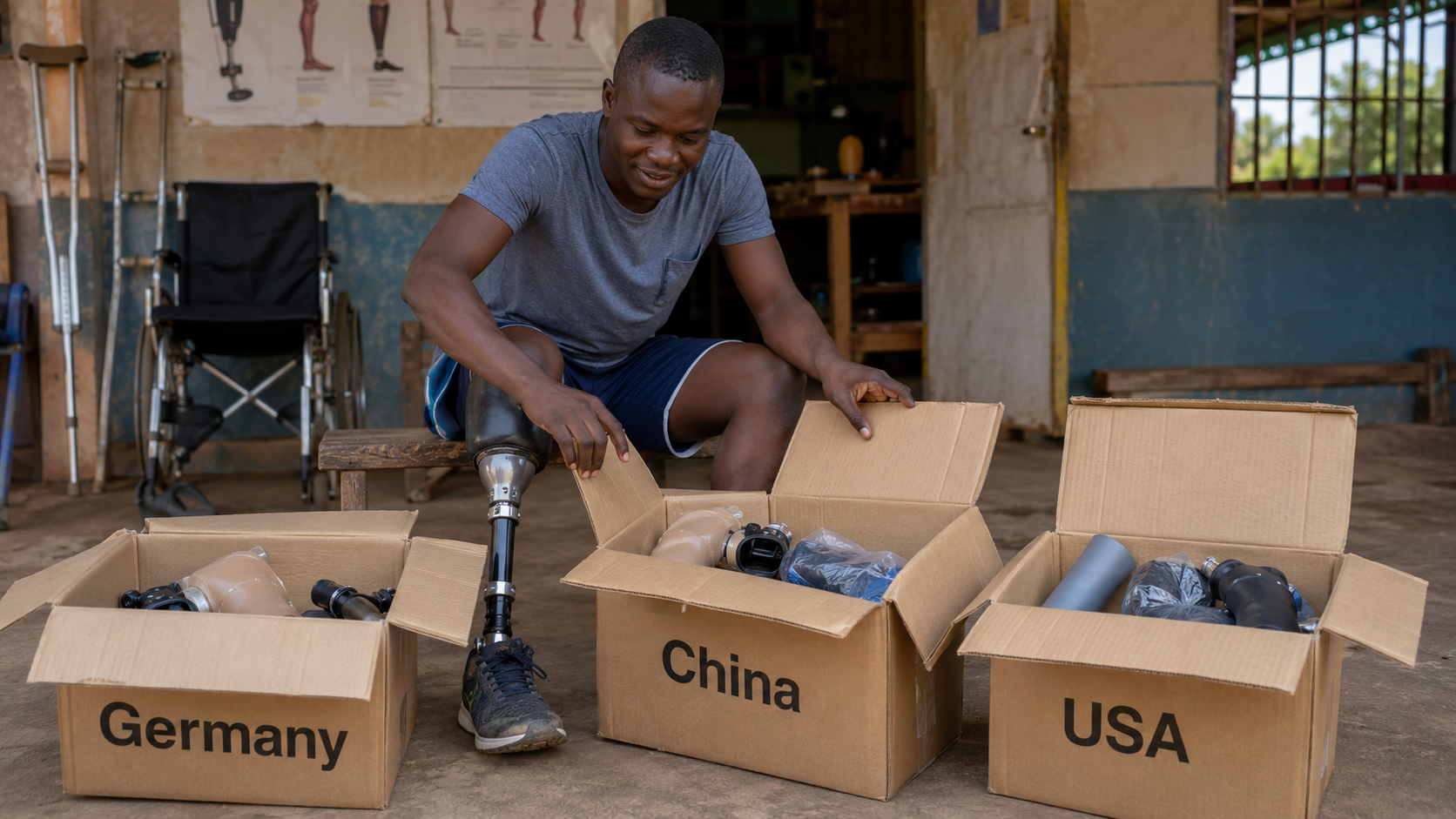
A new Africa-wide review has highlighted a major challenge for rehabilitation, prosthetics, orthotics and assistive technology providers across the continent: despite growing policy attention, sub-Saharan Africa still imports the vast majority of assistive technology products used by people with disabilities.
According to a report covered by TechCabal, the Assistive Technology Landscape in Africa Scoping Review, produced by Stellenbosch University and commissioned by the Mastercard Foundation, found that more than 85–90% of assistive technology products used across Africa are imported. The review warns that this leaves health systems, rehabilitation providers and end users exposed to supply-chain shocks, donor funding changes and inconsistent product availability.
The review synthesised evidence from 523 sources, including 185 peer-reviewed studies and 338 policy documents, organisational reports and other grey literature sources across all 54 African countries. Its findings point to a continent that is increasingly aware of the importance of assistive technology, but still struggling to turn policy commitments into reliable, locally led systems.
Policy Progress, But Weak Implementation
One of the strongest messages from the report is that Africa is not starting from zero. Since 2016, at least 38 African countries have adopted assistive technology-specific strategies aligned with global frameworks. However, many of these policies lack the financing, monitoring systems, enforceable standards and operational detail needed to make them work in practice.
For prosthetic and orthotic professionals, this matters because national AT strategies are only useful if they translate into procurement systems, reimbursement models, trained workforces, maintenance pathways and predictable supply of products. Without those foundations, clinics and rehabilitation centres remain dependent on short-term projects, donations or imported devices that may not be available when patients need follow-up care.
The report describes Africa as moving from fragmented, donor-led provision toward more multi-actor systems, but notes that progress is uneven. East and Southern Africa have stronger coordination between governments, universities, social enterprises and civil society, while West and Central Africa remain more dependent on donors and international partners.
What This Means for Prosthetics and Orthotics
For the O&P sector, the import-dependence finding is particularly important. Prosthetic limbs, orthotic braces, mobility devices and related components are not one-time products. They require assessment, fitting, adjustment, repair, maintenance and often replacement as the user’s body, activity level or clinical condition changes.
When more than 85–90% of assistive technology products are imported, local services can face long lead times, high costs and limited options. This can affect everything from paediatric orthotic provision to prosthetic component replacement and wheelchair seating services.
The report also notes that mobility products dominate many national assistive technology portfolios, while communication, cognitive, learning, self-care and digital assistive technologies remain under-supplied. For rehabilitation providers, this underlines the need to think beyond device delivery and toward participation, education, employment and long-term independence.
Local Manufacturing and Repair Are Strategic Opportunities
The review does not suggest that Africa lacks innovation. In fact, it identifies existing manufacturing and innovation capacity across the continent. East Africa is described as having the most dynamic production and innovation ecosystem, Southern Africa has more stable fabrication capacity, and North Africa contributes technical expertise in biomedical engineering, orthotics and prosthetics manufacturing, rehabilitation robotics and standards-based medical device production.
However, the challenge is scale. The report states that Africa’s assistive technology market is not simply supply-constrained; it is scale-constrained. Weak demand signalling, fragmented procurement, limited certification systems, regulatory gaps and donor-dependent financing all make it difficult for local manufacturers and service providers to grow sustainably.
This creates a clear opportunity for governments, funders and rehabilitation leaders to invest in local repair, refurbishment and maintenance networks. These areas require lower capital investment than full manufacturing and can create practical employment pathways for young people, including young persons with disabilities.
Financing Remains the Weakest Link
The review identifies financing as one of the most fragile parts of Africa’s assistive technology ecosystem. Few countries include dedicated budget lines, costing models or return-on-investment analysis for assistive technology. As a result, many systems remain donor-dependent and vulnerable to changing priorities.
This is a familiar challenge for O&P services across many low- and middle-income settings. A prosthetic knee, AFO, spinal brace or wheelchair may be provided through a project, charity or one-off funding mechanism, but long-term service continuity is often missing. Patients may receive a device but not the follow-up, repair or replacement pathway needed to keep using it safely.
For Africa’s rehabilitation systems to mature, assistive technology must be treated as essential infrastructure rather than occasional charity. That means health insurance coverage, public procurement, local workforce planning, quality standards and long-term maintenance systems.
A Call for Locally Led AT Systems
The report’s message is not only about imports. It is about ownership. Africa’s growing assistive technology needs cannot be met through imported devices and donor-funded projects alone. The continent needs locally led ecosystems that connect policy, clinical services, technical training, manufacturing, repair, data and financing.
For prosthetists, orthotists, rehabilitation doctors, physiotherapists, occupational therapists and AT innovators, this is an important moment. The policy foundations are improving, but the next phase must focus on implementation.
That means building national and regional systems where assistive technology is available, affordable, appropriate, repairable and supported by trained professionals. It also means involving users, including young people with disabilities, not only as recipients of devices but as designers, technicians, entrepreneurs, peer navigators and leaders within the AT ecosystem.
If Africa can move from import dependence toward sustainable local provision, assistive technology could become more than a healthcare intervention. It could become a platform for inclusion, employment, industrial development and dignity.
- TechCabal: Sub-Saharan Africa still imports over 90% of assistive tech
- Assistive Technology Landscape in Africa Scoping Review
- WHO Regional Office for Africa: Framework for improving access to assistive technology
- Ethiopian Prosthetic and Orthotic Service
- Nigeria National Commission for Persons with Disabilities