

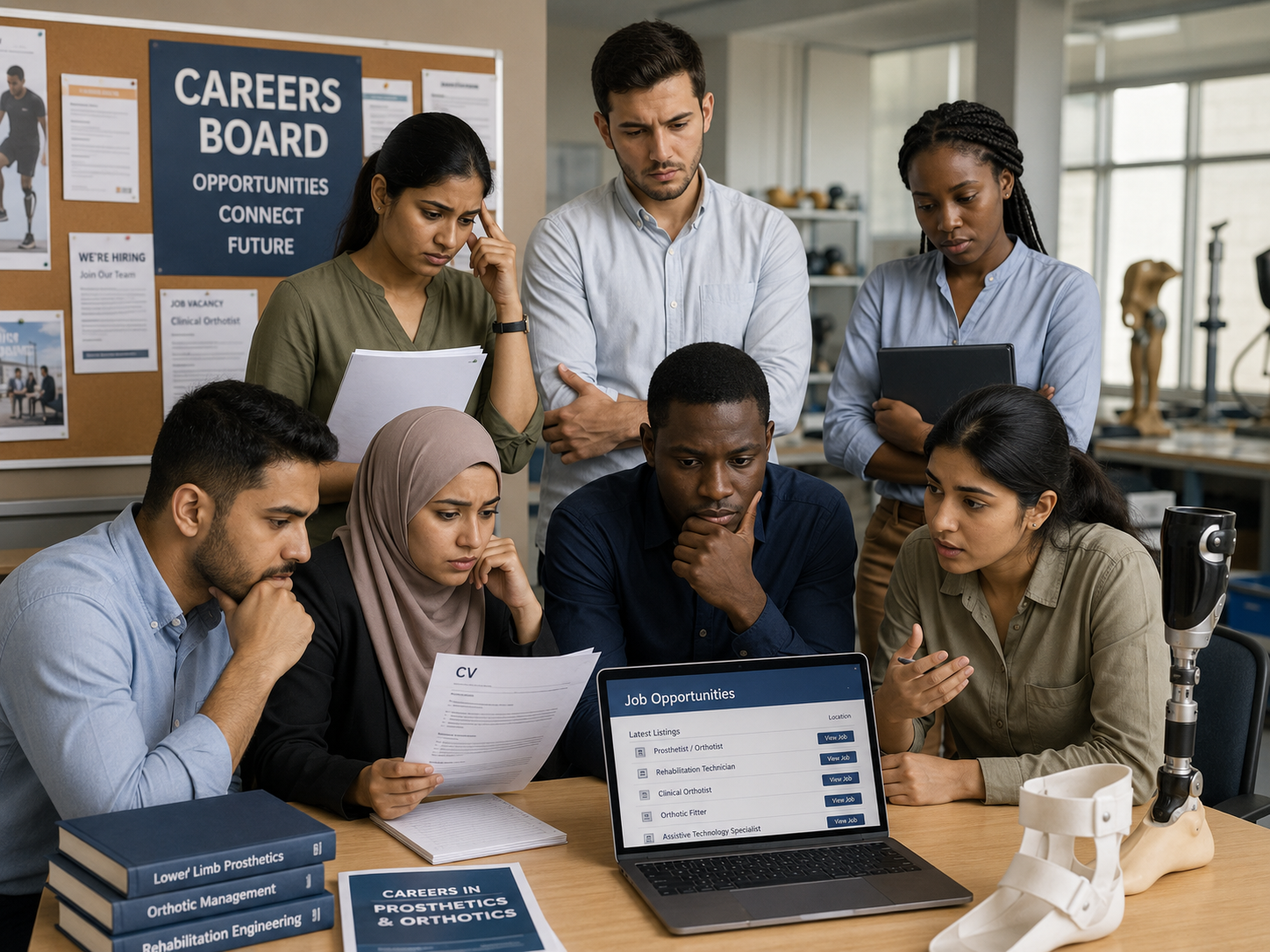
A recent opinion piece in The Guardian Nigeria argues that specialised medical universities could help reduce graduate unemployment by training students for areas of genuine healthcare need. The article identifies rehabilitation sciences and allied health professions as underserved sectors, and specifically highlights prosthetics and orthotics as one of Nigeria’s overlooked healthcare fields. (The Guardian Nigeria)
The argument is important, but for the prosthetics and orthotics profession across the Middle East, Africa, Central Asia and South Asia, it also raises a deeper issue: training more clinicians is only part of the answer. Graduate CPOs need actual jobs, supervised early-career pathways and recognised roles inside public and private rehabilitation systems.
Across many IMEA countries, the problem is not simply that prosthetics and orthotics are unknown. It is that the profession often sits between several systems without being fully absorbed by any of them. Ministries of health may recognise the need for amputee rehabilitation, diabetic foot care, spinal bracing, paediatric orthotics and assistive technology, but this does not always translate into funded posts for prosthetists and orthotists. Hospitals may refer patients for devices, but may not employ CPOs directly. NGOs and humanitarian organisations may provide essential services, but their projects can be donor-dependent and time-limited.
This creates a difficult reality for graduates. A student may complete a specialised P&O qualification, gain technical and clinical skills, and still find that there are few advertised entry-level roles. In some countries, posts are concentrated in a small number of public centres, military hospitals, charitable organisations or private workshops. In others, the profession is under-regulated, poorly classified or grouped under generic technician roles that do not reflect the training and clinical responsibility of a CPO.
The result is a paradox. The need for prosthetic and orthotic services is large, but career opportunities for graduates can remain limited.
Global data supports the scale of unmet need. WHO published standards for prosthetics and orthotics in 2017, developed with ISPO, to help countries strengthen high-quality and affordable P&O services. WHO notes that these standards are intended for countries developing or strengthening prosthetic and orthotic services, which remain a critical part of assistive technology and rehabilitation systems. (WHO)
Research on the global orthotist/prosthetist workforce has also warned that demand for orthotic and prosthetic services is expected to double by 2050, particularly in low- and lower-middle-income settings, as populations age and non-communicable diseases increase. The same research notes that current numbers of orthotist/prosthetists per population are low, meaning significant workforce growth will be needed to meet future demand. (Human Resources for Health)
Yet workforce growth cannot only mean producing more graduates. It must also mean creating the system that allows those graduates to practise.
For IMEA countries, this requires a shift from education planning to workforce planning. Every new P&O programme should be linked to a national or regional employment strategy. How many graduates are being trained each year? How many public-sector CPO posts exist? How many private providers can absorb graduates? Are internship placements available? Are graduates licensed or registered? Are salary grades defined? Do procurement and reimbursement systems create enough service activity to sustain professional roles?
Without answers to these questions, specialised education risks producing frustrated graduates for a profession that patients desperately need but employers have not yet properly structured.
The Guardian Nigeria article correctly points to specialised medical education as a way to align training with labour market demand. But in prosthetics and orthotics, the labour market is often artificially weak because service systems are underdeveloped. Patients need care, but care pathways are fragmented. Hospitals need bracing, mobility and amputee rehabilitation capacity, but job descriptions may not exist. Governments need disability inclusion, but assistive technology budgets may be limited or separated from rehabilitation workforce planning.
This is particularly visible in areas such as diabetic foot care. Many IMEA countries face a growing burden of diabetes, lower-limb complications and amputation risk. Orthotists and prosthetists can contribute through therapeutic footwear, custom insoles, offloading devices, ankle-foot orthoses, post-amputation rehabilitation and long-term mobility support. But if diabetic foot clinics do not include funded CPO roles, graduates cannot build careers in this area even when the clinical need is obvious.
The same applies to paediatric rehabilitation, cerebral palsy services, scoliosis bracing, trauma rehabilitation, stroke-related orthotic care and humanitarian amputee programmes. These are not marginal needs. They are core rehabilitation services. However, they only become graduate job opportunities when health systems, hospitals, insurers, NGOs and private providers formally recognise the CPO role.
There is also a risk that young graduates are pushed too early into entrepreneurship without enough clinical supervision. While private practice and small workshops can be important sources of employment, newly qualified CPOs need mentorship, case exposure and ethical guidance. Encouraging graduates to open clinics without structured support may create business activity, but it does not necessarily build safe, high-quality services.
A better model would combine several employment pathways. Public hospitals and rehabilitation centres should include prosthetist and orthotist posts within multidisciplinary rehabilitation teams. National insurance and reimbursement systems should recognise P&O assessment, fitting, review and maintenance as professional services, not only as product purchases. NGOs and donor-funded projects should include graduate training and transition-to-employment plans. Private providers should offer internships and junior CPO positions, not only hire experienced clinicians. Universities should track graduate employment and use the data to adjust intake numbers, curricula and placement partnerships.
Professional associations also have a role. They can advocate for job titles, salary scales, scopes of practice, registration systems and continuing professional development. They can help ministries understand that a CPO is not simply a device maker, but a rehabilitation professional whose work affects mobility, pain, safety, independence and long-term participation.
The employment question is therefore central to the future of P&O in the IMEA region. More training places may be necessary, but they are not enough. More universities may be helpful, but they are not enough. More graduates may be valuable, but only if countries create posts, fund services and build career pathways that keep skilled professionals in the field.
For patients, this is not an abstract workforce issue. A shortage of jobs for CPO graduates can become a shortage of care for amputees, children, diabetic foot patients, trauma survivors and people with neurological or musculoskeletal conditions. When trained graduates cannot find appropriate roles, communities lose clinical capacity that took years to develop.
The challenge for IMEA is therefore clear: turn rehabilitation need into recognised employment. If countries want stronger prosthetic and orthotic services, they must not only train CPOs. They must hire them, supervise them, retain them and give them a future.
- The Guardian Nigeria: Graduate unemployability — Specialised medical varsities as a panacea
- WHO: Prosthetics and orthotics services
- WHO: Rehabilitation
- Human Resources for Health: Regulation of the global orthotist/prosthetist workforce
- Frontiers: Estimates of the global workforce required for providing rehabilitation
- ISPO Education Standards for Prosthetic and Orthotic Occupations
- ISPO: International Society for Prosthetics and Orthotics