

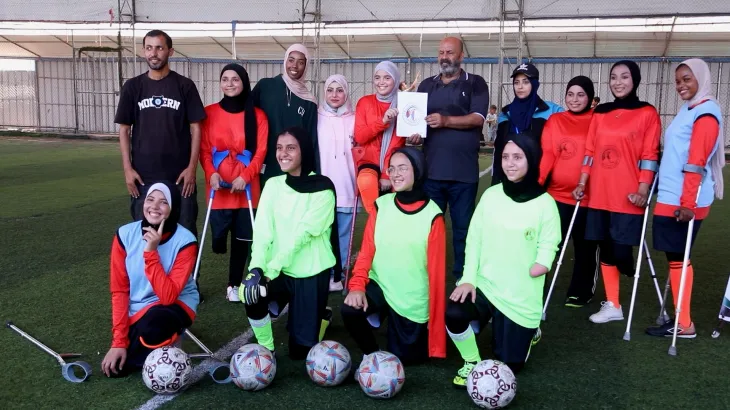
Gaza’s first women’s amputee football team is reclaiming the pitch after war, using sport to challenge stigma around women and people with disabilities while drawing attention to the urgent need for long-term rehabilitation support.
The team was featured by Al Jazeera NewsFeed, which described the players as reclaiming a space that war tried to take from them. The video highlights how women with limb loss in Gaza are returning to football not only as a sport, but as a statement of visibility, resilience and participation. (Al Jazeera)
The story is part of a wider shift in Palestinian adaptive sport. The National reported that the women’s amputee team trains weekly on one of the few remaining grass fields in Deir Al Balah, with players including women who lost limbs during the war and others who have lived with disabilities since birth. The team’s ambition is to represent Palestine internationally, including at the Women’s Amputee Football World Cup scheduled for 2027. (The National)
For the prosthetics and orthotics community, the team’s emergence is highly significant. Amputee football demonstrates that rehabilitation is not only about walking from one room to another. It is also about confidence, social participation, identity, teamwork and the right to return to public life.
In Gaza, the rehabilitation need is immense. The National cited Gaza’s Ministry of Health as saying that 6,000 people in the territory have suffered amputations during the war, all requiring prosthetics and long-term rehabilitation. (The National)
This number represents far more than a device challenge. Each person with limb loss may require emergency surgical care, residual limb management, pain support, psychological support, prosthetic assessment, socket fitting, gait training, maintenance, repairs and future replacement. For women and girls, access may also be affected by cultural expectations, safety concerns, privacy, transport, family responsibilities and stigma around disability.
The formation of a women’s amputee football team therefore carries particular importance. It creates a visible space where women with disabilities can be seen as athletes, teammates and leaders, not only as patients. It also challenges assumptions about what women with limb loss can do in communities affected by conflict, displacement and poverty.
The team has also gained international attention through images distributed by Anadolu Agency via Reuters Connect, showing Gaza’s Women’s Amputee Football Team training in Deir Al Balah in June 2026 as global attention focused on football elsewhere. The images described the players as women who continue to dream of representing Palestine in international tournaments despite war, blockade and hardship. (Reuters Connect)
Behind the football story is a major rehabilitation systems issue. Adaptive sport cannot develop without access to prosthetic and orthotic services, physiotherapy, safe training spaces, equipment, coaching and medical follow-up. Many amputee footballers use crutches during play rather than sport prostheses, but they still need comprehensive rehabilitation to protect the residual limb, prevent overuse injuries, maintain strength and support daily mobility.
The Gaza women’s team also highlights the importance of community-based rehabilitation and peer support. For people living with limb loss, being surrounded by others with similar experiences can reduce isolation and build confidence. Sport can provide structure, purpose and a sense of control in environments where many aspects of daily life have been disrupted.
For IMEA CPO readers, the story should be seen as both inspirational and practical. It shows the need to connect prosthetic rehabilitation with wider goals: education, employment, sport, inclusion and leadership. It also shows why rehabilitation planning in Gaza and other conflict-affected settings must go beyond emergency treatment and one-time device provision.
As Gaza’s first women’s amputee football team returns to the pitch, their message is clear. Mobility is not only about movement. It is about reclaiming space, rebuilding identity and insisting that women with disabilities belong in sport, in public life and in the future of Palestine.
- Al Jazeera: Gaza’s first women’s amputee football team reclaims the pitch after war
- The National: Football offers escape and hope for Gaza’s first women’s amputee team
- Reuters Connect: Gaza’s first women’s amputee football team is chasing its dreams
- World Amputee Football Federation
- Palestine Amputee Football Association on Facebook
- WHO: Rehabilitation
- WHO: Assistive technology
- International Committee of the Red Cross: Physical rehabilitation programme
- International Society for Prosthetics and Orthotics