

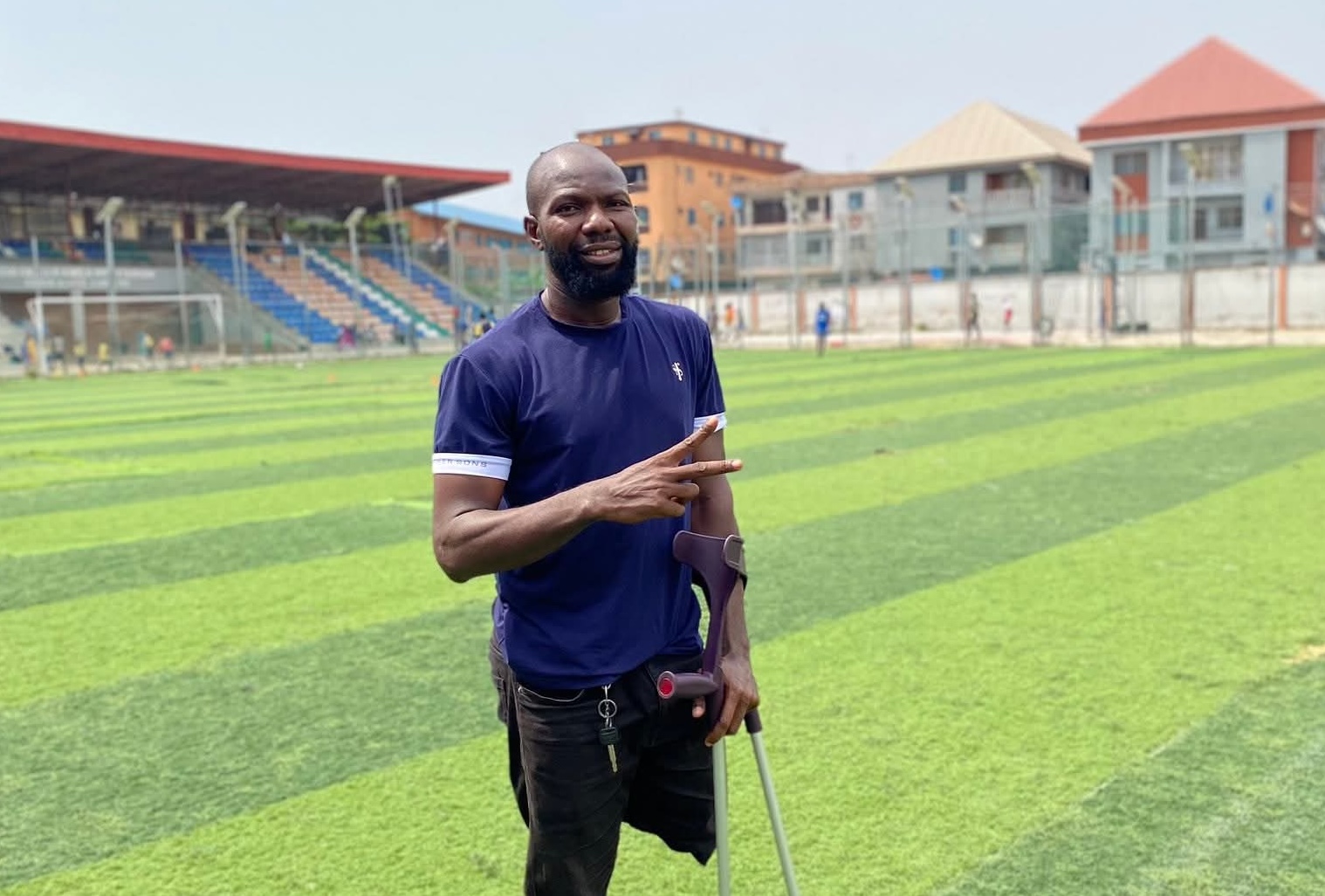
Nigerian amputee footballer Nwankpa Nnanna has described how returning to the sport he loved helped him rebuild his confidence after cancer resulted in the amputation of one of his legs.
The Special Eagles defender survived chondrosarcoma, a rare form of bone cancer. Following an unsuccessful implant procedure, doctors told him that an amputation was necessary.
For a former able-bodied footballer, the operation changed how he moved and played. It did not, however, end his connection with football.
Speaking to Sports247 Nigeria, Nnanna said discovering amputee football gave him a way out of the emotional isolation he experienced after surgery. The sport helped him regain fitness, independence and a sense of belonging among people facing similar challenges.
A chance encounter at the National Stadium
Nnanna first encountered amputee football while searching for an artificial limb.
During that period, he met para-athlete Gloria John, who encouraged him to visit the National Stadium in Lagos and explore para-athletics. While attending a training session, he noticed a group of players competing on crutches.
The sight immediately attracted his attention.
After researching the sport online, he joined the group for training. The transition was difficult, but he gradually became more confident using crutches, controlling the ball and shooting.
For Nnanna, it was “love at first sight.”
He already understood football, but he had to learn an entirely different way of moving around the pitch. Skills that had once come naturally—including sprinting, changing direction and striking the ball—had to be rebuilt through balance, upper-body strength and crutch control.
Learning to play again
Amputee football is generally played by people with amputations or limb differences. Outfield players typically compete using forearm crutches without their prosthetic legs, while goalkeepers usually have an upper-limb difference.
The game demands speed, coordination, strength and endurance.
Nnanna said amputee football training can be as physically demanding as conventional football. Players must maintain their fitness, diet and discipline while learning to sustain high-intensity movement using one leg and crutches.
Crutch-assisted running places considerable demands on the shoulders, arms and remaining lower limb. Players must also develop the confidence to accelerate, turn, challenge for the ball and recover from falls.
This makes appropriate conditioning and injury prevention especially important.
Training programmes may need to address:
- Shoulder and upper-limb strength
- Core stability and balance
- Protection of the remaining leg
- Crutch technique
- Cardiovascular fitness
- Recovery and fatigue management
The player’s everyday prosthetic care and sporting rehabilitation should also remain connected. Pain, skin problems or difficulties with the remaining limb can affect both participation in football and mobility outside sport.
Cancer changed his body, but not his ambition
Nnanna recalled that his greatest fear before the amputation was not simply the loss of his leg. He was concerned about how relatives, friends and members of the public would respond.
He did not want to be defined by sympathy or treated as incapable.
After surgery, he actively searched for opportunities that would help him reclaim his independence. Amputee football provided a practical and emotional route forward.
He said his family now considers him fitter than he was before the amputation.
His experience demonstrates why rehabilitation should focus on more than medical recovery.
A person may leave hospital with a healed residual limb but still face major questions about identity, relationships, work, sport and participation in society.
Rehabilitation should help the individual return to meaningful activities—not simply reach a basic level of movement.
Football became part of his emotional rehabilitation
Nnanna described amputee football as a form of psychological support.
Training introduced him to other people with limb loss who continued to pursue personal and sporting goals. Players could share experiences, learn from one another and challenge assumptions about what was possible after amputation.
This peer environment can be an important part of rehabilitation.
A prosthetist, physiotherapist or psychologist can provide professional guidance, but another amputee can offer a different kind of understanding. Teammates may discuss issues such as public attitudes, confidence, relationships, pain and returning to work in ways that feel more immediate and personal.
The Convention on the Rights of Persons with Disabilities recognises peer support as part of helping people attain independence, inclusion and participation.
Sport can create that support naturally while also giving participants a shared purpose beyond disability.
Rehabilitation must support recreation and participation
Healthcare services sometimes measure rehabilitation through clinical outcomes such as strength, joint movement or walking distance.
These are valuable measures, but they do not capture the whole person.
The World Health Organization defines rehabilitation as interventions that improve functioning and enable people to participate in education, work, recreation and other meaningful roles.
For someone like Nnanna, returning to football was not an optional extra after rehabilitation. It was an important part of becoming active and confident again.
P&O and rehabilitation teams should therefore ask patients what they hope to return to after an amputation.
Goals may include:
- Playing sport
- Returning to work
- Caring for children
- Attending school
- Travelling independently
- Participating in community life
- Rebuilding confidence and relationships
The correct rehabilitation plan depends on these personal objectives.
Sport can complement prosthetic rehabilitation
Amputee football is normally played without a lower-limb prosthesis, but access to a suitable artificial limb remains important for daily life.
Nnanna discovered the sport while seeking prosthetic care, illustrating how different parts of rehabilitation can intersect.
A comfortable everyday prosthesis may support travelling to training, working and participating independently in the community. Football can then provide further exercise, competition and social connection.
Prosthetic services supporting athletes should monitor:
- Socket fit and skin condition
- The health of the remaining limb
- Pain and overuse symptoms
- Crutch-related shoulder strain
- Changes in strength and body weight
- Appropriate footwear
- Recovery between training sessions
Clinicians should recognise sporting ambitions during assessment rather than assuming that a person with an amputation will be satisfied with basic household mobility.
Nigeria has international amputee football potential
Nigeria’s national amputee football team is commonly known as the Special Eagles.
The country finished fourth at the 2024 African Amputee Football Cup of Nations after losing the third-place match to Algeria. Nigeria is also listed among the African teams due to participate in the 2026 World Amputee Football Federation World Cup in Mexico.
Nnanna believes Nigeria has experienced players, promising young talent and coaches capable of developing the sport further.
He has called for greater support from sporting authorities, arguing that amputee football can showcase ability while teaching resilience and discipline.
Developing the game will require more than funding a team immediately before an international tournament.
Sustainable progress depends on:
- Regular domestic competitions
- Access to suitable training grounds
- Qualified coaches
- Safe sporting crutches
- Medical and physiotherapy support
- Player transport
- Youth-development programmes
- Women’s participation
- Reliable international competition funding
Nigeria is recognised by the World Amputee Football Federation as one of its African member organisations.
A stronger national structure could allow more people with limb differences to discover the sport close to home rather than relying on chance encounters at major stadiums.
Opportunities should begin during rehabilitation
Hospitals and prosthetic centres could help connect new amputees with adaptive-sport organisations.
A patient may be medically ready for greater activity but unaware that football, athletics, basketball or other sports are available.
Rehabilitation teams can support participation by:
- Displaying information about local clubs
- Inviting athletes to act as peer mentors
- Including sports goals in rehabilitation plans
- Referring patients to safe introductory sessions
- Advising coaches on medical considerations
- Supporting community demonstration events
Not every patient will want competitive sport. The important principle is that opportunities should be available and presented without assumptions about ability.
Visibility can challenge harmful stereotypes
Amputee athletes are sometimes portrayed only through stories of tragedy or exceptional inspiration.
Nnanna’s experience contains pain, but his identity is not limited to surviving cancer or losing a limb. He is also a defender, teammate and Nigerian international.
Presenting amputee football as competitive sport—not merely a charitable activity—helps challenge the idea that people with disabilities should be passive recipients of care.
FIFA has highlighted amputee football’s ability to show that people with limb differences can continue pursuing sporting ambitions, while the World Amputee Football Federation states that its mission includes improving access and quality of life through football.
Greater media coverage can also help newly injured people discover opportunities that they may not know exist.
From loss to a new sporting identity
Nwankpa Nnanna’s return to football did not involve recreating exactly the same life he had before cancer.
He had to accept a changed body, learn new movement skills and become comfortable competing on crutches.
Through that process, football became both a demanding sport and an important part of his recovery.
His story shows that rehabilitation is not complete when a wound heals or a prosthesis is delivered. It continues when a person returns to the activities, relationships and ambitions that give life meaning.
For Nnanna, that place was the football pitch.
Greater investment in amputee football could give many more Nigerians with limb differences the same opportunity to regain fitness, friendship, confidence and joy.
- Sports247 Nigeria – Nwankpa Nnanna on cancer, limb loss and amputee football
- World Amputee Football Federation
- WAFF – What is amputee football?
- WAFF – African member federations
- WAFF – 2026 Amputee Football World Cup
- FIFA – Football is for everyone
- World Health Organization – Rehabilitation
- World Health Organization – Ensuring access to sport for all