

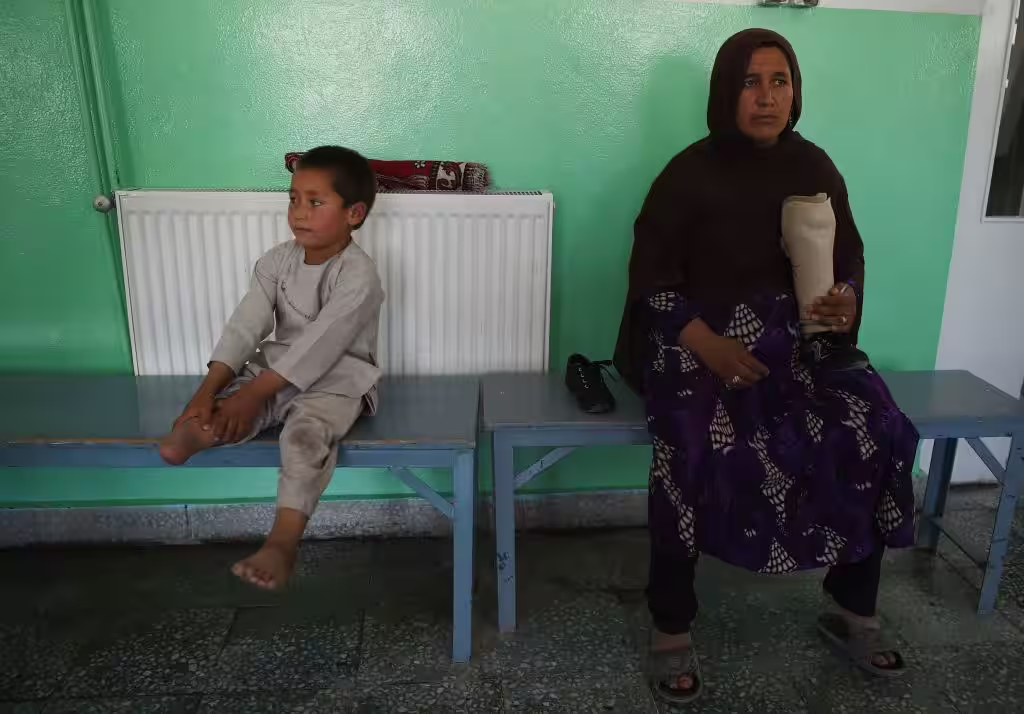
A six-year-old boy has taken his first steps with a prosthetic leg four months after losing a limb in an airstrike on Afghanistan’s Khost province.
Sayed Rahman was injured when an airstrike struck his family home during Ramadan. Three members of the family were killed, 12 were seriously injured and three—including Sayed Rahman and his brother—were left with permanent disabilities, according to a report by TOLOnews.
After receiving a prosthesis at an International Committee of the Red Cross physical rehabilitation centre, Sayed Rahman is now undergoing therapy to learn how to walk again.
His first steps represent an important clinical milestone, but they also reveal the long-term physical and psychological consequences that conflict creates for children.
A new prosthesis after a devastating family loss
Sayed Rahman reportedly experienced severe psychological distress following the attack and the loss of his leg.
Abdul Jalal Maqsoodi, the physiotherapist supporting his rehabilitation, said the child’s psychological condition was very poor when he first arrived. After several weeks of comprehensive rehabilitation, the clinical team observed significant progress in his overall condition.
The child’s rehabilitation has involved more than fitting an artificial limb.
A young patient recovering from a traumatic amputation may need:
- Wound and residual-limb care
- Pain and phantom-limb management
- Prevention of joint contractures
- Strength and balance training
- Prosthetic fitting and alignment
- Progressive gait training
- Psychological and trauma support
- Family education
- Assistance returning to school and play
For a child who has also experienced bereavement and the destruction of the family home, physical and emotional rehabilitation cannot be separated.
Paediatric prosthetic care is a long-term commitment
Providing Sayed Rahman with his first prosthesis is only the beginning of his rehabilitation pathway.
Children grow rapidly, meaning that sockets, pylons and other components may require frequent adjustment or replacement. A device that fits well today may become tight, uncomfortable or too short within months.
Paediatric prosthetic services must monitor:
- Residual-limb growth
- Socket pressure and skin condition
- Bone overgrowth
- Joint movement
- Prosthetic alignment
- Gait symmetry
- Changes in height and body weight
- Participation at school and home
Failure to provide regular review can result in pain, skin damage and compensatory movement.
A child may also continue wearing an uncomfortable prosthesis because of a desire to walk, attend school or avoid appearing different from classmates.
Clinicians and caregivers must therefore create opportunities for children to report discomfort and concerns without feeling that they have failed.
Walking is only one measure of recovery
The ability to walk between parallel bars or across a clinic is an important achievement, but it should not be the sole measure of successful rehabilitation.
For Sayed Rahman, longer-term outcomes will include whether he can:
- Move safely at home
- Return to school
- Play with other children
- Walk over uneven ground
- Manage steps and community environments
- Participate without persistent pain
- Develop confidence in his changing body
- Maintain access to repairs and replacement devices
The prosthesis should support childhood rather than simply demonstrate that a fitting was completed.
Education and community inclusion will be especially important as he adjusts to both limb loss and the psychological effects of the attack.
Cross-border violence is creating more child casualties
TOLOnews reported that a review of recent United Nations Assistance Mission in Afghanistan reports found that more than 230 Afghan children had been killed or injured in Pakistani attacks over a nine-month period.
UNAMA has separately documented substantial civilian casualties from cross-border hostilities and airstrikes during 2025 and 2026.
Between February 26 and March 5, 2026, it verified 185 civilian casualties in Afghanistan, including 56 deaths and 129 injuries. Women and children accounted for 55% of those casualties.
On June 28, UNAMA confirmed that at least 28 civilians were killed and 49 injured in airstrikes in Paktya, Paktika and Kunar provinces. Women and children were among the casualties.
These figures show that the need for paediatric trauma care and rehabilitation is not limited to the long-term effects of Afghanistan’s earlier conflicts. New injuries continue to add to the country’s existing disability burden.
Blast and airstrike injuries can create complex amputations
Conflict-related amputations are often clinically more complicated than planned surgical amputations.
A blast or structural collapse can cause:
- Extensive soft-tissue damage
- Irregular bone loss
- Burns and scarring
- Nerve injuries
- Infection
- Multiple fractures
- Damage to the opposite limb
- Hearing or visual impairment
- Embedded fragments
- Psychological trauma
Emergency surgeons must initially focus on saving life and controlling bleeding. The resulting residual limb may later require revision surgery or reconstructive treatment before a durable prosthetic socket can be fitted.
Children injured in attacks may also experience delays reaching specialist hospitals, particularly when they live in rural areas or when transport and healthcare services are disrupted.
Early rehabilitation after surgery can reduce contractures, maintain strength and prepare the child for future prosthetic use.
Afghanistan has one of the ICRC’s largest rehabilitation programmes
The ICRC has operated physical rehabilitation services in Afghanistan for decades, providing prostheses, orthoses, wheelchairs, walking aids, physiotherapy and social-inclusion support.
In 2024, more than 200,000 patients received prosthetic, orthotic, physiotherapy or assistive-product services through the programme.
Seven ICRC-supported physical rehabilitation centres operate across Afghanistan, serving adults and children with amputations, cerebral palsy, injuries and other physical disabilities.
The programme also extends beyond clinical treatment through:
- Vocational training
- Employment support
- Interest-free microcredit
- Wheelchair sport
- Social reintegration
- Support for education
This broader approach recognises that mobility alone does not guarantee inclusion.
A child may receive a prosthesis but remain excluded from school because of inaccessible buildings, transport difficulties or stigma. An adult may walk again but still be unable to return to employment without training or livelihood support.
Afghan professionals are central to continuity
The rehabilitation received by Sayed Rahman depends on Afghan physiotherapists, prosthetists, orthotists and technicians who can continue supporting him as he grows.
International funding and technical assistance remain important, but children need services that are available locally and repeatedly.
A sustainable paediatric pathway requires:
- Trained Afghan P&O professionals
- Reliable stocks of components and materials
- Local socket fabrication
- Physiotherapy close to the child’s home
- Systems for scheduled growth reviews
- Repair and replacement services
- Referral routes for surgery
- Psychological and peer support
International programmes should therefore continue investing in the workforce and infrastructure surrounding the child rather than focusing only on the delivery of an initial device.
Rehabilitation centres can provide more than treatment
Afghanistan’s physical rehabilitation centres have historically employed people with disabilities, including former patients who trained as prosthetic technicians, physiotherapists and support staff.
This model gives patients direct access to professionals with lived experience of disability.
Peer interaction can be particularly valuable for children and families who may initially see amputation as the end of education, independence or future opportunity.
Meeting adults who use prostheses and work within the rehabilitation sector can demonstrate that limb loss does not remove a person’s ability to contribute professionally and socially.
The ICRC’s Kabul centre has previously employed large numbers of former patients, combining rehabilitation with vocational opportunity and disability inclusion.
Psychological recovery must not be overlooked
Sayed Rahman did not experience limb loss in isolation.
He survived an attack that killed relatives, injured other family members and changed the family’s life within moments.
Children exposed to such events may experience:
- Grief
- Fear of further attacks
- Nightmares
- Withdrawal
- Anxiety around loud noises
- Changes in behaviour
- Difficulty concentrating
- Distress linked to the residual limb or prosthesis
- Separation anxiety
- Survivor guilt
Psychological care should be integrated with prosthetic rehabilitation rather than offered as an unrelated service.
Physiotherapists and prosthetists may be among the professionals who spend the most time with a child during recovery. They should be trained to recognise distress and refer the patient for appropriate mental-health support.
Play, family involvement and peer contact can also help make rehabilitation less clinical and frightening.
Families require practical support
A child’s amputation affects the entire household.
Family members may need to travel repeatedly to a rehabilitation centre, pay for accommodation or stop working while attending appointments.
Caregivers must learn how to:
- Inspect the residual limb
- Apply and remove the prosthesis
- Follow a wearing schedule
- Identify pressure marks
- Maintain the device
- Encourage safe activity
- Recognise when the child needs reassessment
Where the family has also lost members or income because of the same attack, these requirements can become overwhelming.
Transport assistance, accommodation and livelihood support may therefore be necessary to keep the child engaged in treatment.
Prosthetic access should be protected during conflict
The right to rehabilitation does not end during active hostilities.
Children with new amputations and existing prosthesis users must continue to access:
- Surgical follow-up
- Socket adjustments
- Replacement devices
- Physiotherapy
- Walking aids
- Pain treatment
- Psychological care
Interruptions can have particularly serious effects on growing children.
A delayed replacement socket may cause wounds or prevent school attendance. Months without therapy can allow a contracture to develop and make future walking more difficult.
Parties to conflict must protect healthcare facilities, staff and civilian access to treatment, while humanitarian organisations need safe routes for patients, professionals and prosthetic supplies.
First steps towards a longer future
Sayed Rahman’s happiness at receiving a prosthetic leg is an important reminder of what rehabilitation can restore.
Four months after an attack took his limb and members of his family, he has begun walking again with the support of Afghan rehabilitation professionals.
His progress should be celebrated, but it should not obscure the scale of care he will continue to need.
He will grow. His prosthesis will need to grow with him. His physical requirements will change, and the psychological effects of the attack may continue long after his wounds have healed.
For Afghanistan’s injured children, a prosthetic fitting is not the end of treatment.
It is the beginning of a long-term commitment to mobility, education, play and social inclusion.
- TOLOnews – Afghan child takes first steps with prosthetic after airstrike
- ICRC – Rehabilitation pathway to mobility and social inclusion in Afghanistan
- ICRC – Physical rehabilitation
- UNAMA – Update on civilian casualties in Afghanistan
- UNAMA – Statement on June 2026 civilian casualties
- ICRC – Unexploded ordnance continues to affect Afghan communities
- World Health Organization – Rehabilitation
- International Society for Prosthetics and Orthotics