

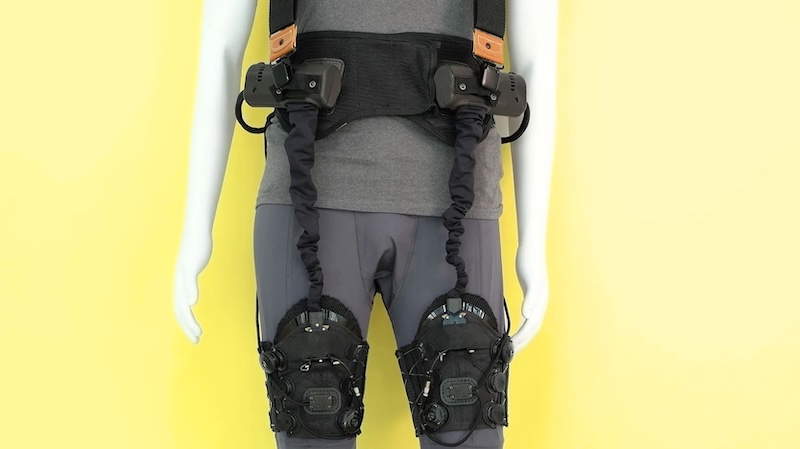
Wearable robotic systems being developed for people with Parkinson’s disease could create a substantial new opportunity for prosthetists and orthotists as powered orthoses, soft exosuits and sensor-driven rehabilitation technologies move closer to everyday clinical use.
A new feature from the Association for Advancing Automation (A3) highlights growing research into exoskeletons and soft robotic apparel designed to help people with Parkinson’s maintain mobility, reduce freezing of gait and potentially delay reliance on wheelchairs.
The technology remains at an early stage, but the direction of development could be highly significant for the P&O profession.
For Certified Prosthetist-Orthotists, the opportunity extends far beyond conventional bracing. Wearable robots require accurate physical interfaces with the body, biomechanical alignment, fitting, adjustment and long-term adaptation — all areas that sit naturally alongside existing orthotic expertise.
Soft robotics targets freezing of gait
One of the most disabling motor problems associated with Parkinson’s is freezing of gait, where a person temporarily becomes unable to move their feet forward despite intending to walk.
These episodes can increase the risk of falls because forward momentum of the upper body may continue while the feet remain effectively fixed to the floor.
A3 highlighted research from Harvard examining soft robotic apparel designed specifically to address this problem.
In an early study, robotic assistance was able to prevent freezing episodes during indoor walking in an individual with Parkinson’s. The system also supported improvements in walking distance and speed, with effects reproduced over several days and different environments.
The concept differs considerably from the large rigid exoskeletons often associated with spinal cord injury.
Soft exosuits use lightweight wearable structures, sensors and powered assistance to support movement while allowing the user to continue generating much of the movement themselves.
That could make them particularly relevant for people with progressive neurological conditions who can still walk but require intermittent assistance.
Machine learning is making exoskeletons more responsive
Research published in Frontiers in Robotics and AI in March 2026 provides further evidence of how quickly this area is developing.
Researchers tested a hip exoskeleton incorporating machine-learning-based movement state estimation in people with Parkinson’s disease and reported improvements in gait kinematics while assistance was being provided.
The importance of machine learning is that Parkinson’s symptoms can change considerably from person to person and even from one day to another.
A fixed mechanical support may therefore be insufficient.
Future devices will increasingly need to detect whether the user is accelerating, slowing, initiating a step, freezing or losing balance and then adjust assistance accordingly.
A3 reported that researchers are combining movement data, sensors and artificial intelligence to make wearable robots more adaptive and better able to anticipate user intention.
The scale of the potential market is enormous
Parkinson’s is not a niche rehabilitation condition.
The World Health Organization estimated that more than 8.5 million people were living with Parkinson’s globally in 2019, with prevalence having doubled over the previous 25 years. WHO also describes disability and deaths associated with Parkinson’s as increasing faster than for any other neurological disorder.
The future burden could be substantially larger.
Research projections have estimated that the global Parkinson’s population could exceed 25 million by 2050, with particularly rapid growth expected across South Asia and sub-Saharan Africa.
Western sub-Saharan Africa has been projected to experience one of the steepest proportional increases globally.
This makes Parkinson’s particularly relevant to IMEA CPO.
The Middle East, Africa and South Asia all contain rapidly ageing populations alongside healthcare systems that are expanding neurological and rehabilitation services.
A recent multinational study of Parkinson’s treatment access in the Middle East reported estimated prevalence rates ranging from approximately 37 per 100,000 in Jordan to more than 80 per 100,000 in Iran, while also highlighting significant variation in specialist access across the region.
For CPOs, this represents a patient population far larger than the traditional amputee market.
Why this is such a major opportunity for CPOs
Wearable robotics creates an important question for the P&O profession:
Who will fit these devices to patients?
A robot can generate assistance, but that assistance must still be transferred safely to the human body.
That requires knowledge of:
- anatomy
- joint alignment
- gait biomechanics
- pressure distribution
- soft-tissue tolerance
- contractures and range of motion
- muscle strength
- device suspension
- interface design
- functional mobility
These are core competencies already used by orthotists.
A poorly aligned powered device could generate unwanted joint forces, skin pressure or instability regardless of how sophisticated its software is.
The CPO therefore has the potential to become the professional who translates the robotic technology into a clinically usable mobility system.
Powered orthotics could become a new category of P&O
The opportunity is broader than Parkinson’s alone.
Wearable robotic systems are already being investigated for:
- stroke
- spinal cord injury
- multiple sclerosis
- cerebral palsy
- neuromuscular disease
- traumatic brain injury
- age-related mobility impairment
This could create a new clinical category positioned between conventional orthotics and rehabilitation robotics.
A future lower-limb orthotic portfolio could include:
Conventional AFO → carbon AFO → microprocessor KAFO → powered orthosis → soft exosuit → robotic exoskeleton.
For CPOs, that represents a significant expansion of both clinical scope and commercial opportunity.
Instead of supplying primarily passive devices, clinics could increasingly provide powered systems incorporating motors, sensors, software and AI.
Parkinson’s may be particularly suited to CPO-led wearable robotics
Parkinson’s represents an especially interesting market because many patients remain ambulatory for extended periods.
The requirement is therefore often not to replace walking entirely but to support walking at the point where the patient’s neurological control begins to fail.
Skip founder and CEO Kathryn Zealand told A3 that many patients want to remain out of a wheelchair for as long as possible, creating a gap where they need more support than existing aids provide but do not yet require full-time wheeled mobility.
This is exactly the type of functional gap in which orthotic intervention traditionally operates.
A wearable robot could become the technological evolution of that principle.
Rather than mechanically restricting or assisting a joint at all times, the device could provide support only when needed.
CPO clinics could become robotic mobility centres
If wearable robotics develops as expected, some P&O clinics may eventually evolve into broader mobility technology centres.
Services could include:
- conventional prosthetics and orthotics
- microprocessor orthoses
- powered AFOs and KAFOs
- soft robotic exosuits
- exoskeleton fitting
- gait analysis
- wearable sensor assessment
- FES systems
- remote mobility monitoring
- AI-assisted device configuration
CPOs could also provide follow-up as the patient’s condition changes.
That point is particularly important in Parkinson’s.
Matthew Dickinson, CEO of Viking Exos and a senior lecturer at the University of Central Lancashire, told A3 that a system designed and fitted for one Parkinson’s patient became challenging very quickly because the disease had progressed significantly within weeks.
The need for repeated adjustment could create an ongoing clinical relationship rather than a one-off device sale.
The opportunity could rival advanced prosthetics
High-technology P&O has historically focused heavily on amputees, particularly microprocessor knees and powered upper-limb prostheses.
Wearable robotics could broaden that high-value technology market into neurological rehabilitation.
The Parkinson’s population alone is measured in millions globally.
Adding stroke, spinal cord injury, multiple sclerosis and other neurological disorders produces a potential patient population many times larger than the global amputee population currently receiving advanced prosthetic components.
That does not mean every patient will require an exoskeleton.
But even relatively modest adoption could create a sizeable new market for assessment, fitting, training and long-term device management.
CPOs will have to claim the space
There is no guarantee that this opportunity will automatically belong to P&O.
Physiotherapists, rehabilitation physicians, biomedical engineers and robotics specialists are all likely to be involved.
CPOs therefore need to become familiar with the technology before it becomes mainstream.
Future professional development may increasingly include:
- wearable robotics
- sensor technology
- robotics alignment
- neurological rehabilitation
- AI-assisted movement analysis
- powered joint systems
- FES
- human-machine interfaces
Clinicians who combine traditional biomechanical expertise with an understanding of robotics could become particularly valuable members of multidisciplinary neurorehabilitation teams.
From orthotics to intelligent wearable assistance
Research remains early, and substantial questions remain around cost, weight, usability, battery life, durability and long-term patient acceptance.
Jessica Bath of the University of California, San Francisco told A3 that longer-term studies will be critical in determining whether patients continue to wear these systems outside the laboratory and whether their benefits justify the additional weight and cost.
A 2026 systematic review and meta-analysis similarly found growing evidence that wearable devices can influence gait, balance and motor function in Parkinson’s, while emphasising the need for further high-quality research.
The technology should therefore not yet be treated as routine care.
But its relevance to prosthetics and orthotics is becoming increasingly difficult to ignore.
The next generation of orthotic intervention may not simply hold a limb in position.
It may sense movement, understand intent, predict instability and provide powered assistance at precisely the moment it is required.
For CPOs, wearable robotics could therefore represent one of the largest opportunities for expansion of the profession in decades — taking orthotics beyond passive bracing and into the rapidly growing field of intelligent human mobility technology.
- Association for Advancing Automation – Parkinson’s Patients Could Soon Benefit From Wearable Robotics
- Frontiers in Robotics and AI – Hip Exoskeleton Assistance in Parkinson’s Disease
- Frontiers in Public Health – Wearable Devices for Gait, Balance and Motor Function in Parkinson’s Disease
- World Health Organization – Parkinson Disease