

Investment in prosthetic and orthotic services should be viewed not simply as a healthcare expense, but as a means of reducing long-term costs, supporting employment and enabling people to live more independently.
That is the central conclusion of a new economic analysis commissioned by the British Association of Prosthetists and Orthotists and prepared by the Centre for Economics and Business Research.
Published in August 2026, The Investment Case for Prosthetics and Orthotics in the UK: A Treasury-Compliant Economic Analysis examines the potential effects of expanding prosthetic and orthotic provision on healthcare, social care and the wider economy.
Although the study focuses on the United Kingdom, its findings offer an important reference point for policymakers, professional associations and service providers across the Middle East, Africa, Central Asia and South Asia. In many of these regions, access to prosthetic and orthotic care remains constrained by workforce shortages, fragmented referral systems, limited public funding and high out-of-pocket costs.
An estimated 193,000-patient treatment gap
The Importance of Prosthetics and Orthotics in Healthcare
The report estimates that 953 prosthetists and orthotists were practising in the UK in 2025. Using the midpoint of World Health Organization workforce guidance—17.5 professionals per million people—the researchers calculated that an additional 263 practitioners would be required.
This workforce shortfall was used to estimate a treatment gap of approximately 193,000 patients who were not receiving adequate prosthetic or orthotic care.
The report is careful to explain that this figure does not come from national waiting-list data. Instead, it is derived from the estimated shortage of qualified professionals and the number of patients each practitioner could reasonably treat.
The range also changes substantially depending on the assumed workforce requirement. At 15 professionals per million people, the treatment gap would be approximately 66,000 patients. At 20 per million, it could reach 320,000.
This variation highlights one of the report’s most significant messages: stronger data systems are urgently needed. Without reliable information on unmet need, patient profiles, conditions, waiting times and clinical outcomes, health systems cannot plan their workforces or allocate resources effectively.
£98.3 million investment could generate immediate savings
Cebr estimates that treating the modelled 2025 patient gap would have required an investment of £98.3 million. Orthotic treatment would account for 55.5% of this expenditure, while prosthetic treatment would represent 44.5%.
That investment was projected to produce £125.9 million in net savings for the NHS and social care system during the first year alone.
The economic benefits arise through several pathways. Appropriate orthotic intervention can help prevent complications associated with diabetic foot conditions, reduce pain and loss of function among people with knee osteoarthritis, and support mobility following stroke. Prosthetic provision can improve independence and reduce reliance on formal and informal care.
Earlier access may also reduce hospital admissions, surgery, injury risk and the use of other healthcare services. These savings illustrate why prosthetic and orthotic care should be integrated into wider prevention, rehabilitation and noncommunicable disease strategies rather than treated as an isolated device service.
Benefits extend beyond healthcare budgets
The analysis also estimates that expanded provision would generate £58.8 million in additional economic output through improved productivity, alongside a £14.6 million increase in tax receipts.
These benefits reflect the ability of appropriate prosthetic and orthotic interventions to help people remain in employment, return to work or function more effectively in their existing roles.
Over ten years, the cost of continued underinvestment becomes considerably larger. If no further action were taken to expand services by 2035, the report projects:
- £1.4 billion in lost net savings to health and social care
- £631 million in lost contribution to GDP
- £156 million in lost tax revenue
The estimates are discounted and expressed at 2025 price levels.
For governments managing rising rates of diabetes, musculoskeletal disorders, stroke, trauma and age-related disability, these figures reinforce the importance of assessing rehabilitation by its total economic impact—not only the initial cost of clinical staff and devices.
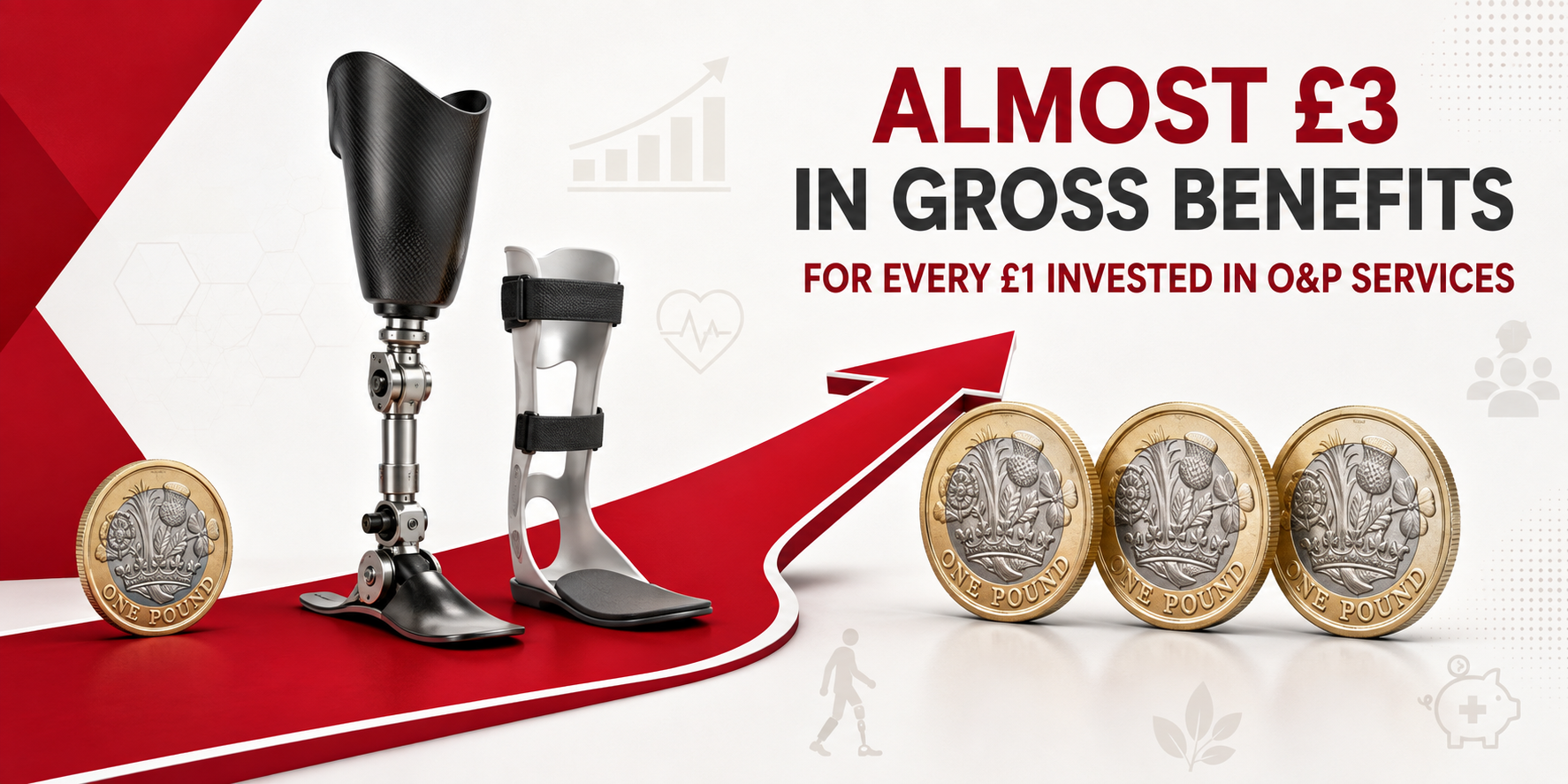
Almost £3 in gross benefits for every £1 invested
For the 2025 patient cohort, the report calculates a health and social care return on investment of 1.28:1. In practical terms, every £1 invested would generate an additional £1.28 in net savings, equivalent to £2.28 in gross savings.
When productivity improvements are included, the total return rises to 1.88:1, representing gross benefits of £2.88 for every £1 invested.
The longer-term results are stronger. Across the ten-year period to 2035, the projected health and social care return reaches 1.84:1, while the total return increases to 2.68:1. That equates to total gross benefits of £3.68 for every £1 invested.
The analysis therefore presents prosthetic and orthotic provision as both a clinically necessary service and a potentially high-value public investment.
Important limitations—and a global data challenge
The authors acknowledge several limitations. Comprehensive national data on untreated patients, waiting lists and the conditions represented within the treatment gap were unavailable. Some assumptions were based on historic workforce data, existing literature, professional input and estimates of reduced social care use.
Quality-of-life improvements were discussed but not converted into quality-adjusted life years. As a result, the report suggests that the full benefits of expanded provision may be higher than the headline return-on-investment figures indicate.
These limitations should also caution against applying the UK estimates directly to other countries. Labour costs, device prices, disease prevalence, workforce capacity and care pathways differ considerably across IMEA CPO’s regions.
Nevertheless, the economic framework is highly relevant. Countries can use similar methodologies to measure their own unmet need, compare intervention costs with avoided healthcare expenditure and account for gains in employment, education and independent living.
The World Health Organization’s standards for prosthetics and orthotics emphasise that high-quality services require coordinated action across policy, products, personnel and service provision. The new BAPO and Cebr analysis adds a persuasive economic dimension to that argument.
For the international prosthetics and orthotics community, the message is increasingly clear: improving access is not only a matter of clinical care and disability rights. It is an investment in healthier communities, more sustainable health systems and wider economic participation.
- BAPO and Cebr: The Investment Case for Prosthetics and Orthotics in the UK
- British Association of Prosthetists and Orthotists
- Centre for Economics and Business Research
- WHO Standards for Prosthetics and Orthotics
- WHO: Strengthening Prosthetics and Orthotics Services