

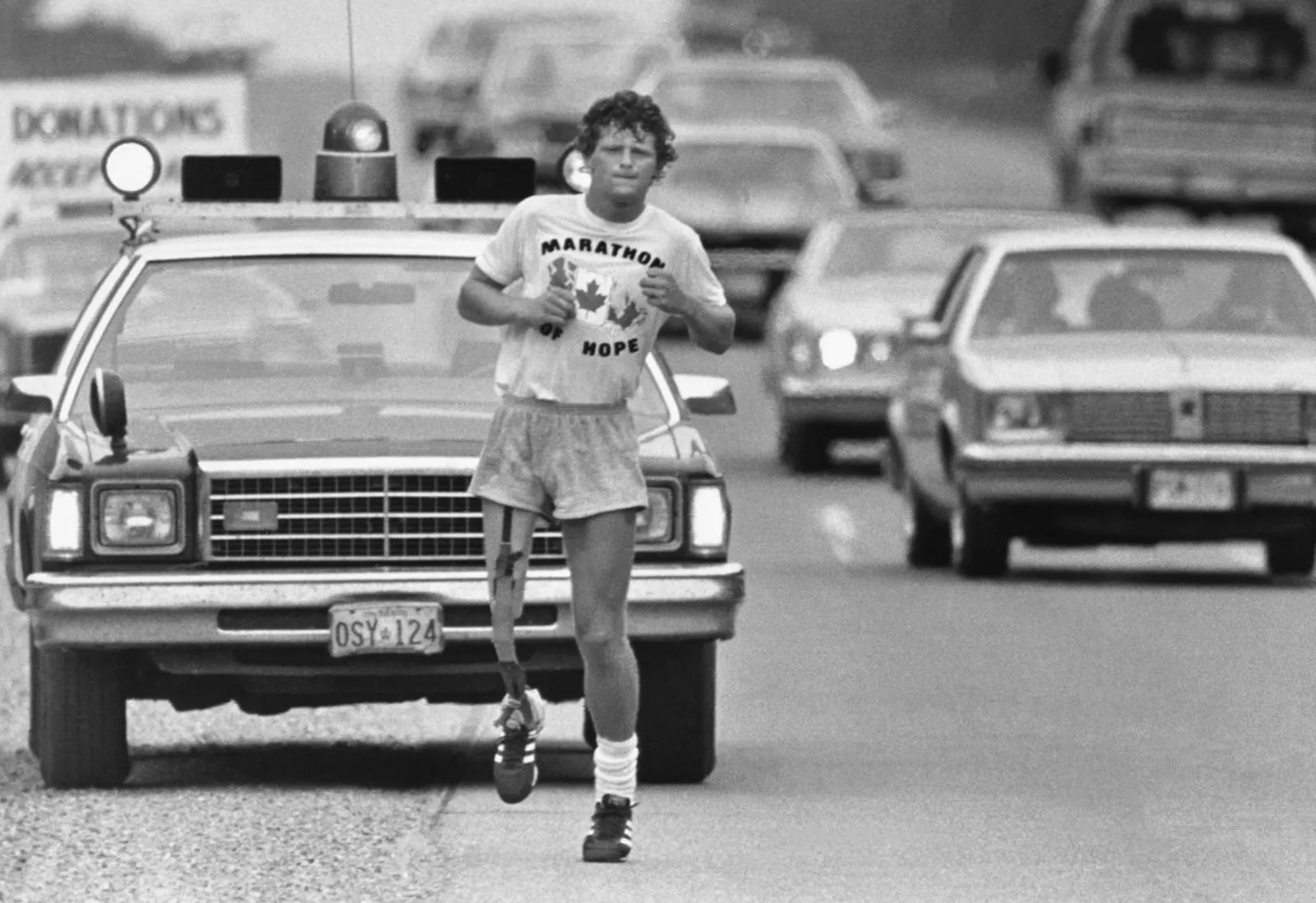
Terry Fox did not complete the journey he set out to make. Yet his unfinished run became one of the most consequential journeys ever undertaken by an amputee.
In 1980, the 21-year-old Canadian began running across his country on a transfemoral prosthesis. His goal was to raise one Canadian dollar from every person in Canada to support cancer research.
Fox called his journey the Marathon of Hope.
He ran 5,373 kilometres over 143 days—approximately one marathon every day—before the return of his cancer forced him to stop. His determination transformed public attitudes towards cancer, disability and what an amputee could achieve.
More than four decades later, fundraising inspired by his journey has exceeded C$1 billion, according to the Terry Fox Foundation.
A young athlete faces amputation
Terrance Stanley Fox was born in Winnipeg, Manitoba, on 28 July 1958 and grew up in Port Coquitlam, British Columbia.
Sport was an important part of his life. He played basketball and remained determined to earn a position on his school team despite initially being considered too small. That persistence would later become one of his defining characteristics.
In March 1977, at the age of 18, Fox was diagnosed with osteogenic sarcoma, or osteosarcoma, in his right leg. The cancer required an amputation approximately 15 centimetres above the knee, followed by 16 months of treatment.
The night before his surgery, Fox read about Dick Traum, an amputee who had completed the New York City Marathon using a prosthesis. The story helped him imagine a future in which losing a leg did not mean abandoning physical activity.
His time in cancer wards also exposed him to the experiences of other patients, including children undergoing difficult treatment. Fox became convinced that more money was needed for cancer research.
The idea of running across Canada began to take shape.
Training for an apparently impossible journey
Fox started preparing seriously for the Marathon of Hope in February 1979. Before beginning the national run, he covered more than 5,000 kilometres in training.
Running with an above-knee prosthesis in the late 1970s was very different from running with the energy-storing carbon-fibre feet available today.
Fox worked with prosthetist Ben Speicher to develop a limb that could withstand repeated running. An early experimental design intended to absorb shock was abandoned. The prosthesis ultimately used for the Marathon of Hope had limited shock absorption and needed to remain relatively straight while he ran.
An elastic element helped bring the prosthesis forward, but much of the work was generated by Fox’s hip muscles. The slow swing of the prosthetic limb contributed to his characteristic step-hop gait: he stepped and hopped on his sound leg while waiting for the prosthesis to move forward.
Educational material published by Canada’s History Society reports that Fox’s running prosthesis weighed approximately four kilograms. A modern equivalent can weigh roughly half as much while offering substantially better energy return and impact management.
Fox therefore undertook his challenge without a modern running blade, microprocessor knee or lightweight composite socket. His body had to repeatedly compensate for the mechanical limitations of the technology available to him.
The Marathon of Hope begins
On 12 April 1980, Fox dipped his prosthetic leg into the Atlantic Ocean at St John’s, Newfoundland, and began running westwards.
His plan was to cross Canada and reach the Pacific Ocean. He hoped to raise one dollar from every Canadian—around C$24 million at the time—for cancer research.
Accompanied initially by his friend Doug Alward in a support van, Fox ran through Newfoundland and Labrador, Prince Edward Island, Nova Scotia, New Brunswick, Quebec and Ontario.
His routine was relentless. He averaged around 42 kilometres each day, often beginning before sunrise. He ran through rain, wind, heat and cold, stopping along the route to speak at schools, community events and public gatherings.
Public attention developed slowly. During the early stages, there were days when few people recognised him and donations remained limited. As his story travelled across Canada, however, crowds grew and national media coverage increased.
Fox was no longer seen simply as an individual attempting an extraordinary physical challenge. He had become the public face of a national campaign for cancer research.
The run ends near Thunder Bay
On 1 September 1980, after 143 days and 5,373 kilometres, Fox experienced increasing chest pain and difficulty breathing outside Thunder Bay, Ontario.
Medical tests revealed that the cancer had spread to his lungs.
He was forced to end the Marathon of Hope and return to British Columbia for treatment. Even from hospital, Fox continued encouraging the public to support cancer research.
A nationally televised fundraising event soon raised millions of dollars. By 1 February 1981, donations to the Marathon of Hope had reached C$24.17 million, achieving Fox’s goal of approximately one dollar for every Canadian.
Terry Fox died on 28 June 1981 at the age of 22, one month before his twenty-third birthday.
A run that continued without him
The first official Terry Fox Run was held on 13 September 1981 at more than 760 locations. Approximately 300,000 people participated, raising C$3.5 million.
The event subsequently developed into an international movement. Runs have been organised in countries including India, Jordan, Kuwait, Saudi Arabia, the Philippines, Malaysia, Japan, Australia and the United Kingdom.
The format deliberately places participation above competition. People can run, walk or use mobility devices, reflecting Fox’s belief that collective action mattered more than sporting status.
In 2026, the Terry Fox Foundation announced that the movement created in his name had surpassed C$1 billion in cumulative fundraising for cancer research.
Fox’s impact is therefore measured not only by the distance he covered, but by the research, public participation and continuing charitable activity generated by his attempt.
What Terry Fox’s story means for prosthetics and orthotics
Fox’s achievement is often described principally as a story of personal courage. It is also part of the history of prosthetic development.
His gait showed the physical cost of running with the technology of that period. The limited shock absorption, heavy construction and slow swing phase placed enormous demands on his sound limb, hip muscles and entire body.
Modern amputee runners may have access to carbon-fibre running feet, lightweight sockets, specialised knees and activity-specific alignment. These technologies can store and return energy more effectively while reducing some of the compensatory movement required from the user.
However, technology alone does not create participation. An amputee also needs access to appropriate clinical assessment, socket fitting, rehabilitation, training, maintenance and opportunities to take part in sport.
For CPOs, Fox’s story is a reminder that the objective of a prosthesis extends beyond replacing an absent limb. The device should support the activities and ambitions that matter to the individual—whether that means walking to school, returning to employment, caring for a family or participating in competitive sport.
A legacy beyond inspiration
Terry Fox should not be remembered simply as an amputee who “overcame” disability. His campaign was never primarily about proving that he could tolerate pain.
It was about directing public attention towards other people living with cancer and converting that attention into research funding.
Fox understood that his visibility could be used to create collective action. He once summarised the belief behind his attempt with the words: “I believe in miracles. I have to.”
His Marathon of Hope remains unfinished geographically, but its purpose has continued far beyond the road outside Thunder Bay.
Terry Fox demonstrated that an amputee could become an athlete, advocate and national leader. He also showed that one person’s rehabilitation journey can grow into something much larger: a movement capable of changing attitudes, advancing research and giving hope to generations of people he would never meet.
- Terry Fox Foundation: Terry’s Story
- Terry Fox Foundation: Historical Facts and Timeline
- Terry Fox Foundation Surpasses C$1 Billion Raised
- The Canadian Encyclopedia: Terry Fox
- The Canadian Encyclopedia: Terry Fox and Running Prostheses
- Canada’s History: Terry Fox and Prosthetic Development