

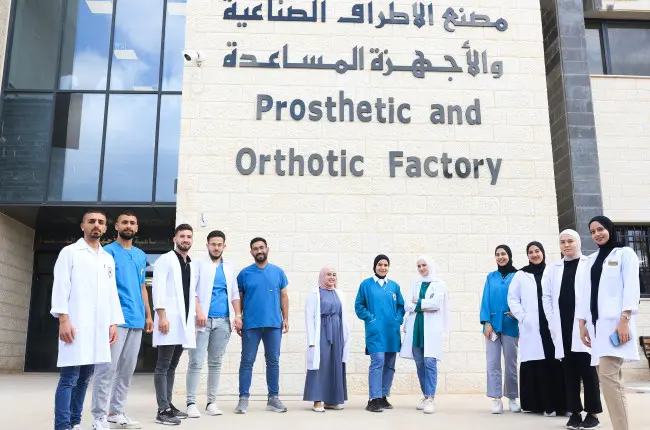
In 2019, the Arab American University (AAUP) took an important step in the development of rehabilitation education in Palestine when it announced the launch of a Bachelor’s programme in Prosthetics and Orthotics Sciences.
The programme was described by AAUP as the first of its kind in Palestine, creating a domestic university pathway for students seeking to become professionally educated prosthetists and orthotists rather than having to depend entirely on training opportunities outside the country.
Seven years later, the programme has developed into a four-year, English-language degree based at AAUP’s Jenin campus, supported by a dedicated Prosthetics and Orthotics Department and a university P&O factory that combines education with direct patient services.
For Palestine, where conflict, trauma, chronic disease, congenital conditions and limited access to specialist rehabilitation all contribute to the need for P&O services, the establishment of a local professional education programme represented far more than the addition of another university degree.
It was an attempt to begin building a sustainable Palestinian P&O workforce.
2019: Palestine’s first dedicated bachelor’s programme
AAUP formally announced the new Bachelor’s programme on 8 July 2019 through its Faculty of Allied Medical Sciences.
From its beginning, the programme was intended to combine healthcare, biomechanics and engineering.
AAUP said graduates would be trained to assess patients requiring prostheses and orthoses and design appropriate devices using knowledge of human anatomy, mechanical movement, engineering drawing, manufacturing and increasingly advanced technologies.
The university identified a broad patient population that future graduates would need to serve, including people with upper- and lower-limb amputations, musculoskeletal disorders, fractures, deformities and neurological impairments.
This multidisciplinary approach remains a defining feature of P&O education internationally.
A prosthetist-orthotist must understand the clinical presentation of a patient while also knowing how materials, mechanical forces, alignment and device design interact with the human body.
For Palestine, establishing this combination of clinical and technical knowledge within a university was a major step towards professionalising the sector.
A four-year professional degree
Today, AAUP describes the programme as the only four-year Category I Prosthetics and Orthotics degree programme in Palestine.
The Bachelor’s programme is delivered through the Faculty of Allied Medical Sciences at the Jenin Campus, with teaching conducted in English. The current programme remains four years in duration.
Its curriculum extends considerably beyond workshop fabrication.
Students study subjects that connect health sciences, biomechanics, engineering and clinical practice, while later courses address evidence-based practice, research, technological developments and changes affecting the professional role of the modern prosthetist-orthotist.
The curriculum even includes study of the historical development of the P&O profession in both local and global contexts, placing students within the wider evolution of prosthetic and orthotic practice.
International standards become part of the ambition
From the programme’s launch, AAUP emphasised external accreditation and alignment with international education standards.
The university currently describes its course as a Category I programme and states that it has accreditation from Palestinian higher-education and health authorities alongside international recognition.
International accreditation has particular importance in a profession such as P&O.
The International Society for Prosthetics and Orthotics has developed education standards intended to ensure that training programmes have the faculty, clinical experience, infrastructure and educational resources required to prepare competent entry-level practitioners.
For a relatively young P&O education programme operating in Palestine, working towards internationally comparable standards helps establish professional credibility while also making graduates part of a broader global rehabilitation community.
2021: Building the clinical training network
Education in prosthetics and orthotics cannot take place solely inside classrooms.
Students need access to patients, workshops and experienced clinicians across a range of conditions.
By 2021, AAUP was already working to expand these practical training opportunities.
In September that year, representatives from the Faculty of Allied Medical Sciences and students from the Prosthetics and Orthotics programme visited organisations in Bethlehem, including the Palestinian Military Medical Services and Life Gate Foundation, to discuss collaboration and student clinical training opportunities.
These partnerships were important because they connected academic education with the existing rehabilitation providers already treating Palestinian patients.
For students, exposure to multiple clinical environments provides experience of the realities that cannot always be replicated in a university laboratory.
The AAUP Prosthetics and Orthotics Factory
Perhaps the most important development supporting the programme has been the establishment of AAUP’s own Prosthetics and Orthotics Factory.
In 2021, AAUP reported that work was progressing on an approximately 1,800-square-metre facility, which it described at the time as one of the largest projects of its kind in the Middle East.
The concept went beyond creating a workshop for university students.
The factory was designed to operate simultaneously as a clinical service centre, manufacturing facility, educational environment and technology-development platform.
Today, AAUP says the factory designs and manufactures both upper- and lower-limb prostheses as well as orthotic devices for deformities, injuries and other conditions. Its clinical pathway includes patient diagnosis, measurement, fabrication and rehabilitation under specialist supervision.
Services extend into areas including custom orthoses, orthopaedic footwear, insoles and foot braces.
For students, the significance is considerable.
Instead of learning fabrication techniques in isolation, they can potentially observe the complete P&O process from clinical assessment to production, fitting and rehabilitation.
Turning the university into a service provider
The establishment of the factory also changed AAUP’s position within Palestinian rehabilitation.
The university was no longer simply educating clinicians who would eventually work elsewhere.
It began providing P&O services directly to the community.
AAUP describes the factory’s objectives as including the provision of high-quality prostheses and orthoses at affordable prices, student skills development, introduction of innovative technologies, earlier detection of deformities and closer collaboration with medical specialists.
That integration between education and service delivery is particularly relevant in Palestine because clinical demand itself provides a valuable training environment.
Students gain access to real patients, while patients potentially gain access to additional P&O capacity.
Technology increasingly enters the programme
The programme has also evolved alongside wider changes in prosthetic and orthotic technology.
Digital design, advanced components and electronic prostheses are increasingly becoming part of the AAUP environment.
In October 2024, the university announced what it described as the first electronic hand of its kind in Palestine, the OHand, supplied through its Prosthetics and Orthotics Factory.
The development demonstrated how the university’s P&O activities were expanding beyond conventional mechanical fabrication into technologies associated with modern upper-limb prosthetics.
For students, exposure to these technologies is becoming increasingly important.
Today’s graduate may begin a career working with thermoplastics, plaster and conventional components but can increasingly expect to encounter 3D scanning, CAD/CAM, additive manufacturing, microprocessor technologies and electronically controlled devices during their professional life.
A programme developed in an increasingly difficult environment
The history of AAUP’s P&O programme cannot be separated from the environment in which it operates.
Palestinian rehabilitation professionals work in conditions that can involve restricted movement, fragmented healthcare access, financial limitations and periods of intense conflict.
At the same time, the demand for prosthetic and orthotic services has continued to grow.
This makes developing a domestic workforce particularly important.
Reliance on international missions or clinicians trained overseas can contribute valuable expertise, but it cannot replace the long-term capacity created when a country is able to educate its own prosthetists and orthotists.
A Palestinian student who can study P&O in Jenin can potentially graduate, work locally, train future colleagues and contribute to developing rehabilitation services over an entire career.
That is the multiplier effect of professional education.
From programme to national rehabilitation infrastructure
The development since 2019 can therefore be viewed in several stages:
2019 – Launch of Palestine’s first dedicated four-year Bachelor’s programme in Prosthetics and Orthotics.
2021 – Expansion of external clinical training partnerships and development of the large AAUP Prosthetics and Orthotics Factory.
2022 onwards – Increasing integration between academic education, practical training and direct patient services.
2024 – Expansion into advanced prosthetic technologies including electronic upper-limb solutions.
2025–2026 – Continued development of the factory as a national clinical resource and strengthening cooperation with Palestinian ministries, rehabilitation centres and other organisations.
This progression has transformed the programme from a new university course into part of Palestine’s wider rehabilitation infrastructure.
Training the generation that comes next
The ultimate legacy of any P&O school is its graduates.
Machines, laboratories and components are important, but the long-term capacity of a rehabilitation system depends on people.
Before 2019, opportunities for a Palestinian student to pursue a full professional university education specifically in prosthetics and orthotics within Palestine were extremely limited.
AAUP changed that.
Its Jenin programme has created a local educational route connecting students with academic study, clinical practice, manufacturing and increasingly advanced technology.
In a country where the need for prosthetic and orthotic services is unlikely to diminish, that may prove to be one of the university’s most important contributions to Palestinian healthcare.
The programme’s history is still relatively short.
But in only seven years, it has moved from the announcement of Palestine’s first dedicated bachelor’s degree to the development of a teaching and manufacturing ecosystem capable of educating clinicians while simultaneously treating patients.
For the Palestinian P&O profession, AAUP is no longer simply training students for an existing workforce. It is helping create the workforce itself.
- Arab American University – Bachelor in Prosthetics and Orthotics
- AAUP – About the Prosthetics and Orthotics Programme
- AAUP – Prosthetics and Orthotics Department
- AAUP Prosthetics and Orthotics Factory
- AAUP – Original 2019 programme announcement
- International Society for Prosthetics and Orthotics – Education
- IMEA CPO