

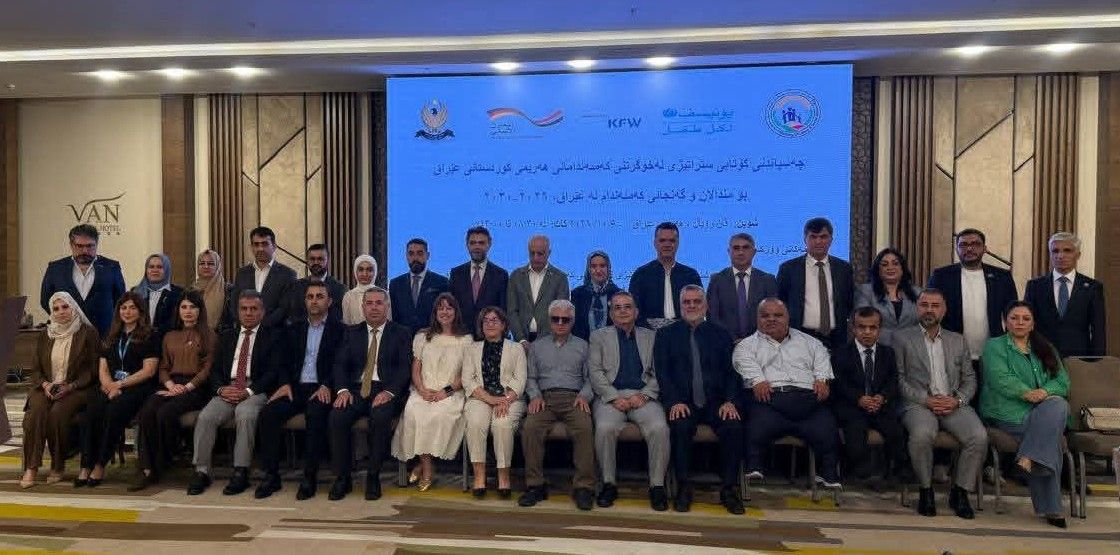
Government and development partners are meeting in Erbil to finalise a five-year strategy intended to strengthen the inclusion of children and young people with disabilities across the Kurdistan Region of Iraq.
The workshop, scheduled for 10 October 2026 at the Van Royal Hotel, brings together representatives of the Kurdistan Regional Government’s Ministry of Labour and Social Affairs, the Ministry of Health, UNICEF and other stakeholders.
Zekra Ali Aziz is participating as a representative of the Ministry of Health.
The workshop is expected to review the final draft of the Strategy for Disability Inclusion in the Kurdistan Region of Iraq for Children and Youth with Disabilities 2026–2030, establish priorities and strengthen the partnerships needed to turn the document into practical services.
Building a regional implementation framework
The Kurdistan initiative builds on wider national work around disability inclusion in Iraq.
Iraq launched its National Disability Inclusion Strategy for Children and Young People 2026–2030 in Baghdad in December 2025. Developed with support from UNICEF, the national framework addresses health, education, protection, social services, accessibility, digital participation and community inclusion. unicef.org
The Erbil workshop appears to focus on translating these principles into a framework suited to the Kurdistan Region’s institutions, population and service-delivery structures.
That regional process matters because a national strategy alone does not guarantee that children receive assessment, treatment, assistive products or educational support. Implementation depends on defined responsibilities, budgets, referral pathways, trained personnel and measurable targets.
Why O&P must be included
For prosthetists and orthotists, the strategy presents an opportunity to ensure that mobility and postural needs are recognised within children’s health and development services.
Children and young people may require orthotic or prosthetic intervention because of:
- Cerebral palsy
- Spina bifida
- Clubfoot
- Poliomyelitis and post-polio impairment
- Limb difference or amputation
- Neuromuscular disorders
- Scoliosis and other spinal deformities
- Trauma, burns or conflict-related injuries
- Developmental and congenital conditions
Access to a device by itself is not enough. Effective provision requires clinical assessment, prescription, fabrication or selection, fitting, training, follow-up, repair and replacement.
This is particularly important for children. Growth, changes in muscle tone and physical development can quickly affect fit and function. A child who receives an ankle-foot orthosis, spinal brace or prosthesis must have a clear route back to the service for review.
The strategy should therefore define prosthetic and orthotic care as an ongoing clinical service—not a one-time distribution activity.
Early identification and referral
One of the most important opportunities is to connect disability inclusion with early identification.
Children can lose valuable developmental time when families must navigate between hospitals, schools, charitable organisations and rehabilitation centres without a coordinated pathway.
A functioning referral system could link:
- Maternity and neonatal services
- Paediatricians
- Primary healthcare centres
- Orthopaedic and neurological services
- Physiotherapy and occupational therapy
- Prosthetic and orthotic facilities
- Schools and inclusive-education teams
- Community-based rehabilitation
- Social-protection programmes
- Organisations of persons with disabilities
Earlier referral can improve the timing of orthotic intervention, postural management, mobility support and family education. It may also prevent avoidable secondary complications such as contractures, pressure injuries and progressive deformity.
Affordability and social protection
Financial protection will be another important part of implementation.
Children may require several devices as they grow. Families can face direct costs for travel, clinical appointments, scans, materials, repairs and replacement equipment, even when the original product is subsidised.
The Kurdistan Region launched an inclusive Social Safety Net pilot in April 2026 with support from UNICEF, UNHCR and the World Bank. The programme includes child-sensitive case management and a unified information system intended to connect vulnerable families with services. unicef.org
Connecting disability services with social protection could help families access more than financial assistance. Case-management systems could also guide them towards rehabilitation, assistive technology, education and community support.
For O&P, public funding should recognise the full cost of care, including assessment, fitting, training, repairs and planned replacement.
Better data for better services
Reliable disability data will be essential if the strategy is to produce measurable change.
Health and rehabilitation authorities need to understand:
- How many children require O&P assessment
- Which diagnoses and functional needs are most common
- Where services are available
- How long families wait
- Which devices are supplied
- Whether children return for follow-up
- How often devices require repair or replacement
- Whether girls and boys have equal access
- How services differ between urban and rural communities
- Whether intervention improves participation in school and family life
The national Iraqi strategy commits to improving disability data and establishing systems capable of monitoring implementation. unicef.org
Regional indicators should extend beyond the number of devices delivered. Measures such as waiting time, successful fitting, continued device use, school participation and user satisfaction offer a more meaningful picture of impact.
Children and young people must help shape delivery
Disability strategies are stronger when people with disabilities participate in their design, implementation and evaluation.
Children and young people should be consulted in age-appropriate and accessible ways. Their families and representative organisations can identify practical barriers that may be invisible at policy level.
For an orthosis or prosthesis, these concerns may include:
- Comfort and appearance
- Ability to use the device at school
- Heat and skin irritation
- Participation in play and sport
- Bullying or stigma
- Difficulty obtaining repairs
- Travel distance to the clinic
- Lack of privacy during assessment
- Limited information in Kurdish or Arabic
These experiences should influence service standards, procurement decisions and outcome measurement.
Turning strategy into measurable action
The Erbil workshop represents an important policy milestone, but the real test will be implementation between 2026 and 2030.
For rehabilitation and O&P, practical priorities should include:
- Mapping existing services and workforce capacity
- Establishing regional referral pathways
- Strengthening paediatric rehabilitation teams
- Including prostheses and orthoses within funded health services
- Developing repair and replacement systems
- Improving rural and displaced-community access
- Training health, education and social-service personnel
- Creating outcome-based monitoring
- Involving young people with disabilities in governance
- Coordinating health, education and social protection
The participation of the Ministry of Health, Ministry of Labour and Social Affairs and UNICEF provides an important basis for cross-sector cooperation.
If the final strategy connects policy commitments with funded clinical pathways, it could improve far more than access to individual devices. It could help children and young people with disabilities enter school, participate in family and community life, develop skills and move into adulthood with greater independence.
- UNICEF: Iraq Launches National Disability Inclusion Strategy 2026–2030
- UNICEF Iraq
- Inclusive Social Safety Net Pilot in the Kurdistan Region
- UNICEF Disability Inclusion Policy and Strategy 2022–2030