

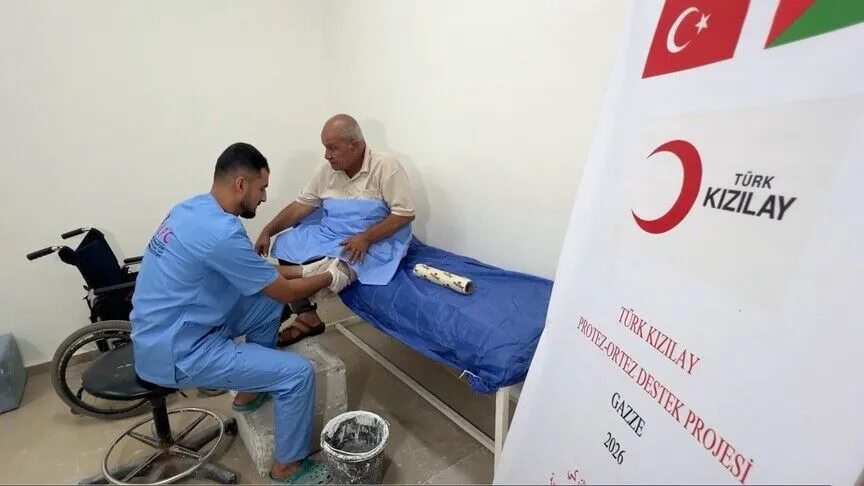
A Turkish Red Crescent-supported prosthetics project in Gaza is helping people with limb loss access replacement devices and rehabilitation, while drawing attention to the consequences of interrupted care.
In an October 2 report by Anadolu Agency, 64-year-old Mahmoud Fouad al-Dahshan described losing access to a prosthesis fitted during treatment in Egypt. He said Israeli soldiers required him to choose between keeping his wheelchair and his prosthetic limb when returning to Gaza in May. He retained the wheelchair.
The report describes technicians taking measurements for a replacement at the Gaza Municipality-affiliated Prosthetics and Orthotics Center. It does not establish that his new fitting had been completed.
For the O&P community, his experience illustrates how access to a device can be interrupted even after a patient has received treatment and begun rehabilitation.
A Project Supporting Local Provision
Anadolu quotes Turkish Red Crescent Gaza office director Saadi Dabour as saying that 10 people received prosthetic fittings during August and September, with a second phase intended to support another 10. He identifies shortages of raw materials and components as a major obstacle.
The Turkish Red Crescent’s own programme information confirms a prosthetics and orthotics project aimed at improving mobility and independence in daily life for people who have lost limbs.
The partnership’s significance extends beyond the number of fittings. Supporting local provision creates a point of contact where patients can be assessed and where prosthetic work can be connected with rehabilitation. Sustaining that capability requires continued support for the professionals and facilities delivering care.
Rehabilitation Needs Extend Far Beyond Individual Projects
The wider scale of need is documented by the World Health Organization. In its May 2026 update, WHO estimated that approximately 43,000 people injured in Gaza since October 2023 had sustained life-changing injuries, with children accounting for up to a quarter.
This figure covers several categories of severe injury; it is not an estimate of amputees alone. WHO also called for rehabilitation equipment, prostheses, assistive products and essential medicines to enter Gaza without delay or rejection.
These findings place prosthetic provision within a much broader requirement for long-term rehabilitation. Individual projects can make a meaningful contribution, but the overall response also needs functioning services, trained personnel and dependable supplies.
Recovery Includes Training and Confidence
An ICRC account published in April 2026 describes Aseel, a young woman from Gaza who underwent amputation following an injury. Her recovery included regular physical therapy and support from a rehabilitation team before and after receiving a prosthesis.
The team helped her prepare for activities that mattered personally to her, including walking and dancing at her wedding. The account also describes the difficulties of continuing life while displaced and living in a tent.
Her experience offers a complementary perspective: a fitted device is part of a process through which people regain confidence and pursue their own goals. Rehabilitation programmes therefore need to consider what patients want to do, alongside the technical requirements of their prostheses.
Continuity of Care Is a Practical Priority
The WHO standards for prosthetics and orthotics services emphasise regular access to qualified teams, equipped workshops and connections with related health services.
Applied to humanitarian planning, this framework supports an approach that includes assessment, fitting, rehabilitation and continuing access to adjustments and repairs. Replacement provision also deserves attention when an existing device becomes unavailable or unusable.
For regional suppliers and humanitarian partners, a practical contribution would begin with requirements identified by the treating centre. Coordinated support could then address compatible components, workshop materials, technical assistance and follow-up capacity.
Keeping Mobility Within Reach
For IMEA CPO readers, the Gaza project highlights the relationship between humanitarian access and everyday prosthetic practice. Funding a fitting, supplying materials and enabling a patient to return for care are connected parts of the same pathway.
Al-Dahshan’s search for a replacement shows why continuity matters. Protecting access to prostheses and supporting the local teams who fit and maintain them can help preserve the progress patients have already made towards greater independence.
- Anadolu Agency: Al-Dahshan’s account and the Gaza prosthetics project
- Turkish Red Crescent: Gaza assistance and prosthetics project
- WHO: Gaza rehabilitation needs, May 2026 update
- ICRC: Aseel’s rehabilitation journey
- WHO: Strengthening prosthetics and orthotics services