

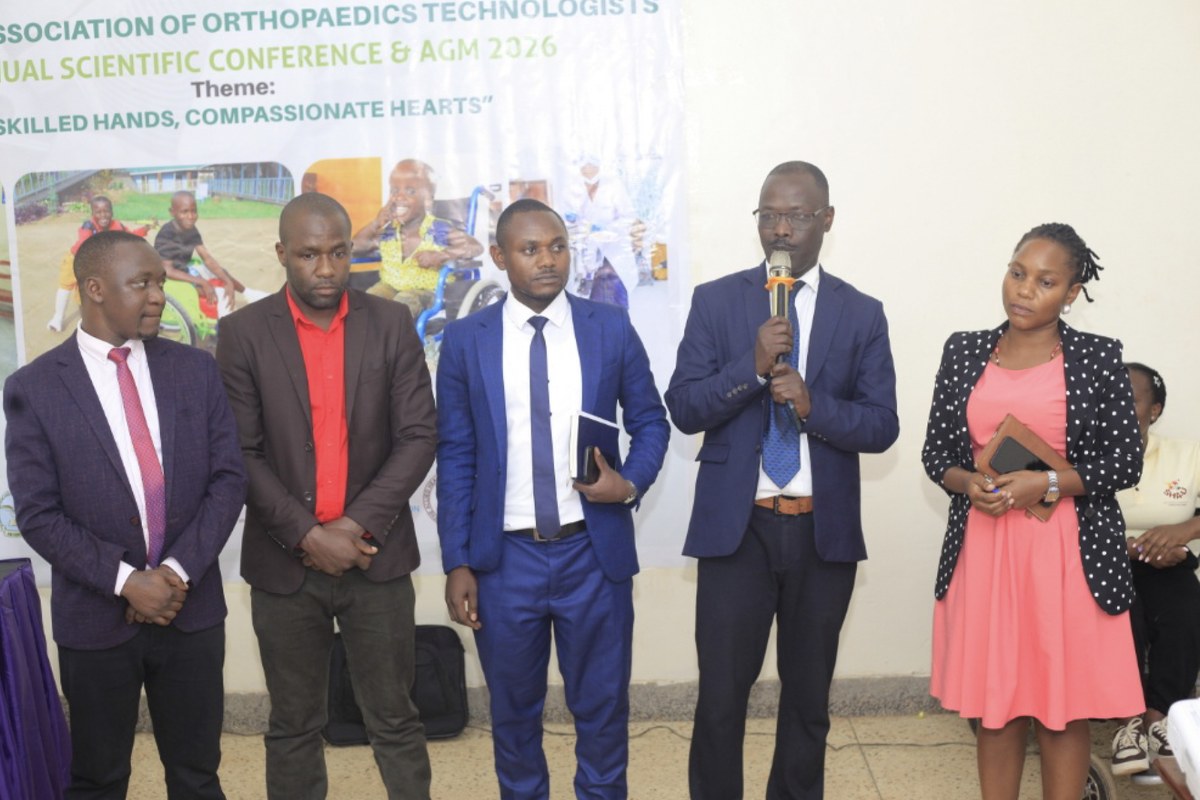
More than 120 orthopaedic technologists and rehabilitation specialists from Uganda and Kenya gathered at the Uganda Institute of Allied Health and Management Sciences–Mulago in Kampala for the Uganda Association of Orthopaedic Technologists (UAOT) Annual Scientific Conference and Annual General Meeting 2026. Held under the theme “Skilled Hands, Compassionate Hearts”, the meeting moved quickly from clinical exchange to the issues shaping the profession’s future: pay, regulation, workforce and the condition of public orthopaedic workshops.
Delegates represented Mulago National Referral Hospital, regional referral hospitals in Fort Portal, Mbale, Hoima, Lira, Mbarara, Gulu, Yumbe, Jinja and Masaka, the UPDF Air Force and St. Francis Hospital Buluba, according to a conference report compiled by Global Health Debate News.
Regional ties and a student-led livestream
Mr. Kisombo, Principal of the School of Orthopaedic Technology, opened proceedings, noting that hosting practising professionals on campus strengthens mentorship between students and clinicians. The President and General Secretary of the National Association for Orthopaedic Technologists–Kenya (NAOT) attended, urging their Ugandan counterparts to keep building the association and to extend future conferences over several days. The Uganda Orthopaedic Technologists Students Association (UOTESA) streamed the full event live on TikTok for about ten hours.
Salary equity and CPD
UAOT President Mr. Ssevumme Kawuma Abbey, Principal Orthopaedic Technologist at Fort Portal Regional Referral Hospital, updated members on the association’s court case against the Attorney General over salary disparities among orthopaedic professionals; a ruling is awaited. He also reminded members that Continuing Professional Development (CPD) hours are mandatory.
New P&O guidelines and an end to double regulation
Mr. Kintu Edmund, a council member of the Allied Health Professionals Council (AHPC) and Head of the conference Planning and Protocol Committee, reported that the Regulations and Guidelines for Prosthetics and Orthotics Services Provision in Uganda have been passed by the Orthopaedic Technology Advisory Board at AHPC and will go to the relevant council committee. He said that overlapping mandates — the National Drug Authority now regulating medical devices, including P&O appliances, while AHPC regulates service quality — will be harmonised so practitioners are not licensed twice.
He also highlighted the Ministry of Health’s first National Strategic Plan for Rehabilitation and Assistive Technology Services, and said the national assistive technology priority list and its costing are in their final stages.
A national workshop under strain
Mr. Kisambira, Manager of the Mulago National Referral Hospital Orthopaedic Workshop, described shortages of raw materials, recurrent flooding, dilapidated buildings and the retirement of more than 70% of orthopaedic workshop assistants. Wheelchair technician Mr. Dennis Ninsimenta then asked for workshop assistants to be admitted to UAOT, to support a standard training curriculum and better pay scales. Members approved the motion unanimously.
After the AGM, delegates toured the Mulago workshop and pledged 20 jerricans of paint to start its refurbishment.
Governance reset
With the surviving founding directors of the UAOT company, registered in 2000, now retired, members nominated six candidates for a new board and elected Mr. Kintu unopposed as Chief Executive Officer, tasked with reviving the company.
Ministry’s call: data, professionalism and 5S
Chief Guest Dr. Muwanga, Assistant Commissioner for Disability and Rehabilitation at the Ministry of Health, said gaps in rehabilitation data continue to hamper planning and budgets. While acknowledging the poor state of many government workshops, he urged technologists to raise professional standards and adopt the 5S approach — Sort, Set in order, Shine, Standardise, Sustain.
Partners included AHPC, Circleg, Spina Bifida & Hydrocephalus Association Uganda, Hope Health Action, INS Orthotics, NAOT Kenya, Knowledge for Change, the Mulago workshop and the Federation of Tug of War Associations Uganda. CoRSU Rehabilitation Hospital also addressed delegates.
IMEA CPO Perspective
Uganda’s agenda mirrors challenges across Africa and the wider IMEA region. Separating device regulation from regulation of the people who fit devices is becoming common as countries build medical-device frameworks; how Uganda harmonises NDA and AHPC roles will be a useful model for neighbours. Bringing workshop assistants and wheelchair technicians into the professional association recognises that P&O services depend on the whole workshop team, not only qualified clinicians.
For CPOs, the opportunity is significant. The WHO–UNICEF Global Report on Assistive Technology estimates that more than 2.5 billion people need at least one assistive product. National AT priority lists, costed strategic plans and published service guidelines are what turn that need into funded posts, procurement and training. Uganda’s cross-border cooperation with Kenya also points to a growing East African professional network.