

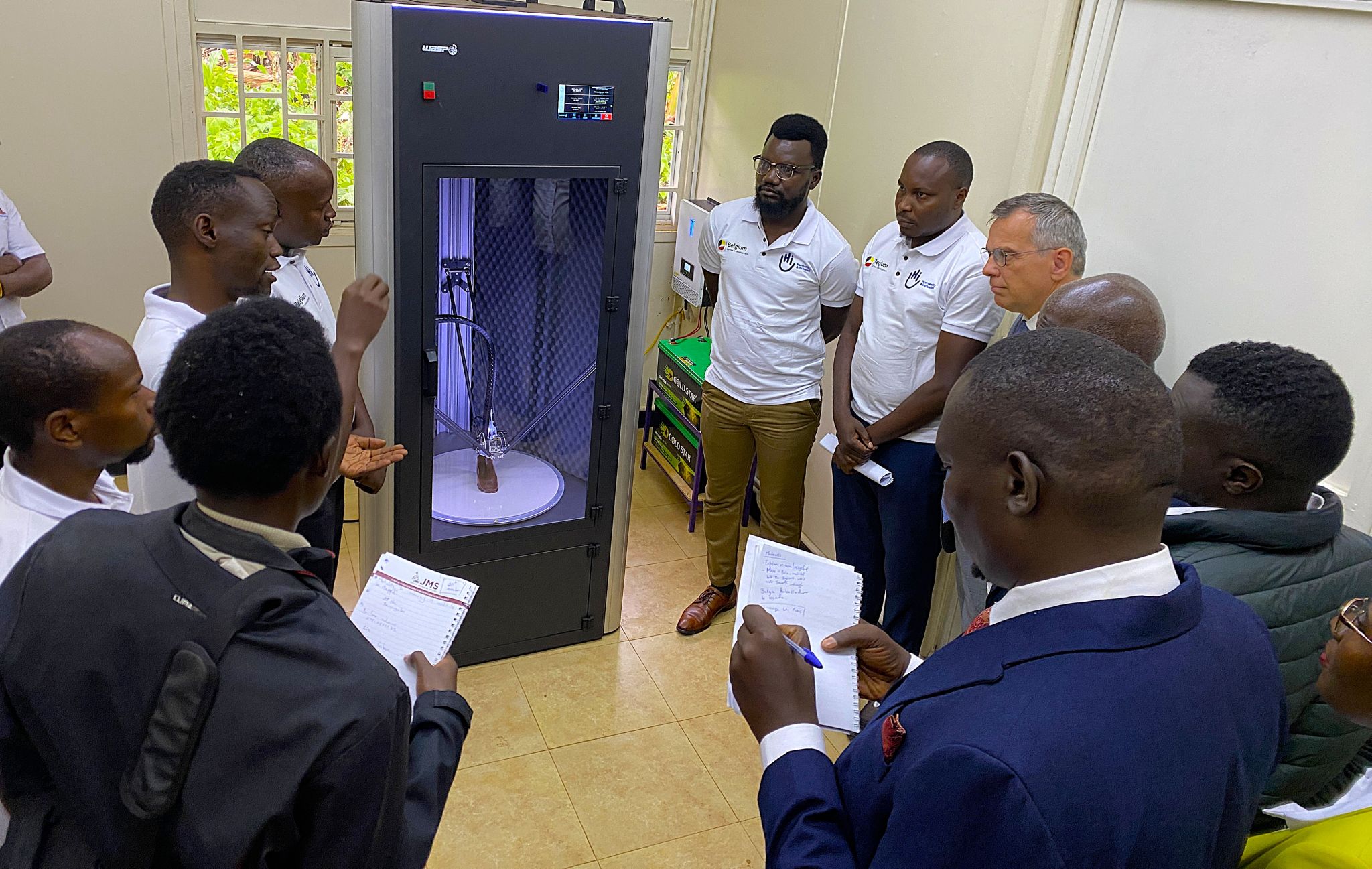
Katalemwa Cheshire Home has officially opened a 3D printing unit at its Assistive Technology Centre near Kampala, Uganda, adding digital scanning, computer-aided design and additive manufacturing to its production of prostheses and orthoses for children and young people with disabilities.
The Ambassador of Belgium to Uganda, H.E. Hugues Chantry, unveiled the facility as guest of honour on 12 November. The project was funded by Humanity & Inclusion (HI), represented at the launch by its Uganda Country Director, and the Embassy of Belgium. Representatives of CBM Christian Blind Mission and Uganda’s Ministry of Health also attended.
From weeks to days
According to Katalemwa’s press release, the unit combines optical 3D scanners for patient assessment, CAD and slicer software for refining digital models, and 3D printers in a dedicated production room. Photos from the launch show a large-format WASP delta printer producing a lower-limb device.
The centre says conventional plaster casting took one to two weeks per device, while the digital workflow cuts preparation to between one and four days. It also expects less material waste and more precise, comfortable devices.
“This technology allows us to serve more people in less time with higher accuracy,” said Kenneth Nangai, Program Manager at Katalemwa Cheshire Home. He added that faster delivery would help children and youth with disabilities return to school, work and community life sooner.
Building on decades of workshop production
Founded in 1970, Katalemwa Cheshire Home supports children and young people with disabilities aged up to 18, and their families, through physiotherapy, occupational therapy, surgical care, assistive technology, education and livelihoods support. Its Assistive Technology Centre already runs metal and welding, carpentry, leather and aluminium production lines, making orthopaedic shoes, Steenbeek foot abduction braces for clubfoot, wheelchairs, calipers, AFOs, KAFOs and splints. The new unit will make custom limbs and braces.
The launch follows the training of Katalemwa’s orthopaedic technologists and technicians in the new technology, which IMEA CPO reported in October. The centre says demand for assistive devices in Uganda is rising because of congenital conditions, road traffic injuries and diabetes-related amputations, while access remains limited for low-income and rural families.
IMEA CPO Perspective
Katalemwa is one of a growing number of African workshops adding digital production to established manual services, and its starting point is a strong one: an experienced workforce, a long-running paediatric caseload and a funder, HI, with its own experience of 3D-printed orthoses and prostheses in Uganda’s refugee settlements. The photos also show a battery and inverter system beside the printer, a reminder that reliable power is part of the infrastructure digital O&P needs in the region.
The real test will come over the next year. Printed AFOs and sockets must prove as durable as thermoformed and laminated devices under daily use, and growing children will need devices replaced often, which is where stored digital scans can save the most time. Filament supply, printer maintenance and published outcome data will decide whether the weeks-to-days promise holds, and whether the model can be shared with other rehabilitation centres in East Africa.
Sources
- Katalemwa Cheshire Home: Launch of 3D Printing Project (press release)
- Katalemwa Cheshire Home on LinkedIn (launch announcement, November 2026)
- IMEA CPO: Katalemwa Cheshire Home Introduces 3D Printing for Assistive Technology