 By
By

In a first-of-its-kind study published in Nature Scientific Reports, a team of British bioengineers applied gentle vibrations to the residual limbs of sixteen people with upper limb differences and discovered something extraordinary: 87 percent of participants felt the sensation of movement in their phantom or missing limbs. Even more striking, three participants with congenital limb differences felt these limb sensations for the first time in their lives.
Conducted by scientists from the University of Portsmouth and University College, London, the study represents the first non-invasive investigation of a phenomenon known as the “proprioception illusion.” The science behind the illusion isn’t new, but its application to limb difference is groundbreaking. And this study’s results may point toward a future where prosthetic limbs could feel almost as natural as biological ones.
First described in 1972 by British physiologist Guy M. Goodwin, the proprioception illusion is caused by a quirk in the brain’s perception of body position. Our muscles contain tiny sensory receptors called muscle spindles that detect changes in muscle length. When a muscle stretches, the spindles send impulses to the brain, which then adjusts its “map” of the body’s orientation in space. In short, it senses movement.
Goodwin documented the proprioception illusion by applying external vibrations to the muscles of subjects with intact limbs. The vibrations tricked the spindles into sending signals that indicate muscle stretch, causing the test subjects to experience the sensation of movement, even though their limbs weren’t moving. Subsequent tests built on Goodwin’s findings, also using nondisabled subjects. In 2018, researchers at the Cleveland Clinic induced the proprioception illusion on upper-limb amputees who’d undergone targeted muscle reinnervation (TMR) surgery, and they found that the technique could improve motor control over prosthetic hands.
But the Portsmouth-London College study is the first to investigate whether external vibrations could trigger the proprioception illusion in amputees who hadn’t undergone specialized surgeries.
The research team (led by Ruth Leskovar and Peter Kyberd) recruited 16 participants—eight with acquired amputations and eight with congenital differences. The subjects were equally divided between above-elbow and below-elbow limb differences, and they ranged in age from 18 to 79 years old. Participants sat with their eyes closed and noise-canceling headphones playing white noise to eliminate visual and auditory distractions. A small vibrating motor, controlled by a microprocessor to ensure precise frequencies, was applied to three different locations on their biceps: the distal tendon (near the elbow), the proximal tendon (near the armpit), and the muscle belly (the meaty middle part).
The researchers tested four different vibration frequencies—50, 70, 90, and 110 Hz—with each vibration lasting 30 seconds. Participants were asked to describe what they felt, if anything, and to rate the vividness, duration, and range of movement of any illusions they experienced. The study tested participants with their arm in two positions: hanging naturally beside their body, and supported in a frame with the elbow bent at 120 degrees. This detail proved surprisingly important.
All but two of the 16 participants felt illusory movements of some sort, and their sensations were strikingly varied. Seven participants felt their elbow extending, while seven felt it flexing. Ten felt their shoulder abducting (moving away from the body), six felt adduction (moving toward the body), and nine felt rotational movements of their upper arm. In addition, participants reported feeling their phantom fingers tapping, gripping, closing, or opening. Some felt specific fingers moving, primarily the thumb, index finger, and middle finger. One participant described the sensation as feeling like their arm was hanging out of a car window. Another felt swimming movements. The experiences were diverse, personal, and remarkably vivid.
Perhaps most intriguing were the three participants with congenital differences experienced sensations of hands and fingers they had never possessed. One participant with bilateral, congenital above-elbow limb differences described sensations that accurately reflected the movement of an unimpaired elbow—despite never having flexed that joint in their life.
Various factors affected the duration and intensity of the proprioception illusion. Limb position made the biggest difference. When participants’ arms hung naturally beside their bodies, illusions were significantly more vivid, lasted longer, and reflected a greater perceived range of movement compared to when the arm was supported in a frame.
The location of vibration also mattered. Stimulating the proximal tendon (near the armpit) with the arm hanging produced the most successful results—75 percent of participants experienced movement illusions at 70 and 110 Hz frequencies. The muscle belly worked well, too, with about 50 percent success across all frequencies when the arm was hanging.
This information could enable prosthetic limb designers to build sensory feedback into devices without requiring TMR, implanted electrodes, or other invasive procedures. It’s also completely intuitive: Instead of routing signals to transplanted nerves or using other translational systems with steep learning curves and cognitive burdens, the proprioception illusion harnesses the same feedback organs our bodies naturally use—and thereby creates the sensation of natural movement in an unimpaired limb.
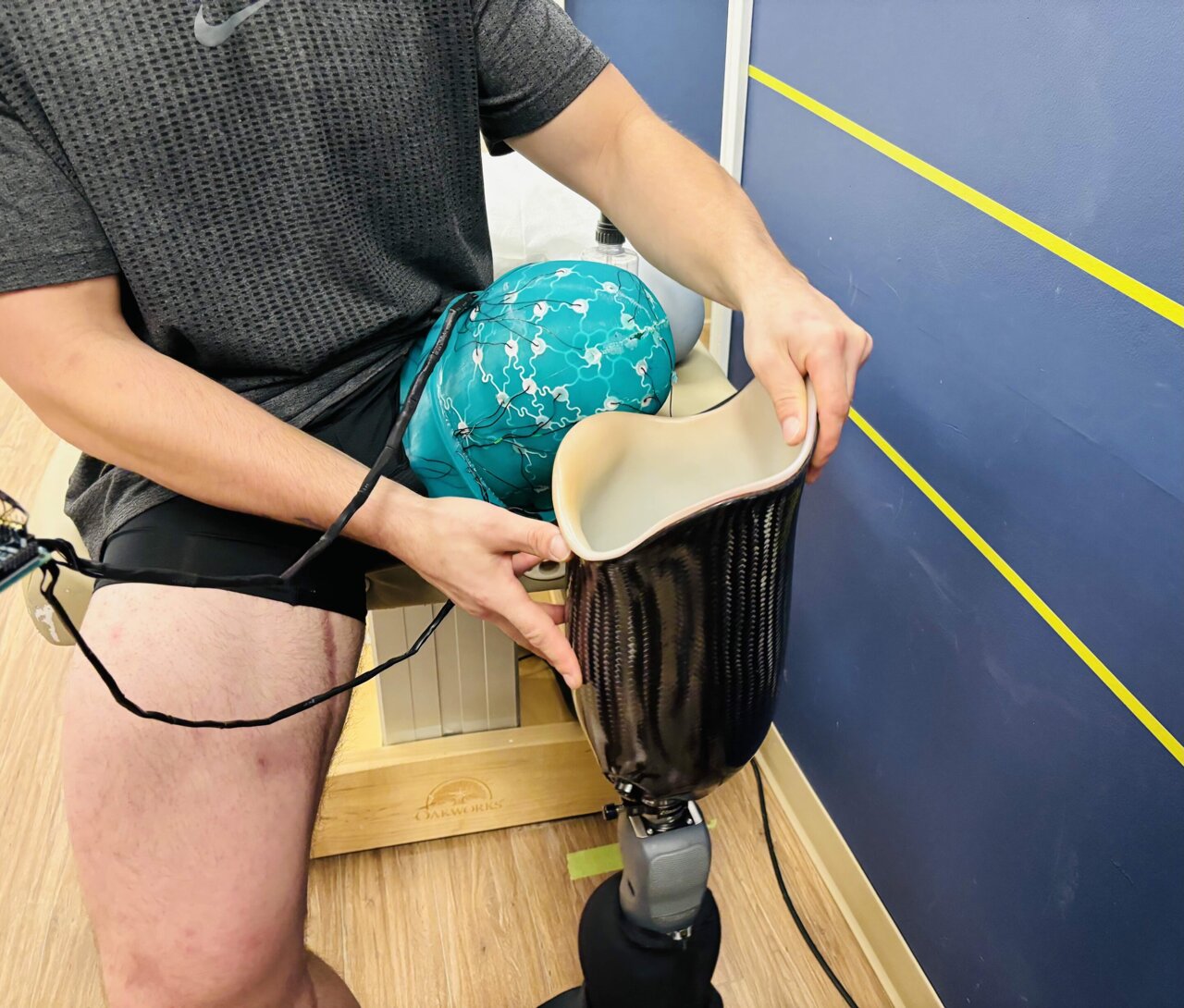
The path from laboratory demonstration to clinical application will require years of additional research and development. Vibrators need to become smaller and lighter, stimulation timing and frequency need to be optimized, and the technology must be integrated with existing prosthetic systems. But the core technological components—small vibrating motors controlled by microprocessors—are already out there and are affordable.
The open-access paper is available at Nature Scientific Reports.