 By
By
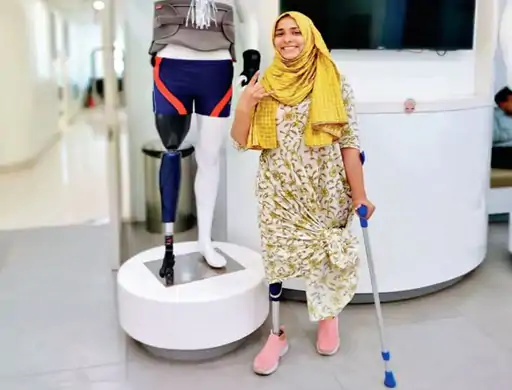
Dr Roshan Jahan Shaikh’s story is one of the most powerful examples of resilience, rehabilitation and disability inclusion in Indian medical education. After losing both legs in a Mumbai local train accident as a teenager, she went on to fight for her right to study medicine, complete her MBBS, pursue postgraduate training in pathology, and become a motivational speaker and advocate for people with disabilities.
The accident took place in October 2008, when Roshan was returning home from college after an exam. According to reports, she fell from a moving local train in Mumbai and suffered devastating injuries that led to bilateral lower-limb amputation. The original Hyderabad Post account describes her as conscious after the accident, waiting for help while severely injured on the tracks.
For many people, such trauma would have interrupted education permanently. For Roshan, it became the beginning of a much larger journey. After surgery, recovery and prosthetic rehabilitation, she returned to her studies, completed her higher secondary education and continued pursuing her ambition to become a doctor. She later learned to walk with prosthetic limbs and rebuilt her independence step by step.
Her next challenge was not only physical, but institutional. After performing strongly in the medical entrance process, she was reportedly denied admission because her disability percentage exceeded the eligibility ceiling then applied for medical admissions. The Bombay High Court later intervened, directing that she be granted provisional admission and criticising the authorities for focusing on what she could not do rather than what she could achieve.
That legal battle became part of a wider disability-rights conversation in India. Roshan’s case highlighted how rigid eligibility rules can exclude capable candidates when systems fail to make reasonable assessments of function, accommodation and individual potential. She went on to study at Seth GS Medical College and KEM Hospital in Mumbai, completing her MBBS and later pursuing MD Pathology.
Her journey also underlines the role of prosthetics, rehabilitation and family support in restoring mobility and opportunity after limb loss. Reports credit her treating orthopaedic surgeon, Dr Sanjay Kantharia/Kotharia, as an important mentor in her recovery and medical journey. Her parents, from a modest economic background, also played a central role in supporting her education and recovery.
Today, Dr Roshan Shaikh is recognised not only as a doctor, but also as a motivational speaker and disability-rights advocate. Alumni accounts describe her as a pathologist, MD holder and public speaker who has advocated for the rights of people with physical disabilities. She has received several awards, including recognition for courage and achievement.
Her story continues to evolve. In May 2026, The Times of India reported that Dr Roshan Shaikh had delivered a healthy baby girl after a high-risk pregnancy, with medical teams supporting her through gestational diabetes, post-surgical recovery, prosthetic mobility and physiotherapy. That milestone adds another dimension to a life already marked by exceptional perseverance.
For the orthotics and prosthetics community, Dr Roshan’s journey is more than an inspirational story. It is a reminder that assistive technology, timely rehabilitation, clinical skill and inclusive policy can change the trajectory of a person’s life. Prosthetic limbs are not simply devices; when combined with rehabilitation, education and social support, they can help restore access to study, work, family life and public leadership.
Her case also raises an important question for medical and rehabilitation systems across India, the Middle East and Africa: how many capable people are still being limited not by their disability, but by systems that are not yet designed to include them?
Dr Roshan Jahan Shaikh’s life challenges those systems. Her achievements show why disability inclusion must move beyond sympathy and toward opportunity, accessibility, fair assessment and long-term rehabilitation support.