 By
By
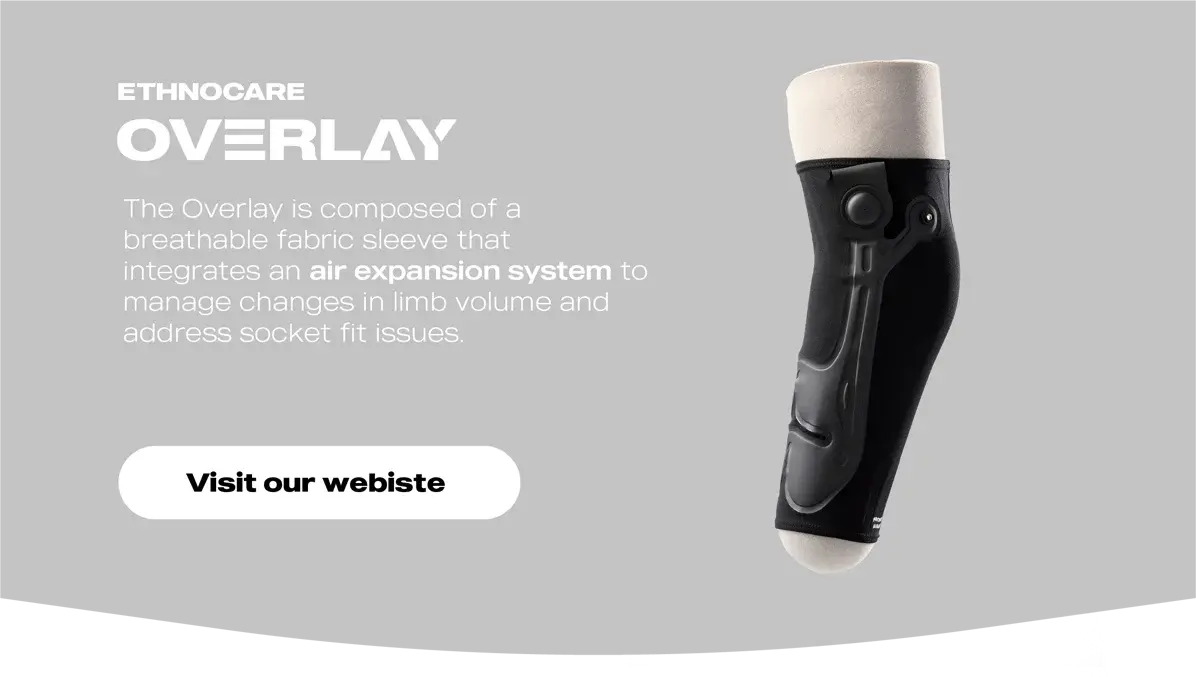
On Wednesday, 4 March at 4:00 pm GMT, a forthcoming Tech and Trends Webinar will spotlight one of the most persistent clinical challenges in prosthetic practice: limb volume variation. Titled “The Solution for Limb Volume Variation: Introducing the Ethnocare Overlay,” the session will present an emerging approach designed to improve socket fit stability and daily comfort for amputees.
For prosthetists across the IMEA region, volume fluctuation remains a daily management issue — affecting suspension, comfort, gait stability, skin integrity and long-term socket performance. Traditional solutions such as stump socks, pads and adjustable sockets often provide partial or reactive control rather than dynamic adaptation throughout the day. This webinar aims to examine that gap and introduce a technology designed to address it more directly.
Addressing a Persistent Clinical Challenge
Volume changes can occur due to:
- Activity level
- Temperature and climate
- Fluid retention
- Time of day
- Weight fluctuations
- Residual limb maturation
In regions such as the Middle East and parts of Africa, where high temperatures and humidity further influence limb physiology, maintaining socket stability can be particularly challenging. Poor volume management is not merely an inconvenience — it can lead to pistoning, skin breakdown, instability and reduced mobility.
The upcoming session will introduce Ethnocare’s Overlay system, a prosthetic interface solution that incorporates an integrated air expansion mechanism intended to allow adjustable internal fit without replacing the socket.
Ethnocare has developed the Overlay as a universal add-on system designed to adapt to residual limb changes while maintaining alignment and stability. Rather than relying solely on sock layering or rigid socket modifications, the device uses controlled air expansion to provide customizable comfort and fit adjustments throughout the day.
A User-Centered Development Approach
The webinar will be presented by:
Marc-Antoine Malouin
Marc-Antoine Malouin, one of Ethnocare’s co-founders, brings a background in product design and a focus on solving real-world human challenges. During the session, he will outline the company’s user-centered development process, including:
- Direct feedback from amputees
- Clinical insight into current socket management limitations
- Design iterations informed by daily-use challenges
- Evidence regarding complications arising from poorly managed limb volume
The webinar will also explore how the Overlay is positioned as a simple and adaptable solution that can be integrated into existing prosthetic systems rather than requiring a complete redesign of clinical workflows.
Clinical Implications for Prosthetists
For clinicians, the implications extend beyond comfort:
- Improved suspension consistency
- Reduced pistoning
- Potential reduction in skin breakdown
- Fewer mid-day socket adjustments
- Enhanced patient confidence and performance
In IMEA markets where prosthetic follow-up intervals can be extended due to geographic and logistical constraints, solutions that offer patient-controlled adjustment may play an increasingly important role in maintaining mobility outcomes between clinic visits.
As prosthetic service delivery evolves — with growing integration of digital design, modular systems and adaptable interfaces — technologies that address biomechanical variability without increasing workshop complexity are gaining attention.
Why This Matters for the IMEA O&P Community
Limb volume management remains one of the most frequent reasons for patient dissatisfaction and return visits globally. As rehabilitation systems expand across GCC and wider IMEA countries, scalable solutions that improve fit reliability may contribute to:
- Better long-term prosthetic adoption rates
- Improved patient retention
- Enhanced clinical efficiency
- Reduced remake costs
Webinars like this provide an opportunity for prosthetists, technicians and rehabilitation professionals to evaluate emerging technologies critically and consider their applicability within diverse clinical and climatic contexts.
The session on 4 March offers a focused exploration of how design innovation can respond to one of prosthetics’ most enduring challenges — with practical insight for both clinicians and workshop teams.
For professionals working across the IMEA rehabilitation ecosystem, staying informed about interface innovations remains essential as the sector continues to evolve.
Anyone can view and Join here