

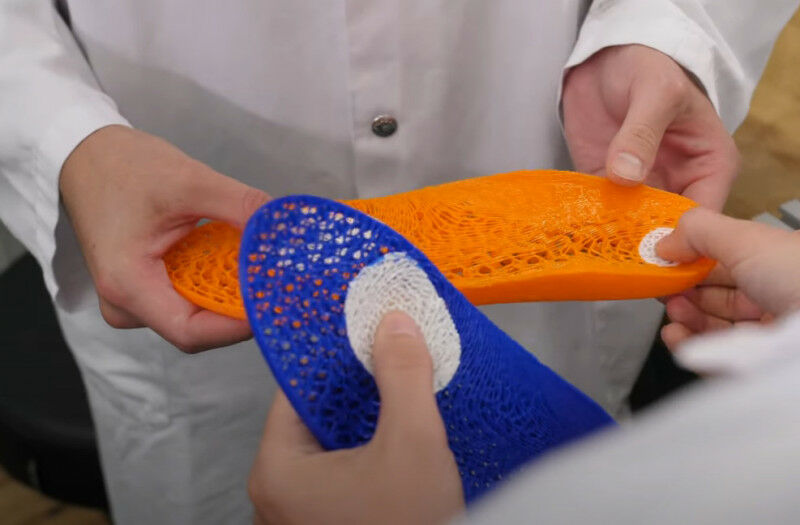
Flexible 3D printing materials are becoming increasingly important for orthotic and prosthetic professionals as digital workflows move beyond rigid sockets, trial devices and structural components. A recent 3Dnatives guide comparing TPE and TPU filament offers a useful reminder for O&P workshops: flexible materials are not interchangeable, and the choice between softness, durability and printability matters.
For clinicians, technicians and digital fabrication teams in the Middle East, Africa, Central Asia and South Asia, the practical question is not simply “Can this material bend?” The more important question is whether the material can be used reliably, safely and repeatably for a clinical or workshop application.
Understanding the Difference Between TPE and TPU
Thermoplastic elastomer, or TPE, is a broad family of flexible materials that combines rubber-like elasticity with thermoplastic processability. This means it can stretch, compress and return towards its original shape, while still being melted and processed using 3D printing or other manufacturing methods.
Thermoplastic polyurethane, or TPU, sits within the wider TPE family. In practical 3D printing terms, TPU is usually the more durable, more abrasion-resistant and more predictable flexible material. TPE is often softer and more rubber-like, but that softness can make it more difficult to print consistently.
For O&P applications, this distinction is important. A material that feels soft in the hand may not be the best option for a device that must survive repeated loading, sweat, shoe friction, daily donning and doffing, or long-term use in hot climates.
Why TPU Is Often the First Choice for O&P Workshops
TPU has become one of the most widely used flexible materials in 3D printing because it offers a practical balance between flexibility and mechanical strength. It is commonly associated with abrasion resistance, impact resistance, toughness and better print reliability than very soft elastomers.
This makes TPU particularly relevant for O&P and rehabilitation applications such as:
- Custom foot orthoses and insoles
- Cushioning or shock-absorbing zones
- Protective covers and flexible shells
- Soft-touch orthotic components
- Trial components and prototypes
- Padding concepts for splints and braces
- Patient-specific wearables
- Flexible interfaces in non-load-bearing applications
Companies such as Formlabs have highlighted TPU powder for applications including orthotics, prosthetics, patient-specific appliances and medical devices, while material suppliers such as ColorFabb have also developed TPU-based materials specifically positioned for prosthetic and orthotic parts.
Where TPE Still Has a Role
TPE can be attractive when the priority is maximum softness, stretch, cushioning or rubber-like behaviour. In theory, this makes it relevant for comfort-focused applications such as soft pads, cushioning elements, gaskets, grips and low-stress interfaces.
However, softer TPE materials can be much harder to print. They may buckle in the extruder, jam during feeding, require very slow print speeds and need a direct-drive extrusion system. For many O&P workshops, this means TPE may be better suited to experienced print teams or specialist applications rather than routine production.
In an O&P context, TPE should be considered when the clinical or product requirement clearly demands a softer, more elastic material than TPU can provide. Even then, the workshop must validate print consistency, mechanical behaviour, skin-contact suitability, cleaning requirements and long-term durability.
The Clinical Relevance: Insoles, Foot Orthoses and Soft Interfaces
The most immediate O&P opportunity for flexible 3D printing materials is custom foot orthoses and insoles. Digital design allows laboratories to vary geometry, thickness, lattice structures and local stiffness zones in ways that are difficult to reproduce with traditional subtractive or manual methods.
A growing body of interest around 3D-printed insoles suggests that additive manufacturing may support more customised approaches for conditions such as flatfoot, plantar pressure management and diabetic foot risk, although clinical validation remains essential.
TPU is especially interesting because it can support lattice-based designs, flexible zones and durable cushioning structures. For podiatry and orthotic services, this could allow more controlled combinations of support, comfort, offloading and ventilation.
However, the material choice must be linked to the clinical objective. A diabetic foot insole, a sports orthotic, a comfort insole and a rigid functional foot orthosis do not have the same mechanical or safety requirements. TPU may be useful in some layers or zones, but it is not a universal replacement for EVA, polypropylene, carbon fibre, foams or traditional orthotic materials.
Printability Matters in Real-World Clinics
A key point from the 3Dnatives comparison is that printability is often the deciding factor. TPU is generally easier to print than very soft TPE, especially for teams that are still building experience with flexible filaments.
Flexible materials typically require slower print speeds, careful control of retraction, dry filament, correct bed preparation and well-tuned extrusion. Direct-drive extrusion is strongly preferred, especially for softer materials. Bowden systems may work with harder TPU grades, but they are usually less forgiving.
For O&P services in hot and humid regions, filament storage is another practical issue. Flexible materials can absorb moisture, leading to bubbling, oozing, poor surface quality and inconsistent mechanical performance. Clinics and labs considering flexible filament printing should budget not only for printers and materials, but also for drying systems, storage containers, staff training and documented print parameters.
Material Selection Must Include Safety and Regulation
For clinical use, O&P teams should not assume that every TPU or TPE filament is suitable for patient contact. Material data sheets, biocompatibility information, skin-contact claims, cleaning guidance and regulatory documentation matter.
A low-cost TPU filament may be acceptable for a prototype, training model or non-contact workshop jig, but that does not automatically make it suitable for prolonged skin contact or a finished medical device.
Before using any flexible printed part clinically, providers should consider:
- Whether the material is certified or tested for the intended use
- Whether it is suitable for skin contact
- Whether it can be cleaned or disinfected appropriately
- Whether it can withstand sweat, heat and humidity
- Whether it will deform under repeated clinical loading
- Whether the part is structural, cushioning, cosmetic or experimental
- Whether local medical device rules apply
This is especially important as more clinics in the IMEA region adopt digital manufacturing without always having access to full in-house materials testing.
A Practical Rule for O&P Teams
For most O&P workshops starting with flexible 3D printing, TPU is the safer first step. It is generally easier to print, more durable and more predictable than very soft TPE. It is also better supported by printer manufacturers, material suppliers and existing application examples in orthotics and prosthetics.
TPE may be useful where extra softness or rubber-like performance is essential, but it requires more experience and more careful validation.
A simple workshop guide would be:
- Use TPU when the priority is durability, repeatability and functional performance.
- Consider softer TPE only when the priority is maximum elasticity, softness or damping.
- Always check Shore hardness, not just the material name on the spool.
- Treat “flexible” as a design parameter, not a clinical approval.
- Validate printed parts before patient use.
What This Means for the IMEA Region
For orthotic and prosthetic services across the IMEA region, flexible 3D printing materials could support more localised production, faster prototyping and greater customisation. This is particularly relevant for custom insoles, paediatric devices, splinting, protective interfaces, sports orthotics and rehabilitation innovation.
However, the technology should be introduced carefully. The future is not simply about replacing traditional materials with printed flexible plastics. It is about understanding when a printed TPU or TPE part offers a genuine clinical, manufacturing or economic advantage.
The most successful O&P teams will combine digital tools with traditional clinical reasoning: pressure management, tissue tolerance, alignment, gait, durability, hygiene, repairability and patient comfort.
Flexible materials such as TPU and TPE are valuable additions to the O&P workshop. But like plaster, EVA, polypropylene, silicone, carbon fibre or foam, they must be used with skill, judgement and respect for the patient’s real-world needs.
- 3Dnatives: TPE vs TPU Filament: Choosing the Right Flexible Material
- Formlabs: Introducing TPU 90A Powder for Flexible SLS 3D Printing
- Formlabs: Complete Guide to TPU 3D Printing
- Formlabs: 3D Printed Orthotics Guide
- ColorFabb: Advanced 3D Printing Filaments for Prosthetics and Orthotics
- Review: Comparative Efficacy of 3D-Printed Insoles