

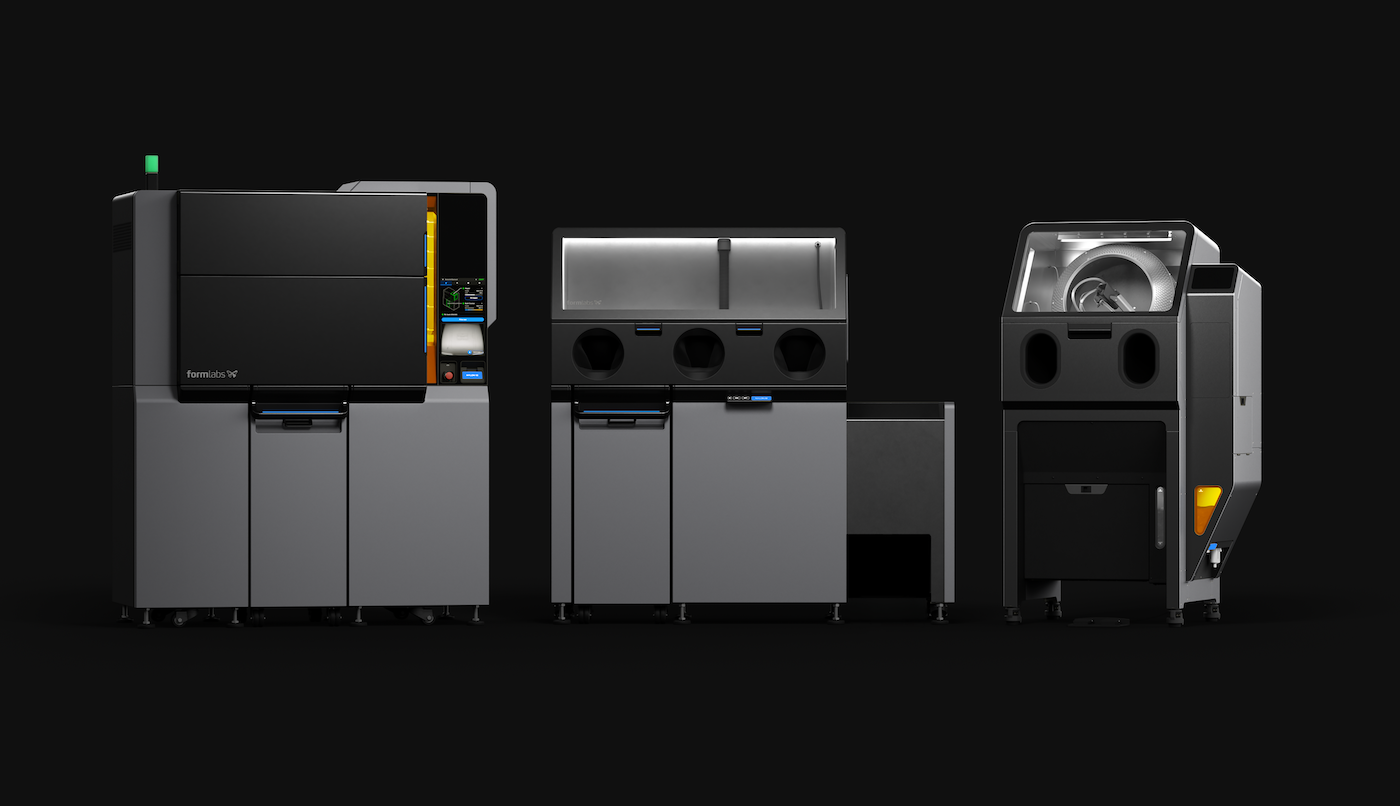
A recent New York Times article on Formlabs and industrial 3D printing has brought renewed mainstream attention to a trend that orthotists and prosthetists can no longer ignore: additive manufacturing is moving from prototyping into scalable production.
The timing is important. Formlabs has announced the Fuse X1, priced at $84,999, a large-format selective laser sintering system positioned to make industrial SLS production more accessible to engineering teams, manufacturers and service bureaus. For the orthotics and prosthetics sector across the Middle East, India and Africa, the launch is not just another 3D printer announcement. It is a signal that industrial additive manufacturing is becoming more usable, more compact and more relevant to healthcare production environments.
For IMEA CPOs, the question is no longer whether 3D printing will affect O&P. The question is how quickly clinics, rehabilitation centres, distributors, training institutions and central fabrication providers can prepare for a more digital, distributed and production-ready future.
Why this matters for orthotics and prosthetics
O&P has always depended on custom manufacturing. Every socket, AFO, insole, spinal brace, prosthetic cover or paediatric orthosis exists at the intersection of anatomy, material science, clinical judgement and workshop skill.
That makes O&P a natural candidate for digital production. But adoption has been uneven. Many clinics have experimented with scanners, CAD software and entry-level 3D printers, yet few have fully integrated additive manufacturing into a reliable clinical production pathway.
The launch of larger, more industrial systems such as Formlabs’ Fuse X1 suggests that the market is moving toward a new phase: not just printing trial parts, but producing functional components in higher volumes with more predictable output.
For IMEA markets, this could be especially relevant in areas such as:
- paediatric AFO production
- diabetic foot orthoses and insole workflows
- prosthetic socket trials and check sockets
- prosthetic covers and cosmetic components
- orthotic shell production
- clinic tooling and jigs
- low-volume spare parts
- assistive technology components
- central fabrication for regional clinic networks
This does not mean every O&P clinic should buy an industrial SLS system. It does mean every serious O&P provider should understand how these systems could reshape supply chains, pricing models and patient access.
From workshop replacement to workshop extension
One common mistake is to frame 3D printing as a replacement for the O&P workshop. That is not the right way to view it.
The future is more likely to be hybrid.
Traditional plaster modification, lamination, thermoforming, alignment, finishing and clinical fitting skills will remain essential. But industrial 3D printing can extend what a workshop is able to produce, particularly when there is a need for repeatability, complex geometry, lightweight structures or faster digital reproduction.
For example, a clinic may continue using manual casting and thermoforming for many devices, while using 3D printing for selected cases where digital repeatability is valuable. A central fabrication partner may print orthotic shells or covers from files supplied by several clinics. A rehabilitation hospital may use 3D printing for paediatric orthoses that need frequent replacement as children grow.
This is the most realistic opportunity for IMEA CPOs: not abandoning existing craft skills, but adding a digital manufacturing layer that improves capacity.
The central fabrication opportunity
Industrial SLS systems may be particularly important for central fabrication models.
Across many IMEA countries, specialist O&P expertise is concentrated in major cities, while patient need is distributed across rural areas, regional hospitals and humanitarian settings. Digital workflows can help bridge this gap if scanning, design, fabrication and delivery are properly connected.
A clinic in one city could scan a patient, upload the file to a central fabrication hub, receive a printed part, and complete fitting locally. This model could be useful for:
- diabetic foot programmes
- paediatric orthotic campaigns
- NGO and humanitarian device delivery
- government rehabilitation centres
- private clinic networks
- hospital-based O&P departments
- regional distributors supporting multiple countries
Systems such as the Fuse X1 show that industrial additive manufacturing is being packaged in ways that may be easier to install, operate and integrate than older, larger industrial platforms. This could reduce the barrier for regional hubs that want production capability but cannot justify the cost or infrastructure of traditional high-end industrial systems.
The economics will matter
For IMEA CPOs, technology adoption is rarely driven by novelty alone. It must make economic sense.
The major questions will be practical:
- What is the true cost per part?
- How much post-processing is required?
- Which materials are suitable for clinical use?
- Can the parts meet local regulatory expectations?
- What training is needed for technicians and clinicians?
- How quickly can files move from scan to CAD to print?
- How many failed builds can the business tolerate?
- Is there enough device volume to justify the investment?
- Should clinics buy systems or outsource to a regional print bureau?
The most likely early adopters in IMEA will be larger O&P groups, rehabilitation hospitals, academic centres, military or government facilities, and distributors that can aggregate demand across multiple clinics.
Smaller clinics may benefit first through service models rather than ownership. Instead of investing in the full ecosystem, they may send files to a specialised O&P print centre or manufacturing partner. This could allow them to offer 3D printed options without carrying the full capital, maintenance and training burden.
What could be printed for O&P?
Not every O&P device is suitable for 3D printing, and not every printed device is ready for clinical use. Material selection, load requirements, heat tolerance, skin contact, finishing, hygiene and long-term durability must all be evaluated carefully.
However, industrial SLS and related technologies could support a growing range of O&P applications, including:
- ankle-foot orthosis shells
- paediatric orthotic components
- prosthetic covers
- trial sockets and diagnostic sockets
- flexible inner structures
- spinal brace components
- custom foot orthoses
- partial foot orthotic elements
- adaptive device parts
- jigs, fixtures and alignment aids
- replacement parts for assistive devices
The strongest immediate opportunity may be in devices where geometry, repeatability and lightweight structures are valuable, but where the clinical risk is manageable and the part can be validated through proper fitting and follow-up.
A wake-up call for education and training
The wider industrial 3D printing shift also creates a challenge for O&P education.
CPOs and technicians in IMEA markets will increasingly need to understand digital capture, CAD modification, material selection, print orientation, nesting, post-processing, finishing and quality control. At the same time, they must not lose the manual skills that allow them to assess fit, make adjustments and solve problems when digital workflows fail.
The future O&P workforce will need both.
Educational institutions should consider adding stronger modules on:
- 3D scanning
- digital rectification
- CAD/CAM for orthotics and prosthetics
- additive manufacturing materials
- SLS, MJF, FDM and resin workflows
- quality control for printed devices
- digital file management
- device traceability
- hybrid fabrication methods
This is especially important in the IMEA region, where many clinics still rely heavily on manual workshop methods. Digital manufacturing can improve access, but only if clinicians and technicians are trained to use it responsibly.
Procurement and regulation must catch up
Another major implication is procurement.
Many public and insurance-funded systems still buy O&P devices through traditional categories that do not clearly distinguish between manually fabricated, milled, thermoformed or 3D printed devices. As additive manufacturing becomes more common, procurement bodies will need better definitions, quality standards and documentation requirements.
For example, tender specifications may need to address:
- approved materials
- mechanical testing
- device traceability
- file storage
- patient-specific design records
- cleaning and hygiene requirements
- repair and replacement protocols
- acceptable manufacturing methods
- local regulatory classification
Without this, 3D printing risks being treated either as a gimmick or as a low-cost shortcut. The correct approach is to treat it as a serious manufacturing pathway requiring clinical governance.
The opportunity for IMEA CPOs
The Formlabs Fuse X1 launch is part of a wider story: industrial 3D printing is becoming more accessible, more production-oriented and more relevant to healthcare.
For IMEA CPOs, this creates several opportunities.
First, it could help expand access by enabling more distributed production. Second, it could shorten lead times for selected devices. Third, it could help clinics standardise parts across multiple locations. Fourth, it could create new central fabrication businesses serving regional markets. Fifth, it could support local manufacturing strategies in countries that want to reduce dependence on imported devices and components.
But the opportunity will only be realised if the O&P sector approaches the technology with clinical discipline.
3D printing should not be adopted simply because it is modern. It should be adopted where it improves fit, speed, repeatability, access, documentation, patient acceptance or cost efficiency.
What IMEA CPOs should do now
O&P professionals across the region should begin preparing for this next phase by asking practical questions:
- Which devices in our clinic could realistically move into a digital workflow?
- Do we have enough case volume to justify in-house production?
- Would outsourcing to a specialist print partner be more sensible?
- What training do our clinicians and technicians need?
- How will we validate printed parts before clinical use?
- How will we document device design, material and manufacturing data?
- How will we maintain manual skills alongside digital tools?
- Which patients are most likely to benefit first?
The clinics that answer these questions early will be better positioned than those that wait until digital manufacturing becomes unavoidable.
A new manufacturing era for O&P
The message from Formlabs’ latest industrial 3D printing move is clear: additive manufacturing is no longer confined to the prototyping lab. It is moving toward production, scale and decentralised manufacturing.
For orthotics and prosthetics, that matters.
IMEA CPOs should see this not as a threat to clinical craftsmanship, but as a chance to build more responsive, more connected and more scalable fabrication models. The future of O&P will still depend on clinical judgement, patient care and hands-on skill. But it will increasingly be supported by digital manufacturing systems capable of producing custom devices faster, more consistently and closer to the point of need.
For the region’s CPOs, the next challenge is not whether 3D printing works.
It is whether the profession is ready to use it well.
- New York Times article on Formlabs and industrial 3D printing
- Formlabs Fuse X1 official product page
- Formlabs official website
- Fast Company report on the Formlabs Fuse X1
- 3Dnatives report on Formlabs Fuse X1
- Formlabs medical 3D printing applications
- Formlabs SLS 3D printing technology