

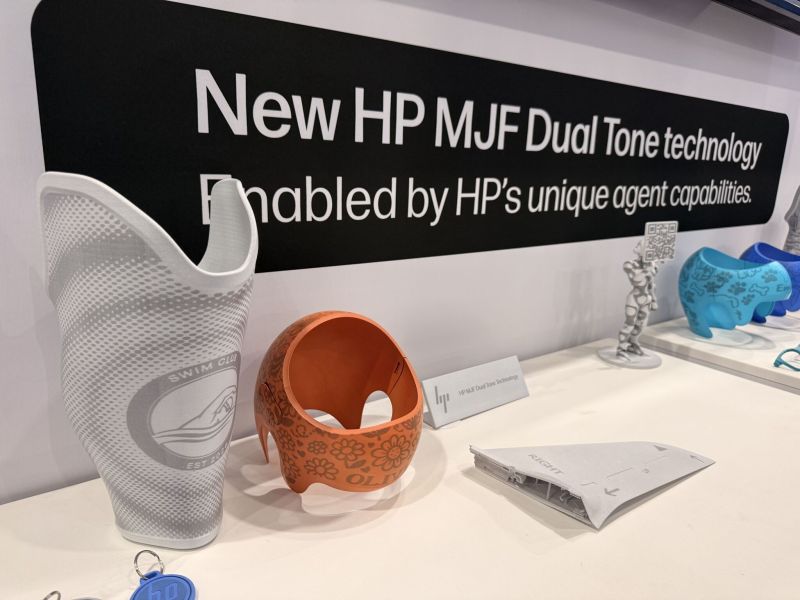
The announcement of HP Multi Jet Fusion Dual Tone technology marks an important step forward for what is possible with 3D printing in orthotics and prosthetics.
Introduced as part of HP’s latest additive manufacturing updates at RAPID + TCT 2026, Dual Tone enables parts to be printed in two tones — white and grey — using HP’s agent-based Multi Jet Fusion process. According to HP, the technology can create visual part features such as textures, QR codes, markings and labels directly into printed components.
For many industrial sectors, this may be viewed as a production improvement. For the orthotics and prosthetics sector, however, it could be much more than that. It could change how patients see, accept and emotionally connect with the devices they use every day.
Why visual identity matters in O&P
Orthotic and prosthetic devices are not simply technical products. They are worn on the body, seen by others, integrated into daily routines and, for many users, connected to confidence, independence and identity.
This is why patient acceptance remains one of the most important parts of the O&P journey. A device can be clinically appropriate, mechanically effective and well fitted, but if the user feels embarrassed, disconnected or reluctant to wear it, the clinical outcome may still be compromised.
That is where Dual Tone becomes interesting for O&P. By making it possible to build visual detail directly into the printed part, HP’s new MJF capability points toward a future where 3D printed orthoses, prosthetic covers, sockets, paediatric devices, insoles and other components can become more personal, more identifiable and more acceptable to the user.
In other words: Dual Tone. Where function meets expression.
From plain functional parts to personal devices
Until now, many 3D printed O&P devices have been judged mainly by their mechanical performance, speed of manufacture, repeatability and cost efficiency. These factors remain critical. But the next stage of adoption will also depend on whether digital manufacturing can produce devices that patients are proud to wear.
Dual Tone creates the possibility for subtle personalization without relying only on post-processing, stickers, surface coatings or manual finishing. Clinics and manufacturers could potentially incorporate:
- patient names or initials
- decorative textures or patterns
- visual alignment guides
- brand or clinic identifiers
- left/right markings
- paediatric-friendly graphics
- device type or prescription identifiers
- QR codes or data matrix codes
- serial numbers and traceability labels
For paediatric orthotics in particular, this could be highly relevant. Children and teenagers may be more willing to wear an AFO, insole, spinal brace component or protective orthosis if the device feels less clinical and more personal. For adult users, the ability to move from a plain medical device to something more discreet, premium or identity-led could also support daily compliance.
Better traceability for clinicians and manufacturers
The second major opportunity is traceability.
In O&P, devices are often custom made, modified, repaired and replaced over time. In busy clinics, hospitals, rehabilitation centres and central fabrication facilities, it is essential to know which device belongs to which patient, when it was made, which digital file was used, which material batch was selected and whether it has passed internal quality checks.
By allowing QR codes, markings and labels to be printed directly into the part, Dual Tone could help clinicians and manufacturers improve device tracking without relying only on external labels that may peel, fade or be removed.
For O&P providers, this could support:
- serial number integration
- batch and build identification
- digital patient file linking
- clinic inventory control
- warranty and repair tracking
- quality assurance documentation
- recall or field correction management
- easier differentiation between similar-looking custom devices
In more advanced workflows, a QR code printed directly onto a device could link to a secure digital record containing the prescription, scan data, CAD file version, manufacturing date, responsible clinician, material type and follow-up schedule.
This matters because O&P is moving increasingly toward digital workflows, but the physical device still needs to remain connected to the digital record. Dual Tone could help close that gap.
Relevance for IMEA markets
For the Middle East, India and Africa, the implications are particularly important.
Many markets in the IMEA region are looking for scalable O&P production models that can combine digital scanning, CAD modification, additive manufacturing and distributed service delivery. 3D printing is often discussed in terms of faster production and lower unit costs, especially for paediatric orthotics, diabetic foot orthoses, prosthetic covers and assistive technology components.
But for adoption to grow, devices must be trusted by clinicians and accepted by patients.
Dual Tone could add value in both areas. For patients, it offers the possibility of more personal, less generic devices. For clinicians, it provides a pathway toward clearer identification and better tracking. For NGOs, rehabilitation centres and government programmes, printed serial numbers or QR codes could support monitoring, reporting and accountability across high-volume device delivery.
This could be especially valuable in humanitarian and public health settings, where devices are often delivered in large numbers and follow-up can be difficult. A printed identifier that remains part of the device could help connect the patient, provider and manufacturing record more reliably.
Not just colour — a workflow shift
Dual Tone should not be viewed only as a cosmetic feature. In O&P, appearance, identity and traceability are functional considerations.
A child who wears an AFO more consistently because it feels personal may achieve better mobility outcomes. A prosthetic user who feels more confident with a visually refined cover may be more willing to use the device socially. A clinician who can scan a QR code and immediately confirm device details may reduce errors and improve follow-up.
That makes this a workflow shift, not just a design feature.
It also reinforces a broader trend in additive manufacturing: the move from simply printing shapes to printing information, identity and intelligence into the part itself.
What should O&P clinics watch next?
The first HP system expected to offer Dual Tone as a built-in capability is the HP Jet Fusion 5600 Series, with availability planned for late 2026. As the technology becomes available, O&P clinics, central fabrication facilities and digital manufacturing partners should watch several key areas:
- how durable the printed markings are during daily wear
- whether QR codes remain readable after cleaning and use
- how Dual Tone affects production cost and build preparation
- whether patient-facing design libraries can be created
- how clinicians can link printed identifiers to digital patient records
- whether regulatory and quality systems can adopt printed device identification
- how personalization affects patient satisfaction and device compliance
The most successful applications will likely be those that combine clinical function, manufacturing reliability and user-centred design.
Dual Tone: where function meets expression
HP’s Dual Tone announcement is a reminder that the future of O&P manufacturing is not only about speed, automation or cost per part. It is also about making devices that people want to wear, clinicians can track and providers can manage with confidence.
For orthotics and prosthetics, this is where the real opportunity lies.
Not simply in printing two tones, but in printing devices that carry identity, information and clinical value directly into the part.
Dual Tone: Where function meets expression.
- HP official announcement: HP introduces MJF 1200 and Dual Tone technology
- TCT Magazine: HP announces new 3D printer, productivity boosts and Dual Tone at RAPID + TCT
- VoxelMatters: HP launches HP Multi Jet Fusion 1200 compact MJF system
- HP Jet Fusion 5600 Series
- HP Multi Jet Fusion 3D Printing Technology