

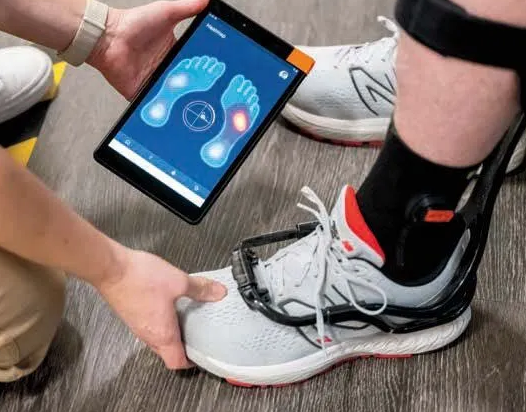
Sensor-equipped socks can distinguish people with mild and severe multiple sclerosis (MS) disability, and pick up gait changes as they tire, according to an independent study by researchers at Shepherd Center in Atlanta. The study used Sensoria Smart Socks from Sensoria Health, whose Vice President of Business Development, John Carpenter, shared the findings this week.
How the study worked
The cross-sectional study took place in an outpatient rehabilitation setting with 32 people with MS. Participants were split by Patient-Determined Disease Steps (PDDS) score into a mild-to-moderate group (0–4) and a severe group (5–6). Wearing the smart socks, each completed three standard walking tests: three trials of the Timed 25-Foot Walk, three trials of the Timed Up and Go (TUG), and one 6-Minute Walk Test, with fatigue rated on a visual analogue scale before and after.
The research team included Julie Stowell, Victory Ladipo, Russell Jeter, Sujay Galen and Brad Willingham, PhD.
What the socks detected
Across all three tests, people in the severe group walked very differently from those in the mild-to-moderate group:
- walking speed 45–50% lower
- cadence 24–35% lower
- double-support time 45–64% longer
- stance time 40–51% longer
- gait cycle 34–45% longer
Timing and coordination measures were the best at separating the two groups, with ROC-AUC values of 0.84 to 0.87, compared with 0.70 or lower for spatial measures such as step length. Cadence during the TUG on its own predicted disability level with a ROC-AUC of about 0.84.
During the 6-Minute Walk Test, the socks also captured fatigue. Double-support time rose by an average of 49.1% (± 53.5%) and gait cycle duration by 7.5% (± 14.4%), while participants’ own fatigue ratings rose by 197% (± 236%). The wide ranges show how much fatigue varied between individuals.
The authors conclude that smart sock wearables could offer a scalable way to monitor MS progression and fatigue remotely and to tailor rehabilitation.
IMEA CPO Perspective
For orthotists, the study is a reminder that the timing of gait, not just step length or how a walk looks, carries much of the clinical signal. People with MS are frequent AFO and FES users, and fatigue often decides whether they keep wearing a device through the day. A low-cost, wearable way to measure double-support time and cadence before and after fitting, and again at follow-up, could help show whether an orthosis is actually reducing fatigue over a longer walk, not just during a short clinic test.
The evidence is still early: 32 participants, one US centre and a cross-sectional design, with the device maker publicising the results. Across the Middle East, Africa and South Asia, where gait laboratories are rare and many patients travel long distances to clinic, remote gait monitoring is an attractive idea, but cost, connectivity, data protection and validation in local populations would need to be addressed before it becomes routine.
Sources
- John Carpenter, Sensoria Health, on LinkedIn (November 2026)
- Shepherd Center: Smart socks innovation to expand accessibility and precision of rehabilitation for people with multiple sclerosis
- Sensoria Health