

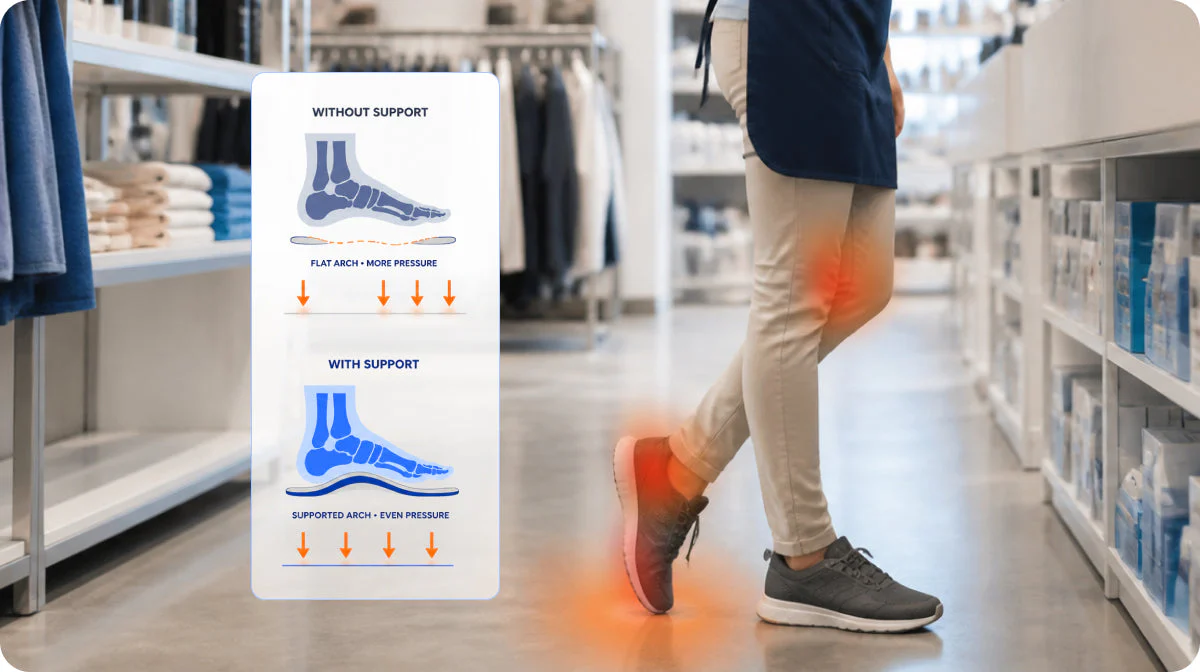
The global sports and athletic insole market is forecast to almost double in value over the next decade, creating significant opportunities for orthotists across the Middle East and Africa to expand beyond traditional clinical referrals.
Market estimates suggest that the sector could grow from approximately $4.3 billion in 2026 to $8.4 billion by 2036, driven by greater participation in sport, increased awareness of foot health and rising demand for personalised products.
For orthotists in the MEA region, this growth is not simply a retail trend. It represents an opportunity to build new service lines around foot assessment, digital scanning, pressure analysis, customised orthoses, footwear advice and long-term management of complex foot conditions.
The strongest opportunity may lie in combining the accessibility and convenience of consumer insole services with the clinical expertise of a qualified orthotist.
Foot orthotics are moving into the mainstream
Foot orthoses were once associated mainly with hospitals, rehabilitation centres and specialist clinics.
Today, consumers are increasingly purchasing insoles for running, football, hiking, gym training, occupational comfort and general foot pain. Retailers, sports stores and footwear brands are also introducing scanning systems and personalised fitting services.
The market now includes:
- Standard comfort insoles
- Sport-specific footbeds
- Semi-customised orthoses
- Carbon-fibre performance devices
- Digitally designed custom insoles
- 3D-printed foot orthoses
- Pressure-relief products
- Sensor-equipped smart insoles
This expanding product range is introducing more people to the potential benefits of foot support.
It also creates a natural pathway from retail products to specialist orthotic assessment when pain persists, deformity is present or the patient has a higher-risk medical condition.
MEA orthotists can reach a much larger customer base
Many orthotic practices remain dependent on referrals from rehabilitation physicians, orthopaedic surgeons, paediatricians or hospitals.
A larger consumer foot orthotics market allows clinics to engage directly with people who may never otherwise consult an orthotist.
Potential customer groups include:
- Recreational runners
- Football and padel players
- School-age athletes
- Retail and hospitality workers
- Healthcare professionals who stand for long periods
- Industrial and construction workers
- People with plantar heel pain
- Consumers with tired or painful feet
- People seeking greater footwear comfort
- Patients with diabetes or previous ulceration
Not every person in these groups requires a fully customised medical orthosis.
However, an orthotist can assess the individual, explain the available options and direct them towards the most appropriate level of intervention.
This may include a standard insole, a semi-custom product, a digitally customised orthosis or a full clinical prescription.
Digital scanning can make services faster and more scalable
Digital foot scanning is one of the most important developments supporting the growth of the market.
Optical scanners, smartphone scanning systems and plantar-pressure platforms can replace or supplement traditional foam-box impressions and plaster casting.
For an MEA orthotist, a digital workflow can provide several advantages:
- Faster assessment and data capture
- Reduced storage of physical casts
- Easier repeat ordering
- Remote access to previous scans
- More consistent design records
- Shorter manufacturing times
- Improved visual explanation for patients
- Ability to work with multiple production partners
Digital systems can also allow a clinic to expand through satellite locations, retail partnerships or mobile assessment services.
A technician or trained retail partner may capture a scan at one location, while the orthotist reviews the case and prescription remotely.
This can be particularly valuable in geographically large markets where specialist orthotic services are concentrated in major cities.
Retail partnerships offer a route to new patients
Sports retailers, footwear stores, pharmacies and running shops already attract consumers who are looking for comfort, support or performance products.
Orthotists can use these locations as referral and assessment points rather than viewing them solely as competitors.
Possible partnership models include:
- Regular orthotist-led assessment clinics inside sports stores
- Referral agreements for customers with pain or deformity
- In-store digital foot scanning
- Joint running and footwear assessment events
- Training retail staff to recognise clinical warning signs
- Co-branded semi-custom insole services
- Corporate foot-health screening programmes
The retailer benefits by offering a more credible specialist service, while the orthotist gains access to a larger customer base.
Clear clinical boundaries remain important.
Retail staff should not diagnose medical conditions or recommend products for high-risk patients without appropriate professional input.
Sports participation is creating demand across the Gulf
The Gulf region has seen growing participation in running, cycling, football, padel, hiking and organised fitness events.
Cities across the UAE, Saudi Arabia, Qatar, Bahrain, Oman and Kuwait now host major races, sports leagues and wellness initiatives.
This creates opportunities for orthotists to develop specialist sports-foot services.
A sports orthotics service could include:
- Foot and lower-limb assessment
- Running or walking analysis
- Plantar-pressure measurement
- Footwear evaluation
- Custom sports orthoses
- Cleat and football-boot fitting
- Return-to-sport support
- Follow-up and device adjustment
These services can be positioned differently from conventional hospital-based orthotic care.
They can be delivered in sports clinics, gyms, performance centres, football academies or specialist retail environments.
Diabetes creates a major clinical need
The commercial growth of foot orthotics should not distract from the region’s substantial diabetic-foot burden.
Many countries across the Middle East and North Africa have high rates of diabetes, increasing demand for pressure management, accommodative orthoses and specialist footwear.
Patients with diabetes may require:
- Plantar-pressure assessment
- Total-contact insoles
- Multi-density accommodative orthoses
- Custom footwear
- Offloading devices
- Regular skin inspection
- Repeat assessment as foot shape changes
- Integration with podiatry and wound-care services
This is an area where qualified orthotists can provide clear value over non-clinical retail suppliers.
A consumer with diabetes, neuropathy or a previous ulcer should not simply be fitted using an automated scanner and sent away with a standard product.
These patients require clinical assessment, appropriate materials, pressure redistribution and regular review.
Orthotic clinics that develop strong links with diabetologists, podiatrists, vascular surgeons and wound-care teams can become central providers within multidisciplinary diabetic-foot services.
Local manufacturing could improve affordability
Imported custom orthoses can be expensive and may involve long delivery times.
Digital design, CNC milling and 3D printing offer MEA orthotists the opportunity to manufacture locally or through regional production centres.
Local production can reduce:
- International shipping costs
- Customs delays
- Dependence on foreign laboratories
- Minimum-order requirements
- Replacement lead times
- Difficulties making adjustments
A clinic does not necessarily need to purchase a complete manufacturing system immediately.
Orthotists can begin with digital scanning and outsource production to a specialist laboratory. As order volumes grow, the practice can consider bringing design or manufacturing in-house.
Regional laboratories could also serve several countries, receiving digital files from clinics and returning completed devices without the need to transport casts.
Tiered services can attract different customer groups
A major opportunity is to avoid offering only one type of foot orthosis.
MEA clinics can create a tiered service model that reflects different needs and budgets.
Entry-level service
This could include a basic foot assessment and selection of an appropriate prefabricated insole.
It may suit customers seeking improved comfort or mild support without significant pathology.
Semi-custom service
A semi-custom product can combine a standard shell or base with individual adjustments, posting, cushioning or pressure relief.
This provides greater personalisation while remaining more affordable than a fully custom device.
Digital custom service
A digitally designed orthosis based on a scan, clinical assessment and prescription can serve patients with more specific biomechanical or activity-related requirements.
Medical custom service
High-risk patients may require a full clinical pathway involving pressure analysis, accommodative materials, specialist footwear and regular follow-up.
This tiered structure allows the orthotist to compete in the broader market without lowering clinical standards.
Corporate foot-health programmes offer another revenue stream
Workers in healthcare, hospitality, aviation, retail, security and manufacturing may spend much of the day standing or walking.
Employers may benefit from programmes designed to reduce foot discomfort and improve workplace wellbeing.
An orthotic provider could offer:
- Workplace screening days
- Footwear assessments
- Digital foot scans
- Standard or personalised insoles
- Educational sessions
- Referral for complex cases
- Annual replacement programmes
Large employers, airlines, hotel groups, hospitals and industrial companies may represent substantial contract opportunities.
These programmes can also generate repeat business because insoles require replacement and employees may need reassessment as their symptoms or footwear change.
Paediatric and school services remain underdeveloped
Children with flat feet, lower-limb alignment concerns, neurological conditions or sports-related symptoms may be referred for orthotic assessment.
However, access to paediatric orthotic services remains inconsistent across many MEA countries.
Orthotists could work with:
- Schools
- Paediatric clinics
- Sports academies
- Physiotherapy centres
- Developmental clinics
- Special-needs organisations
School-based screening should not be used to overdiagnose normal developmental variation.
Its purpose should be to identify children with pain, functional limitations, significant asymmetry or conditions requiring further assessment.
A responsible paediatric service can create long-term relationships with families while supporting appropriate early intervention.
Clinical expertise remains the strongest advantage
The growing market will attract consumer brands, footwear companies and technology providers.
Orthotists should not attempt to compete only on the appearance of a scan or the speed of delivery.
Their strongest advantage is the ability to interpret findings and make a clinical decision.
A scanner can measure foot shape, but it cannot independently determine:
- Why the patient has pain
- Whether the pain is referred from another area
- Whether the patient has neuropathy
- Whether circulation is impaired
- Whether a deformity is flexible or fixed
- Whether footwear is contributing to the problem
- Whether the patient needs medical referral
- Whether an orthosis is appropriate at all
The value of the orthotist lies in combining technology with clinical reasoning.
This distinction should be made clear in marketing, patient education and discussions with referral partners.
Follow-up can generate stronger outcomes and repeat business
Many retail insole services end at the point of sale.
Orthotists can differentiate their service by including structured follow-up.
This may involve reviewing:
- Comfort
- Skin condition
- Footwear compatibility
- Gait changes
- Pain levels
- Device wear
- Patient adherence
- Activity progression
Follow-up improves clinical outcomes and allows adjustments to be made before the patient abandons the device.
It also supports long-term customer relationships.
Patients may return for replacement orthoses, additional pairs for different shoes, sports-specific devices or assessments for other family members.
Evidence and outcome measurement will strengthen credibility
As the market expands, claims relating to injury prevention, performance and biomechanical correction are likely to increase.
Orthotists can strengthen their position by measuring and documenting outcomes.
Clinics could record:
- Pain scores
- Patient satisfaction
- Walking or running tolerance
- Plantar-pressure changes
- Functional improvements
- Return-to-sport times
- Skin outcomes in high-risk patients
- Device durability
These records can demonstrate value to patients, insurers, employers and referring clinicians.
They can also help the orthotist refine prescriptions and identify which products work best for particular patient groups.
The market opportunity is broader than selling insoles
The projected growth of the foot orthotics market should encourage MEA orthotists to think beyond the traditional model of receiving a prescription, producing a device and completing a fitting.
The larger opportunity includes:
- Assessment services
- Digital scanning
- Pressure measurement
- Retail partnerships
- Sports performance
- Diabetic-foot management
- Corporate screening
- Paediatric services
- Local manufacturing
- Footwear advice
- Remote prescription review
- Repeat and replacement programmes
The foot orthotics market is becoming more visible, more consumer-driven and more technologically advanced.
Orthotists who combine clinical expertise with convenient digital services can benefit from this growth while maintaining a clear distinction between general comfort products and medically necessary orthotic care.
For providers across the Middle East and Africa, the future may not be defined by competition between retail insoles and clinical orthoses.
The greatest opportunity will be created by building a structured pathway that begins with accessible foot-health services and progresses to specialist care when the patient’s needs require it.
- SGI Europe – Global sports and athletic insole market growth
- Future Market Insights – Sports and athletic insoles market
- International Society for Prosthetics and Orthotics
- International Working Group on the Diabetic Foot
- World Health Organization – Diabetes
- International Diabetes Federation