

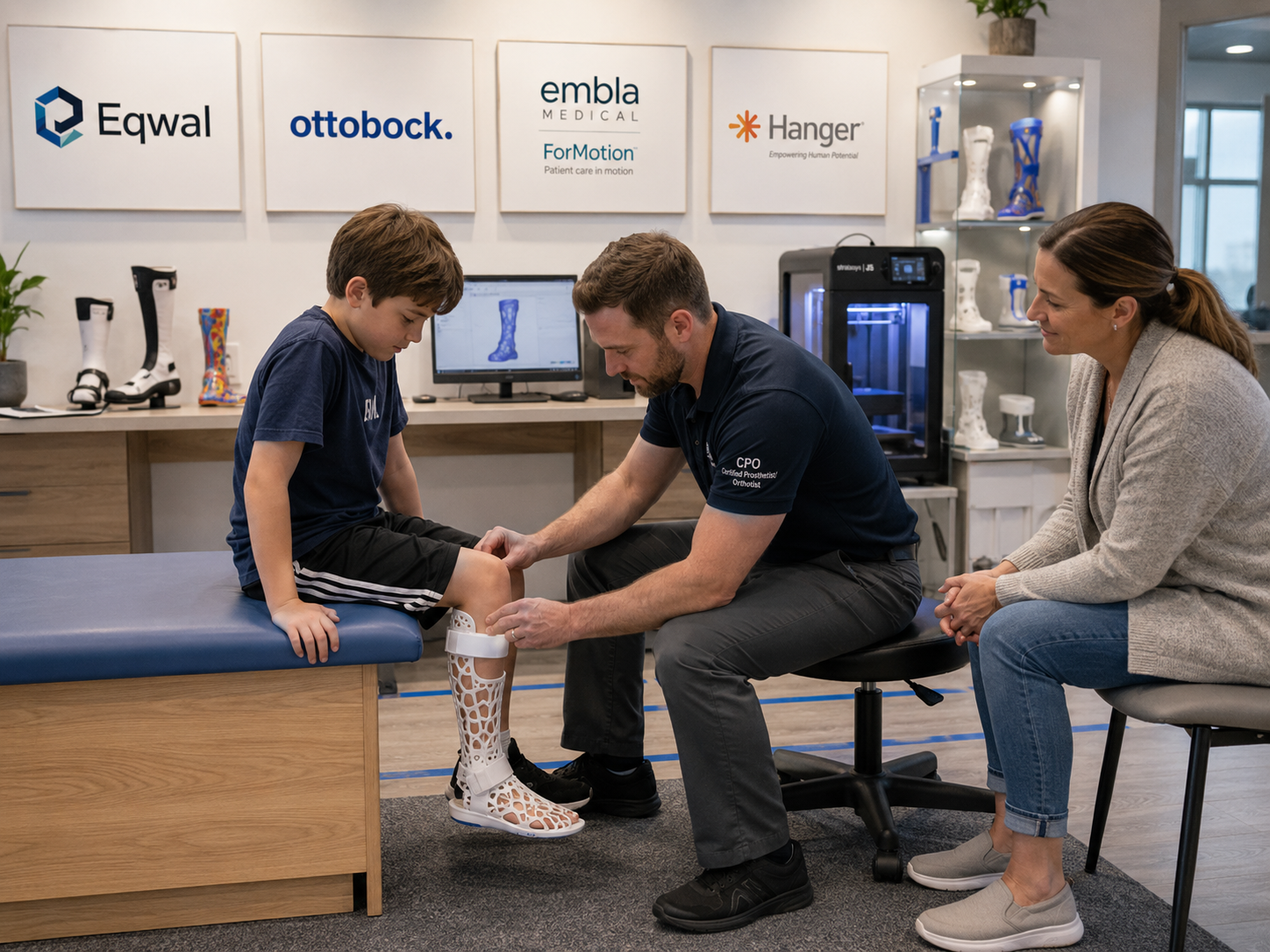
The global orthotics and prosthetics sector is entering a new era of consolidation.
Four organisations—Eqwal, Ottobock, Embla Medical through ForMotion, and Hanger—are increasingly combining clinical services, component supply, digital technology, manufacturing and purchasing power within large corporate platforms.
Their models are not identical. Hanger remains predominantly focused on the United States, while Eqwal, Ottobock and Embla Medical have built increasingly international patient-care networks. However, all four demonstrate the direction in which part of the O&P market is moving: away from isolated clinics and towards integrated groups with hundreds of locations, centralised systems and access to institutional capital.
For independent O&P providers across India, the Middle East and Africa, this raises an important question.
Are these groups strengthening the profession—or gradually taking control of it?
The answer is that consolidation can create genuine benefits for patients, employees and healthcare systems. It can also reduce competition, narrow component choice and place independent clinics under increasing commercial pressure.
The emergence of a global O&P “big four”
O&P has traditionally been a highly fragmented industry.
Many clinics began as family-owned businesses led by a prosthetist or orthotist serving a local hospital, rehabilitation centre or geographic community. Relationships with patients, doctors and suppliers were built over decades.
That structure is now changing.
Large groups are acquiring clinics, workshops, digital companies, manufacturers and distributors. Their objective is no longer simply to own more patient-care locations. It is to control a greater share of the complete O&P pathway.
That pathway may include:
- Patient referrals
- Clinical assessment
- Device prescription
- Component selection
- Digital scanning and CAD
- Central fabrication
- Procurement
- Outcome measurement
- Repairs and follow-up
- Professional education
- Data and software systems
The scale of the four groups illustrates how far this transformation has already progressed.
Eqwal: private capital supporting rapid international expansion
Eqwal has become one of the fastest-growing consolidators in the international O&P sector.
The group says it has expanded from approximately €120 million in turnover in 2021 to an expected €700 million by the end of 2026, with nearly 400 branches, more than 3,500 employees, operations across 13 countries and approximately 350,000 patients supported annually.
Its strategy combines patient care, specialised components and digital solutions within one integrated disability-care platform.
Eqwal has completed repeated acquisitions across Europe and North America, including clinical providers, orthopaedic footwear companies, component businesses and digital technology specialists.
Its integration of OrthoMENA established a direct presence in Dubai and gave the group an important entry point into the Middle East. This move is particularly relevant for independent providers across the Gulf because it demonstrates that international O&P groups increasingly view the region as a patient-care market rather than simply an export destination.
The group’s latest financing round gives it additional capacity to continue its expansion.
The transaction includes a new unitranche financing line from Ardian Private Credit and La Caisse, renewed mezzanine support from CIC Private Debt, and participation from Crédit Agricole and several regional Caisse d’Epargne investment entities.
The value of the financing was not disclosed, but the participation of major private-credit institutions indicates that Eqwal retains substantial financial backing for acquisitions and international development.
This is significant for independent providers because Eqwal does not need to fund every acquisition solely from operating cash flow. It can use institutional debt and private-equity backing to move quickly when suitable clinics, manufacturers or digital businesses become available.
Ottobock: products, technology and patient care under one listed group
Ottobock operates one of the most vertically integrated models in the sector.
It is simultaneously a leading component manufacturer, developer of advanced prosthetic and neuro-orthotic technologies, digital-solutions provider and owner of a global clinical-services network.
The company reports approximately 420 patient-care centres across 33 countries, nearly 9,300 employees and business activities in 45 countries.
Ottobock’s patient-care network gives the group direct access to patients, while its products and components business supplies independent clinics and competing networks.
This creates both a commercial advantage and a point of tension.
An independent clinic may purchase knees, feet, orthoses, software and workshop materials from Ottobock while competing against an Ottobock-owned care centre in the same market.
The company’s financial results show that the integrated model is performing strongly.
Ottobock reported 2025 core revenue of approximately €1.6 billion, an increase of 11.7%, while underlying core EBITDA rose 29.5% to €415.3 million. The underlying core EBITDA margin reached 26%. Its Patient Care business grew by 8.3%, while Products and Components increased by 14.5%.
In the first quarter of 2026, Patient Care revenue increased by a further 6.1% to €164.8 million, with acquisitions contributing to growth.
Ottobock’s public-market performance sends a mixed message
Ottobock completed its Frankfurt Stock Exchange listing in October 2025.
The shares were offered at €66 and opened at €72, valuing the business at approximately €4.2 billion at the offer price.
By the end of July 2026, the shares were trading at approximately €56, around 15% below the original issue price and more than 20% below the first-day opening price.
This does not mean Ottobock’s underlying business is weak. Its reported revenue, earnings and margins remain strong.
However, the share-price performance indicates that public investors expect more than growth alone. They will scrutinise valuation, acquisition returns, margin sustainability, governance and whether the company can continue delivering premium growth following its IPO.
For independent O&P businesses, the public listing also changes Ottobock’s strategic environment.
The company now has access to public capital markets, but it also faces investor expectations for continued organic growth, acquisitions, operating efficiencies and stronger returns from its clinical network.
This may increase the pressure to expand into underpenetrated regions, including India, the Gulf and selected African markets.
Embla Medical and ForMotion: building a unified global clinic identity
Embla Medical—formerly known as Össur—has developed a similar combination of manufacturing and patient care.
The group owns product brands including Össur, College Park, Fior & Gentz and Streifeneder, while its global clinical businesses are being consolidated under the ForMotion name.
During the second quarter of 2026, Embla Medical confirmed that participating patient-care facilities had completed their transition to the ForMotion brand. The objective is to unite its clinical network under one patient-centred international identity.
This is more than a marketing exercise.
A shared brand can support common clinical systems, central procurement, patient-data infrastructure, outcome measurement and referral relationships across several countries.
It may also help Embla Medical introduce its product portfolio through its own clinical network. Its reporting has highlighted the opportunity to use the ForMotion footprint to expand specialist products into new markets.
This is a clear example of the strategic value of vertical integration: the manufacturer owns both the technology and part of the route through which it reaches patients.
Strong group performance, but patient care remains challenging
Embla Medical reported second-quarter 2026 sales of $259 million, representing reported growth of 11% and organic growth of 6%.
EBITDA reached $58 million, equivalent to a 22% margin, while net profit rose 39% to $29 million.
However, the results also showed that operating patient-care networks is not automatically easy or highly profitable.
Embla Medical’s Patient Care sales declined organically by 2% during the quarter. The company attributed this partly to timing effects, difficult conditions in selected markets and disruption associated with systems integration and the ForMotion rebranding.
This illustrates an important point for independent clinics in IMEA: large corporate ownership does not eliminate reimbursement problems, workforce shortages, referral changes or regional market pressures.
Clinical care remains operationally complex whether the clinic is owned by an individual practitioner or a multinational group.
Embla Medical’s shares remain below their recent peak
Embla Medical is listed on Nasdaq Copenhagen under the ticker EMBLA.
Its shares closed at approximately DKK28.30 at the end of July 2026, compared with a 52-week high of DKK37.90 and a low of DKK25.00.
This placed the shares around 25% below their 52-week high, although above the low recorded earlier in 2026.
The market performance presents a more cautious picture than the operating results alone.
Investors appear to recognise the strength of Embla Medical’s product businesses, cash generation and improving margins, but concerns remain around Patient Care performance, integration and the pace at which acquired clinics produce sustainable returns.
The contrast between strong product growth and weaker clinic sales highlights the challenge of combining manufacturing and clinical provision within one group.
Hanger: the model others may be following
Hanger remains the largest O&P patient-care provider in the United States.
The company reports approximately 925 clinics, 7,000 employees, 1,800 certified clinical providers and one million patients treated annually.
Its structure includes Patient Care and Products and Services divisions. In addition to Hanger Clinic, the group supplies products, distributes components, provides consulting services and operates other businesses supporting the wider O&P market.
Hanger was taken private in 2022 and is therefore not subject to the same public reporting requirements as Ottobock and Embla Medical.
Although Hanger is overwhelmingly US-focused and is not currently a major direct competitor to independent clinics in IMEA, it remains highly relevant.
It demonstrates what a mature consolidated O&P market can look like: one national provider with hundreds of clinics, hospital agreements, payer relationships, centralised education, extensive data resources and significant purchasing power.
Independent IMEA providers should therefore view Hanger less as an immediate local threat and more as an indication of where consolidation could eventually lead.
Why large groups may be good for O&P
Consolidation is not inherently negative.
Large organisations can bring investment into a sector that has often struggled with limited capital, ageing workshop infrastructure and slow adoption of digital systems.
Potential benefits include:
- Investment in advanced clinical technology
- Better access to component inventories
- Centralised fabrication and digital design
- Formal clinical governance
- Standardised outcome measurement
- Professional education and residency programmes
- Stronger cybersecurity and data systems
- Greater negotiating power with governments and insurers
- More structured career pathways
- Easier succession planning for retiring clinic owners
Scale can also improve resilience.
A small independent clinic may be heavily affected if one clinician leaves, a major referral source changes or an expensive machine fails. A larger group may be able to share clinicians, production capacity and inventory across several locations.
Corporate ownership can also provide an exit route for clinic owners who have built valuable businesses but have no family member or employee able to finance a succession.
For patients, a network can offer continuity when they relocate and access to specialist clinicians who may not be available in every local clinic.
Why consolidation may be bad for independent providers
The risks are equally real.
The first is purchasing power.
A group buying components, liners, joints, materials and software for hundreds of clinics can negotiate prices that are unavailable to a single independent provider. This can make it difficult for an independent clinic to compete on tender pricing or insurer contracts.
The second is vertical integration.
When a company owns products, software, fabrication facilities and patient-care clinics, there is a risk that internal commercial priorities influence clinical choice.
Clinicians may be encouraged—directly or indirectly—to use products available within the group rather than selecting from the entire market.
This does not automatically mean inappropriate devices are prescribed. Nevertheless, even the perception of restricted choice can affect professional trust.
The third risk is referral concentration.
Large groups can sign agreements with hospital systems, governments, insurers and rehabilitation networks that direct significant patient volumes towards their clinics.
An independent provider may lose access to referrals even when its clinical outcomes and local reputation remain strong.
The fourth is acquisition inflation.
As consolidators compete to acquire good clinics, valuations may rise. This benefits clinic owners who are ready to sell, but it can make succession more difficult for younger clinicians hoping to purchase an independent practice.
The fifth is loss of diversity.
Independent practices often develop specialist expertise, different clinical philosophies and alternative supplier relationships. If too many are absorbed into a small number of groups, the market may become more standardised and less experimental.
The supplier–competitor problem
Perhaps the most difficult issue is that independent clinics increasingly buy products from companies that also own competing clinical services.
Ottobock and Embla Medical are major suppliers to independent O&P facilities. Both also operate patient-care networks.
Eqwal has component and digital businesses alongside its clinics. Hanger’s Products and Services division supplies the wider US O&P market while Hanger Clinic competes for patients.
This creates a complicated commercial relationship.
An independent clinic may be:
- A customer of the group’s component business
- A user of its software
- A competitor to its patient-care network
- A possible future acquisition target
The large group gains market visibility across several levels of the supply chain, while the independent clinic may have limited insight into how its purchasing and digital data are used strategically.
Clear separation between supplier activities and patient-care operations will therefore become increasingly important.
IMEA will not consolidate evenly
The impact of consolidation will differ significantly across India, the Middle East and Africa.
India
India has a large but highly fragmented O&P market, with government centres, charitable providers, hospital departments, private clinics and manufacturers operating alongside each other.
The country offers significant long-term potential because of its population, growing private healthcare sector, expanding digital-manufacturing capability and continuing unmet need for prosthetic, orthotic and diabetic-foot services.
However, pricing remains highly sensitive, reimbursement is limited and charitable provision plays a major role.
A large international group could enter through acquisitions, joint ventures, component distribution, digital platforms or centralised manufacturing rather than immediately building a nationwide premium clinic network.
Indian independent providers may face increasing pressure from international brands, but they also retain advantages in cost-effective manufacturing, local relationships and the ability to serve lower-price market segments.
Middle East
The Gulf offers strong private healthcare growth, government investment, large hospital networks and demand for advanced technology.
Saudi Arabia and the UAE are particularly attractive because governments are seeking integrated partners capable of providing clinical services, professional education, digital systems, local production and long-term support within a single contract.
Eqwal’s move into Dubai demonstrates that major groups now see the region as part of their international patient-care strategy.
Further acquisitions in the UAE, Saudi Arabia and neighbouring markets would not be surprising.
Independent providers may face pressure in tenders and hospital contracts, particularly where large groups can combine products, education, software and clinical provision.
However, locally established businesses retain important advantages in licensing, government relationships, cultural understanding and the ability to respond quickly to regional requirements.
Africa
Across much of Africa, O&P services remain underfunded and concentrated within government hospitals, universities, NGOs, faith-based organisations and humanitarian rehabilitation centres.
Acquisition opportunities may be more limited than in the Gulf or Europe, but international groups could enter through distribution, training partnerships, donor-funded projects, public-private agreements, central fabrication or digital service platforms.
There is also a risk that large international companies focus primarily on premium urban markets while rural and low-income patients remain dependent on underfunded public services and charities.
For Africa, the most valuable form of international investment would include workforce development, affordable component supply, repair infrastructure and sustainable local manufacturing—not only the establishment of high-end private clinics.
Independent clinics still have powerful advantages
Scale does not automatically defeat independence.
Independent O&P providers retain several advantages that are difficult for a multinational organisation to reproduce.
Local relationships
Independent clinics are often deeply integrated with local surgeons, rehabilitation physicians, physiotherapists, hospitals and disability communities.
These relationships may have been built through years of consistent service rather than corporate contracting.
Clinical agility
An independent practitioner can introduce a new component, modify a workflow or work with an emerging supplier without waiting for approval from a central procurement department.
Genuine product choice
A clinic that remains commercially independent can credibly state that it selects from competing manufacturers according to the patient’s requirements.
Specialist expertise
Smaller providers can build strong reputations in areas such as paediatrics, scoliosis, diabetic-foot care, upper-limb prosthetics, sports prosthetics or complex seating.
Continuity of care
Patients may value knowing that the clinic owner or senior clinician will remain personally involved in their treatment over many years.
Local affordability
Independent IMEA providers may be better positioned to adapt device designs, materials and payment structures to local economic conditions.
Entrepreneurship
Independent practices can respond to unserved needs, open in overlooked locations and develop new service models faster than a large organisation.
The future therefore does not necessarily belong exclusively to the biggest groups. It may belong to providers that clearly understand their position.
Competing only on price will become increasingly difficult
Independent clinics are unlikely to defeat multinational groups by attempting to match their purchasing power.
Instead, they will need to demonstrate value that cannot be reduced to a component discount.
That may involve:
- Faster appointment availability
- Senior clinician involvement
- Independent component selection
- Specialist clinical expertise
- Better communication with referral partners
- Home and community visits
- More responsive repairs
- Transparent outcome reporting
- Strong patient education
- Long-term continuity
- Locally adapted service models
Independent providers must also become more financially and operationally disciplined.
Good clinical care alone may no longer be sufficient if the clinic lacks reliable documentation, digital security, stock control, outcome data and succession planning.
Collaboration may offer an alternative to selling
Independence does not require isolation.
Smaller clinics could form purchasing groups, shared fabrication networks or regional alliances without surrendering ownership.
They may also share:
- Digital CAD technicians
- Central manufacturing equipment
- Clinical education
- Quality-management systems
- Regulatory expertise
- Tender resources
- Data and cybersecurity platforms
- Specialist referral pathways
Such collaborations could give independent providers some benefits of scale while preserving local ownership and clinical autonomy.
Professional associations may also need to become more active in supporting independent practices with benchmarking, business training, procurement models and shared technical resources.
Regulators and payers should watch vertical integration
Governments, insurers and competition authorities should assess consolidation based not only on clinic numbers but on ownership across the complete supply chain.
A group that owns clinics, components, software, fabrication and distribution may have substantially more market power than its share of patient-care locations initially suggests.
Questions worth examining include:
- Are clinicians free to prescribe products from competing manufacturers?
- Are patients informed about ownership relationships?
- Can independent clinics access products on fair commercial terms?
- Are tenders written around one group’s technology?
- Is clinical data separated from commercial supplier information?
- Do acquisitions reduce meaningful patient choice?
- Are reimbursement savings achieved through efficiency or reduced clinical input?
- Are local professionals and manufacturers being developed or displaced?
The aim should not be to prevent growth. It should be to preserve fair competition and professional independence while allowing investment to improve services.
Is consolidation good or bad?
For O&P, it is both.
It is good when capital improves workshops, supports training, expands access and gives clinicians better technology.
It is good when acquired clinics retain their local expertise while gaining stronger systems and long-term financial security.
It is bad when purchasing power removes competitors, when internal products begin to determine prescriptions or when patients lose access to genuinely independent clinical advice.
It is bad when clinical businesses are managed primarily according to short-term margin targets rather than the long-term requirements of people using prostheses and orthoses.
The latest Eqwal financing and the public-market positions of Ottobock and Embla Medical show that O&P patient care is no longer viewed as a collection of small, local healthcare businesses.
It is now an investable international sector capable of attracting private equity, institutional debt and public shareholders.
That brings resources, visibility and professionalisation. It also brings pressure for growth, acquisition and financial returns.
Independence will need to become a deliberate strategy
The large groups are not literally taking over the whole world of O&P.
Thousands of independent providers remain essential to patient care, particularly in IMEA markets where local relationships, affordability, specialist expertise and flexibility matter more than corporate scale.
However, independence can no longer be treated as the default position.
Clinic owners must decide whether they want to sell, join a group, build a regional network or remain independent—and then structure their businesses accordingly.
Those choosing independence will need a clear clinical identity, strong referral relationships, efficient operations and evidence demonstrating the value of their care.
The future of O&P in IMEA is unlikely to be entirely corporate or entirely independent.
The strongest market may be one in which well-governed international networks coexist with confident, specialist and commercially sustainable independent clinics.
Maintaining that balance will require vigilance from clinicians, patients, suppliers, payers, professional bodies and regulators.
- Eqwal Group
- Eqwal’s international acquisitions and news
- Eqwal’s integration of OrthoMENA in Dubai
- IMEA CPO: Eqwal secures new international financing
- Ardian Private Credit
- Ottobock investor relations
- Ottobock financial results and reports
- Ottobock Clinical Services Network
- Embla Medical investor relations
- Embla Medical share information
- ForMotion
- Hanger corporate information
- Hanger Clinic
- International Society for Prosthetics and Orthotics
[…] Market structure. The deal adds to the consolidation of O&P clinical services, component supply and technology that IMEA CPO has been tracking, including the planned Hanger and Numotion merger and the wider shift among four global groups. […]