

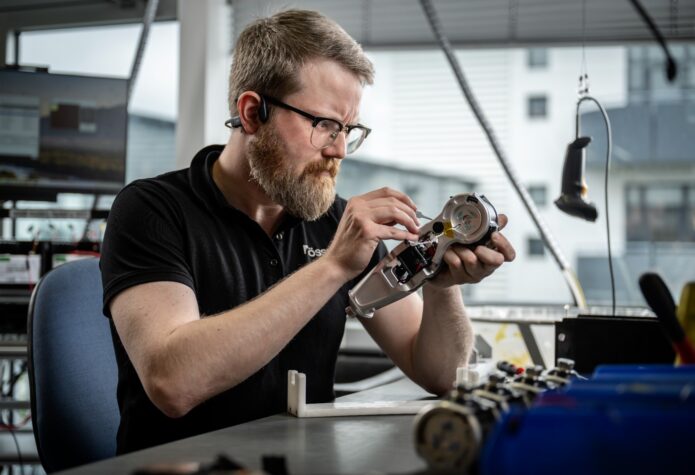
The Nordic Investment Bank has provided Embla Medical with a €50 million seven-year loan to support research and development in prosthetics, bracing and mobility technology, reinforcing the growing level of investment flowing into advanced orthopaedic innovation.
The financing will support Embla Medical’s R&D programme, with most development activity centred at the company’s headquarters in Reykjavík, Iceland.
According to the Nordic Investment Bank, the programme is focused on developing new medical technologies and improving existing products for people living with limb loss or mobility impairments.
The investment is particularly relevant for the global prosthetics and orthotics sector because Embla Medical operates some of the industry’s best-known brands, including Össur, College Park, Fior & Gentz and ForMotion.
€50 million committed to prosthetic and orthotic innovation
The loan was signed in June 2025 and has a maturity of seven years.
NIB says the funding supports Embla Medical’s research and development programme across prosthetics and bracing and support solutions, with the company expected to continue expanding its product portfolio.
The bank has identified R&D intensity of approximately 8% between 2024 and 2028 as part of its assessment of the programme.
Embla Medical’s R&D expenditure was approximately US$37 million in 2023, with NIB projecting this to increase to around US$49 million by 2026. The programme is also associated with plans for around 15 new product launches.
For a prosthetics company, this represents a substantial commitment to continued engineering and clinical development.
It also reflects how the competitive landscape in P&O is increasingly being shaped by sustained investment in materials, electronics, biomechanics, digital systems and user-centred design rather than individual product launches alone.
Recent developments include waterproof bionic knee technology
NIB highlighted several recent Embla Medical developments when announcing the financing, including a fully waterproof bionic prosthetic knee and a mechanical prosthetic foot designed to provide greater flexibility, balance and adaptability.
These technologies sit within Össur, Embla Medical’s flagship prosthetics brand.
The company’s development strategy spans both advanced electronically controlled devices and mechanical technologies intended to improve everyday mobility.
The ability to use a prosthetic knee around water, for example, addresses an issue that extends beyond recreational activities.
For amputees, waterproof technology can influence daily independence in activities such as showering, walking around swimming pools, using wet environments and participating in family or recreational activities.
Similarly, advances in mechanical foot design can improve terrain adaptation and comfort without requiring additional electronics or charging infrastructure.
That distinction is particularly relevant across IMEA markets, where the appropriate technology may vary significantly according to reimbursement, environment, patient activity and access to maintenance.
Embla Medical now spans multiple areas of mobility care
Embla Medical was established as the parent organisation above Össur in 2024 as the company expanded into a broader range of chronic mobility solutions.
Today, its portfolio includes:
- Össur – prosthetics and bracing and supports
- College Park – prosthetic feet and components
- Fior & Gentz – neuro-orthotic systems
- ForMotion – prosthetic and orthotic patient care services
NIB says Embla Medical employs approximately 4,500 people across 40 countries, while its Reykjavík operation remains a major centre for research and engineering.
Approximately 150 engineers and designers are involved in cross-functional R&D teams at the Reykjavík site, according to a later NIB profile of the company.
This integrated structure gives Embla Medical exposure to multiple parts of the P&O value chain: technology development, component manufacturing, clinical feedback and direct patient care.
Patient feedback increasingly influences product development
One of the more important elements of Embla Medical’s research model is its connection with clinicians and prosthetic users.
NIB says prototypes developed in Reykjavík are refined using feedback from patients and clinicians, including people attending Embla Medical’s own ForMotion clinical network.
For the P&O industry, this type of user-centred development is becoming increasingly important.
A technically advanced prosthetic component can still fail to deliver meaningful benefit if it is difficult to fit, uncomfortable, unreliable in the user’s environment or incompatible with everyday activities.
Clinical feedback can therefore influence areas such as:
- socket and component compatibility
- waterproofing
- weight and durability
- battery performance
- footwear compatibility
- gait behaviour
- ease of adjustment
- maintenance requirements
That feedback loop can become even more valuable when a manufacturer operates its own clinical network.
More than €200 million in NIB financing since 2001
The latest financing is part of a long-standing relationship between NIB and Embla Medical, formerly Össur.
NIB says it has provided approximately €200 million in financing to the company since its first loan in 2001.
The bank views the current programme as an investment in high-value R&D activity that could create wider productivity benefits through innovation and knowledge transfer.
Embla Medical also holds one of the largest intellectual-property portfolios in mobility technology, with more than 2,100 patents, according to NIB.
Maintaining much of its R&D activity in Iceland allows the company to keep engineering expertise and intellectual property close to its headquarters while commercialising products globally.
Relevance for IMEA prosthetic markets
Although the financing is centred on Iceland, the technologies it supports will ultimately compete and be used globally.
For the IMEA region, this is important because the market encompasses some of the widest variations in prosthetic provision anywhere in the world.
Advanced microprocessor knees and high-performance prosthetic feet are increasingly available within wealthier Gulf markets, particularly through private healthcare, government rehabilitation centres and internationally funded treatment programmes.
At the same time, many countries across Africa, the Middle East and Central Asia continue to require durable, affordable mechanical prosthetic systems capable of operating with limited maintenance infrastructure.
A diversified R&D programme therefore has the potential to influence multiple levels of the market.
Innovation does not necessarily have to mean adding more electronics.
Improvements in mechanical function, durability, adjustability, waterproofing, manufacturing efficiency and clinician usability can sometimes have as much impact on patients as more technologically complex systems.
Neuro-orthotics becoming another growth area
Embla Medical’s expansion into neuro-orthotics is also notable.
Through Fior & Gentz, the company has been investing in orthotic systems for people with neurological mobility impairments.
In 2025, Embla Medical reported that Fior & Gentz had secured a new US reimbursement code for its NEURO HiTRONIC microprocessor-controlled knee joint, supporting the company’s expansion of advanced neuro-orthotics.
This area could become increasingly significant for the wider P&O industry.
While high-tech prosthetics have traditionally received much of the sector’s attention, neurological orthotics represents a very large potential patient population including people affected by stroke, spinal cord injury, multiple sclerosis and other neurological disorders.
Investment in powered and microprocessor-assisted orthotic joints could therefore become an important parallel growth area alongside bionic prosthetics.
Long-term investment signals confidence in P&O innovation
NIB describes technical progress and R&D as central to improving productivity within healthcare and other technology-intensive sectors. The bank typically supports longer-term investments where substantial development costs occur before commercial returns are realised.
That financing model fits particularly well with prosthetic and orthotic technology.
Developing a new knee, foot or orthotic joint can involve years of mechanical engineering, software development, laboratory testing, clinical validation and regulatory approval.
A €50 million seven-year financing facility gives Embla Medical additional capacity to maintain that development pipeline.
For the global P&O sector, the significance goes beyond one company’s balance sheet.
It demonstrates that prosthetics, orthotics and mobility technology are increasingly being viewed as investable areas of medical technology research and industrial innovation.
As demand for mobility solutions increases globally through ageing populations, conflict-related injuries, diabetes and neurological disease, sustained R&D financing is likely to play an increasingly important role in determining which companies and technologies shape the next generation of prosthetic and orthotic care.
- ArcticToday – NIB Finances Research and Development at Embla Medical
- Nordic Investment Bank – NIB Finances Embla Medical’s R&D Investments
- Nordic Investment Bank – Embla Medical Loan Details
- NIB – A Life Without Limitations, Engineered in Iceland
- Embla Medical
- Össur
- College Park Industries
- Fior & Gentz